
Fighting Zika with easy-to-use diagnostic kit
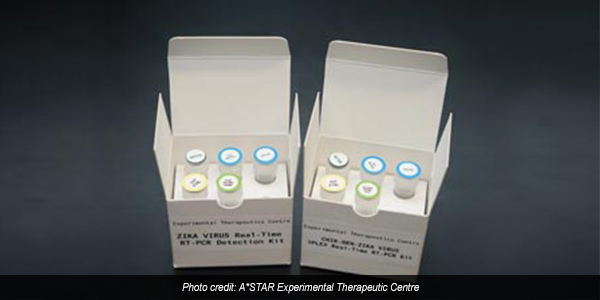
Two days after the World Health Organization (WHO) declared Zika as a public health emergency, A*STAR researchers got into the action.
An ongoing Zika research project was established, involving researchers from the Singapore Immunology Network, Bioprocessing Technology Institute, Experimental Therapeutics Centre, Bioinformatics Institute and the Institute of Medical Biology.
The first breakthrough came in the form of a three-way diagnostic kit that can detect strains of the Zika, dengue and chikungunya viruses. Simple and inexpensive, the kit utilises blood samples and simple hospital instruments. It is able to detect Zika strains within two hours and can detect the virus up to one week of infection.
To detect Zika in people infected for over a week- another team of researchers isolated and developed antibody ‘markers’. These antibodies ‘spot’ Zika by binding to it and can potentially block it from infecting patients’ host cells.
A third development in fighting Zika involves isolating the gene responsible for microcephaly – katanin – and injecting the Zika virus into lab-cultured ‘brains’ to observe first-hand how the virus interacts with the katanin gene.
Zika first became a global pandemic in 2015, where doctors realized that babies born to Zika-infected mothers developed severe birth defects, such as microcephaly (extremely small heads) and other neurological diseases.
With the mosquito-borne virus affecting the nation- A*STAR’s Zika research project has united researchers from various specialisations to diagnose- detect and treat it as one team.
Bruno Reversade, a molecular biologist at the A*STAR Institute of Medical Biology said: “The beauty of A*STAR is that it can bring together scientists who are very well regarded in their respective fields to actually make a difference.”