
A new method of transporting ions through cell membranes based on a single amino acid
Singapore – Researchers from A*STAR’s Institute of Bioengineering and Nanotechnology (IBN) have successfully developed a unique family of pore-forming monopeptides based on a single amino acid. Other pore-forming peptides typically consist of up to fifty amino acids. The research team- led by IBN Team Leader and Principal Research Scientist Dr Huaqiang Zeng- has created a new paradigm for the efficient transportation of important ions across cellular membranes. This has the potential to tackle diseases where this kind of ion transport has malfunctioned- such as Cystic Fibrosis.
Pore-forming peptides form channels through cellular membranes for the transportation of ions such as chlorides and iodides in and out of a cell. The formation of these channels are crucial for the precise regulation of our bodies’ physiological processes- cellular defenses and immune responses. Patients with Cystic Fibrosis suffer from a defective gene that reduces the transport of such ions- thus dehydrating the mucus layer in the lungs. This results in a build-up of thick and viscous mucus that causes breathing difficulties.
The IBN researchers focused on studying artificial pore-forming monopeptides based on a single amino acid. These could form channels of pore sizes smaller than 1.0 nm in diameter- while remaining capable of transporting negatively-charged ions- including chloride- efficiently across the membrane. Designing artificial ion channels is an area of increasing interest- particularly channels that can self-assemble in a controlled manner from simple molecular precursors. Many current systems utilise complex- high molecular weight components- which greatly limit their potential for future therapeutic applications. This unique breakthrough is one of the most exciting advances in the field of artificial ion channels in recent years. It presents opportunities to design novel small molecule-based artificial ion channels which can result in better therapies for ion channel dysfunctions- and anti-bacterial or anti-cancer agents.
Dr Ichiro Hirao- Covering Executive Director of IBN- said- “The IBN research team originally studied ion-transporting molecules designed to function as gelators to coalesce oil spills in water. Through this- they discovered that one of the gelators was of significant toxicity- causing them to explore whether the molecule might self-assemble into a pore-like structure in the cell membrane and cause an imbalance of ions. This hypothesis turned out to be true and led to a completely new principle of the molecular design of ion channels.”
The research results were published in the Journal of the American Chemical Society on 21 June 2018.
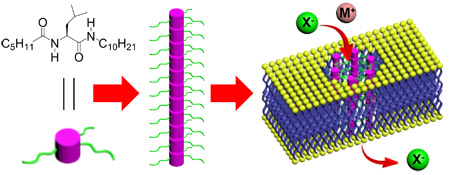
(Copyright: A*STAR’s Institute of Bioengineering and Nanotechnology)
Extremely simple monopeptides self-assemble into rod-like structures and further into ring-shaped ensembles for mediating highly efficient transport of anions in membrane.
Reference
Changliang Ren- Fei Zeng- Jie Shen- Feng Chen- Arundhati Roy- Shaoyuan Zhou- Haisheng Ren- and Huaqiang Zeng- “Pore-Forming Monopeptides as Exceptionally Active Anion Channels” J. Am. Chem. Soc. (2018) DOI:10.1021/jacs.8b04657. See article
About the Institute of Bioengineering and Nanotechnology
The Institute of Bioengineering and Nanotechnology (IBN) is the world’s first bioengineering and nanotechnology research institute. Established in 2003- IBN’s mission is to conduct multidisciplinary research across science- engineering- and medicine for breakthroughs to improve healthcare and quality of life. IBN’s research activities are focused on Nanomedicine and Biomaterials- Synthetic Xenobiology and Biosystems- Tissue and Organoid Models- and Green and Safe Biomaterials. The Institute has published over 1-320 papers in leading scientific journals- filed over 660 active patents and patent applications on its inventions- and established 12 spin-off companies. For more information on IBN- please visit www.a-star.edu.sg/ibn.
About the Agency for Science- Technology and Research (A*STAR)
The Agency for Science- Technology and Research (A*STAR) is Singapore's lead public sector agency that spearheads economic oriented research to advance scientific discovery and develop innovative technology. Through open innovation- we collaborate with our partners in both the public and private sectors to benefit society.
As a Science and Technology Organisation- A*STAR bridges the gap between academia and industry. Our research creates economic growth and jobs for Singapore- and enhances lives by contributing to societal benefits such as improving outcomes in healthcare- urban living- and sustainability.
We play a key role in nurturing and developing a diversity of talent and leaders in our Agency and research entities- the wider research community and industry. A*STAR’s R&D activities span biomedical sciences and physical sciences and engineering- with research entities primarily located in Biopolis and Fusionopolis. For ongoing news- visit www.a-star.edu.sg.