A*STAR IMCB Welcomes Professor Rickie Patani and Dr Xia Yun
MEDIA RELEASE
A*STAR IMCB Welcomes Professor Rickie Patani and Dr Xia Yun
SINGAPORE – A*STAR Institute of Molecular and Cell Biology (A*STAR IMCB) warmly welcomes Professor Rickie Patani and Dr Xia Yun to the institute. Their complementary expertise in neurodegeneration and organoid biology strengthens IMCB's efforts to develop advanced human models for understanding disease mechanisms and advancing therapeutic innovation.
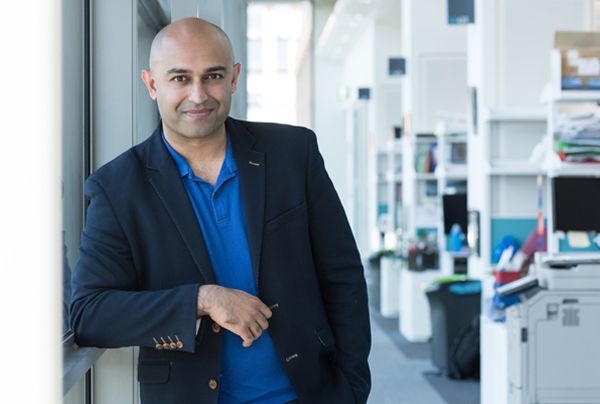
Professor Rickie Patani
Professor Patani is a clinician-scientist who holds a joint appointment with NUS Yong Loo Lin School of Medicine and IMCB. His research seeks to understand why neurons die in age-related neurodegenerative diseases. His laboratory uses human induced pluripotent stem cell (iPSC)-based models derived from patient cells to investigate the earliest molecular events that contribute to neurodegeneration. A key focus of his research is understanding how disruptions in RNA biology and interactions between neurons and glial cells influence disease progression. His team applies these approaches to study conditions such as amyotrophic lateral sclerosis (ALS) and related neurodegenerative disorders.
Trained and practised as a neurologist in the United Kingdom, Professor Patani has remained closely connected to clinical medicine throughout his scientific career. Motivated by the patients he has cared for, he combines clinical insight with stem cell-based disease models to better understand the molecular and cellular changes that drive neurodegeneration and translate new discoveries into improved outcomes for people affected by these conditions. He believes that meaningful scientific advances depend not only on rigorous experimentation, but also on fostering a culture where curiosity and intellectual courage can thrive.
“One of the most exciting opportunities in our field is the ability to study neurodegenerative diseases in human cells. By investigating the earliest molecular changes that occur during disease progression, we hope to gain new insights that can ultimately inform future therapeutic strategies and improve patient outcomes,” said Professor Patani.

Dr Xia Yun
Bringing expertise in organoid biology, Dr Xia Yun's research focuses on developing kidney organoid models that better recapitulate the cellular diversity, tissue architecture and functional features of the human kidney. Her work seeks to engineer more physiologically relevant human systems for studying kidney development and disease, while supporting therapeutic discovery and translational research.
A stem cell biologist with expertise in organoid engineering, Dr Xia has spent her career developing human stem cell-based models to better understand kidney biology and disease. Her group developed one of the first vascularised human kidney organoid systems with segmentally patterned nephron-like structures and, more recently, established in vivo organoid models of polycystic kidney disease for translational disease modelling and therapeutic evaluation. At IMCB, she aims to further advance the complexity and anatomical organisation of organoid systems while developing inter-organ models that better capture the systemic aspects of human physiology and disease.
“We may not generate fully transplantable kidney tissue from human iPSCs anytime soon, but each step towards that ambitious goal brings us closer to building increasingly sophisticated human organoid systems that can help us better understand disease and accelerate therapeutic discovery,” said Dr Xia. 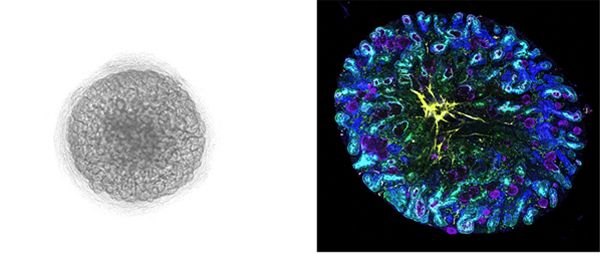
Human PSC-derived kidney organoid
Left: Bright-field image, Right: Immunofluorescence staining showing proximal tubules (green), distal tubules (blue), glomeruli (purple), and endothelial cells (yellow).
Together, their research programmes leverage next-generation human model systems to advance our understanding of human health and disease. We warmly welcome Professor Patani and Dr Xia to IMCB and look forward to the impact of their work.