Congratulations to IMCB’s latest PhD graduate – Hwee Hui LAU

Thesis Title: Dissecting the role of diabetes-associated PAX4 polymorphismsin modulating pancreatic beta cell development and function
Diabetes is a leading health problem affecting over 537 million individuals worldwide,incurring a huge healthcare burden on society. Populations living in Asia have thehighest prevalence of diabetes among all ethnicities and often have a younger age ofonset with a lower body mass index (BMI). To develop novel therapeutic strategies,numerous genome-wide studies have been performed across different ancestries toidentify genetic variants that can predispose carriers to elevated risks for diabetes. Amissense variant within the coding region of the PAX4 gene (rs2233580) is associatedwith T2D in East Asians. The variant is common in East Asians (MAF 10 %) but rareor absent in other ancestry groups. Carriers of the R192H allele have a dose-dependent earlier age of diabetes-onset and have a lower C-peptide level, suggestinga defect in pancreatic beta cell function.
To elucidate the mechanisms underlying the associations between PAX4variants andthe risk of diabetes, our study included detailed clinical and in vitro studies on twodistinct PAX4 coding variants. We recruited donors carrying the East Asian-specificR192H variant and a novel protein-truncating variant Y186X identified in a Singaporefamily for assessment. We demonstrated carriers of the PAX4 R192H variant to havereduced beta cell function, reflected as elevated blood glucose and insufficient insulinsecretion. The two carriers of the PAX4 Y186X variants had poor beta cell function asreflected by low disposition index.
Our in silico and in vitro molecular studies predicted that proteins derived from PAX4R192H and Y186X variants have a loss of function due polymorphism within the DNAbinding domain and protein truncation respectively, possibly resulting in reduced betacell function. In mice, Pax4 is essential for beta cell formation, but neither the role ofdiabetes-associated variants in PAX4nor PAX4 itself on human beta cell developmentand/or function are known. To study the consequence of PAX4 variants in human betacell development, we generated three independent human induced pluripotent stemcell (hiPSC) models. First, a PAX4-knockout hiPSC model was generated usingCRISPR-Cas9-mediated genome editing to investigate the role of PAX4 in humanpancreatic beta cell development. Second, we generated donor-derived hiPSCscarrying PAX4+/+, PAX4+/R192H, PAX4R192H/R192H and PAX4+/Y186X genotypes to studythe consequences of gene variants in beta cell development. Finally, we utilized genecorrected donor-derived hiPSCs to confirm the association of phenotype with thePAX4 variant via a rescue study. Contrary to the observation in rodent models, wefound that PAX4 is not required for insulin-expressing beta cell formation from human hiPSCs. We found that, in beta cells derived from hiPSCs that were deficient in PAX4or carried PAX4 variants exhibited derepression of genes associated with alpha cells.These cells were more likely to be polyhormonal and demonstrated to coexpressGCG+/C-PEP+ in immunostaining assays. These cells also had reduced total insulincontent, contributing to decreased functionally. This phenotype was reversed in thedonor-derived hiPSC lines through correction of the PAX4 variant allele(s).
Using the human beta cell line EndoC-βH as a model, we demonstrated that PAX4variant proteins had aberrant transcriptional regulatory activities on INS and GCGgene promoters. The loss of repression of the GCG gene promoter in beta cellspossibly explained the coexpression of GCG+ in C-PEP+ endocrine cells carryingPAX4 gene variants. Gene silencing of PAX4 in EndoC-βH1 cells also resulted inelevated GCG expression, reduced total insulin content and impaired glucosestimulated insulin secretion (GSIS) function.
Collectively, we made use of clinical in vivo studies, hiPSC models (including PAX4-knockout, donor-derived hiPSCs and gene-corrected hiPSCs) and mature beta cellline models to sequentially interrogate the role of PAX4 in human beta celldevelopment and function. Our study i) does not support a role of PAX4 variant incausing maturity-onset diabetes of the young (MODY); ii) demonstrated that unlike themouse, PAX4 is not essential in the differentiation and formation of beta cells in hiPSCmodels; iii) supports a role of PAX4 deficiency or gene variant in causing the formationof polyhormonal endocrine cells with reduced insulin content and impaired insulinsecretion, uncovering a role of human PAX4 in modulating mature beta cell function.Our study therefore facilitates a better understanding of the effects of PAX4 genevariants contributing to the risk of T2D. We conclude that PAX4 R192H (loss offunction) and Y186X (haploinsufficiency) variants contribute to the formation of polyhormonal endocrine cells with impaired insulin secretion function, predisposingEast Asian carriers to higher risks of developing T2D.
Supervisors: Dr Adrian Teo and Assoc Prof Tan Nguan Soon
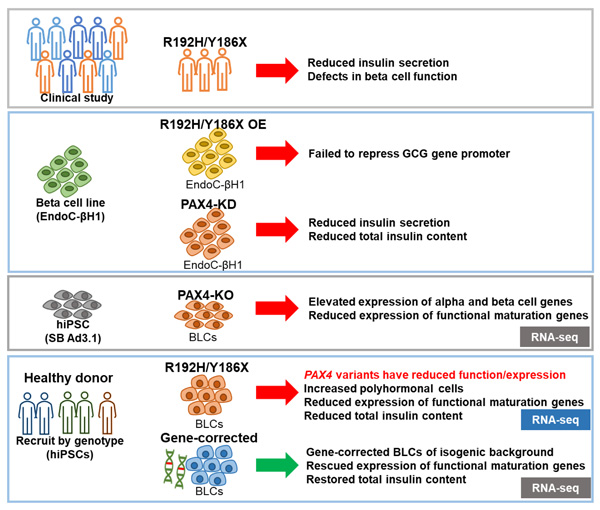
Graphical summary: PAX4 R192H and Y186X contribute to the formation ofpolyhormonal endocrine cells with impaired insulin secretion function, predisposingcarriers to higher risks of T2D. This work contributes to Lau, H. H., et al. (2022)."PAX4 loss of function alters human endocrine cell development and influencesdiabetes risk." bioRxiv: 2022.2005.2015.491987.