IMCB reseacher awarded the National Research Foundation Competitive Research Programme (CRP) funding
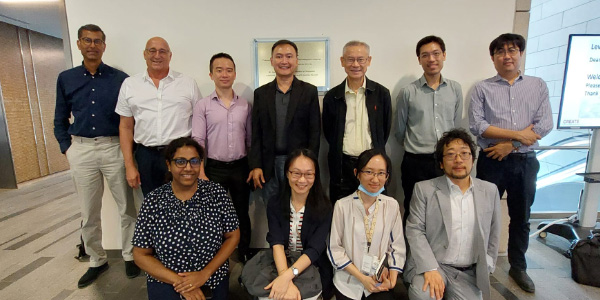
The ‘SPECTRA’ team. Standing (left to right): Shyam Prabhakar (Team PI, GIS),Nicholas RJ Gascoigne (Team PI, NUS), Chen Ching Kit (Team PI, NUHS), JonathanYuin-Han Loh (Lead PI, IMCB), Andy Hor (Deputy Chief Executive (Research),A*STAR), Leslie Beh (Collaborator, IMCB), Ng Lai Guan (Collaborator, Shanghai JiaoTong University). Front row (left to right): Uma Sangumathi Kamaraj (Principal Scientistworking for the project, IMCB), Chen Jinmiao (Collaborator, SIgN), Chen Ying (PrincipalScientist working for the project, IMCB), Li Qi-Jing (Team PI, IMCB & SIgN)
The National Research Foundation Competitive Research Programme (CRP) fundingscheme seeks to foster the formation of multi-disciplinary teams to conduct cutting-edgeresearch projects that are of relevance to Singapore and the society. The CRP funds useinspired basic research projects that are selected through a merit review process basedon scientific excellence. The theme of the proposed research project must be motivatedby an important need or problem to be solved. For the CRP29 grant call, five projectswere recommended for funding out of a total of 36 submissions across the Singaporeecosystem. The Institute of Molecular and Cell Biology (IMCB) is proud to announce thatone of the five recipients of this prestigious grant is our Deputy Executive Director(Research & Development), Jonathan Yuin-Han LOH along with team membersfrom GIS, SIgN, NUS, NUHS and Shanghai Jiao Tong University.
Jon’s CRP29 project entitled “Spatial Multiome Cartography in Human Thymus to GuideNextGen Cell-based Therapies (SPECTRA)” is a collaborative effort between the Instituteof Molecular and Cell Biology (IMCB), Genome Institute of Singapore (GIS), SingaporeImmunology Network (SIgN), National University of Singapore (NUS), National UniversityHealth System (NUHS) and Shanghai Jiao Tong University.
A summary of the background and aims of the project is given below:
Thymus is the major site for T-cell development. Hematopoietic progenitors migrate fromthe bone marrow into the thymus, where massive engagements between migratingthymocytes and spatially ordered stromal cells, mainly thymic epithelial componentsoccur to promote T-cell differentiation and maturation. During ageing, thymus shrinks insize, with the key epithelial components being gradually replaced by adipocytes. Thereduced output from thymus could contribute to declining immunity in ageing populations.However, the mechanistic details governing both the development and ageing processesof thymus remain unclear. Therefore, this project firstly aims to deploy high-resolutionsingle-cell spatial technology to decipher the molecular information governing the processof normal thymus development and ageing.
In addition, the thymus plays an integral role in the prevention of T-cell-mediatedautoimmunity, by developing self-tolerance. Autoimmune diseases such as Myastheniagravis (MG) is prevalent in patients with thymic epithelial cancer (thymoma). Hence, thisproject also aims to profile pathologic thymuses associated with MG, thymoma and otherautoimmune disorders, to understand the mechanistic insights behind thymic diseases.We also endeavour to develop new technological platforms combining multiple modalitiesfor a more integrative approach to profile those changes in thymus.
By doing so, we would have a more comprehensive understanding of both thymic ageingas well as the underlying mechanisms behind autoimmune conditions. Further improvements are possible for autologous cell treatment based on the findings from suchstudies, which could benefit patients who are suffering from either old age or autoimmunediseases.