New discovery in T-Cell research could lead to improved treatment of solid tumours
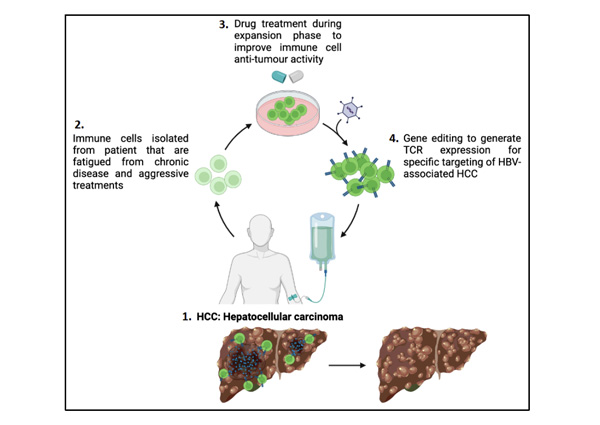
Caption: Cell therapy process for patients with Hepatocellular carcinoma (HCC), a tumour of the liver.
SINGAPORE – A local study led by the Agency for Science, Technology andResearch (A*STAR) discovered that by inhibiting the function of two proteins, G9a andGLP, during the cell therapy production process, immune cells could become moreeffective in combatting cancer. These findings, published in the journal NatureCommunications, can help advance the development of innovative therapies thatcould benefit cancer patients, bringing us closer to more effective targeted treatmentsfor solid tumour cancers.
Solid tumours are a major cause of cancer-related deaths worldwide1. Traditionaltreatments such as chemotherapy, radiation therapy and surgery are available, butthey have differing efficacy against solid tumours, particularly in advanced stages ofthe cancer2. T-cell therapy has been very successful in targeting liquid tumours such as blood cancers, but the same efficiency has not been observed in solid tumourssuch as breast, liver or brain cancer.
Engineered T cells are usually introduced into the patient’s bloodstream as part of thetreatment. They are in the same environment as liquid tumours, allowing them tolocate and target the liquid tumours easily. However, in the case of solid tumours, theengineered T cells face physical and molecular obstacles such as migrating throughdense tissue structure inside the body and encountering other cells and moleculesthat may negatively impact their function3.
Researchers and clinicians from A*STAR’s Institute of Molecular and Cell Biology(IMCB) and Singapore Immunology Network (SIgN), and Duke-NUS Medical Schoolcollaborated to explore innovative approaches to improve the efficiency of T cells, theimmune cells responsible for recognising and eliminating cancer cells.
The research team, led by Dr Andrea Pavesi, Senior Scientist at A*STAR’s IMCB,conducted a comprehensive analysis of epigenetic drugs that can affect the efficacyof the engineered T cells in increasing anti-tumour activity. The team used 2D andnovel 3D assays that mimicked the physical environment that T cells would encounterto find and target the cancer cells in the human body. A drug was administered to theimmune cells during the cell expansion process of cell therapy performed in the lab,which targeted the G9a and GLP proteins. The drug was subsequently washed awaybefore the engineered immune cells were re-introduced into the patient’s body, thuseliminating side-effects from the drug. The findings showed that the drug helped toincrease the anti-tumour function of the engineered immune cells – it increased theproduction of granzymes, proteins that help to locate and eliminate target tumour cells.
Tapping on the immune cell profiling capabilities of Dr Giulia Adriani, Principal Scientistat A*STAR’s SIgN, and patient samples from Duke-NUS, the study’s findings werevalidated using well-established cell-lines and patient-derived immune cells to confirmthe efficacy of blocking G9a and GLP activity in improving the efficiency of T-celltherapy. The results showed that the drug enhanced the anti-tumour function ofengineered immune cells.
This would mean better patient outcomes such as improved survival rates and qualityof life. It also has broad implications for all cell therapies targeting solid tumours.Patients with a weak immune system, who usually require immune cells from healthydonors for cell therapy treatment, may also benefit from treatments using their ownimmune cells. This reduces the chances of the patient’s body rejecting the cells, aswell as implications from using incompatible cells. The drug used to block G9a andGLP activity also holds significant potential for further development, presenting itselfas an attractive therapeutic option for cancer treatments.
Dr Andrea Pavesi, Senior Scientist at A*STAR’s IMCB and lead author of the study,said, “The approach of improving the individual anti-tumour activity of each immunecell can address many limitations in T-cell therapy and enhance treatment efficacy.
Our discovery will advance the development of effective therapeutics for solid tumourcancers and help improve lives.”
Professor Antonio Bertoletti, from Duke-NUS’ Emerging Infectious DiseasesProgramme, said, “There is a high demand for the production of suitable T cells foradoptive T-cell therapy, a type of cell therapy where engineered T cells areadministered to patients to fight diseases such as cancer. This discovery could helpimprove cell therapies that use both patient-derived and donor-derived immune cells,benefitting a variety of patients. We hope to work towards successful clinical trials andbring this method to market to improve patient outcomes.”
1 World Cancer Research Fund International
2 The Emerging Landscape of Immune Cell Therapies, Cell, Volume 181, Issue 1, April 2020
3 Adoptive cellular therapy in solid tumor malignancies: review of the literature and challenges ahead, Journal forImmunoTherapy of Cancer, Volume 9, Issue 7, July 2021