Singapore study discovers novel therapeutic target to advance the treatment of diabetic eye diseases
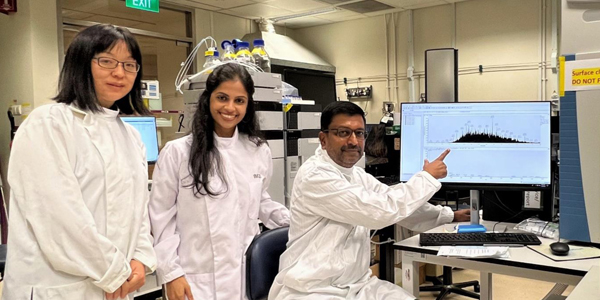
Caption: The core scientific research team, (L-R) Associate Professor Wang Xiaomeng from theCardiovascular and Metabolic Disorders Programme and Centre for Vision Research at Duke-NUSMedical School, Research Scientist Dr Asfa Alli Shaik and Senior Principal Investigator Dr JayanthaGunaratne from IMCB, investigated disease-modified protein profiles in the eye to discover noveltherapeutic targets for Diabetic Retinopathy, a condition which leads to blindness induced by prolongeddiabetes.
SINGAPORE - A local study discovered a novel therapeutic target named ADAM10that could be used to treat patients with Diabetic Retinopathy (DR), a condition whichleads to blindness induced by prolonged diabetes. Abnormal blood vessel formationin the eyes of diabetic patients is a common phenomenon for DR which couldultimately result in vision loss. The study, published in the journal Theranostics,demonstrated that by restoring the function of ADAM10, a major shedding protein, itwas possible in preclinical models to control the abnormal formation of blood vessels,offering an attractive therapeutic target to treat DR.
A collaborative effort involving researchers and clinicians from A*STAR’s Institute ofMolecular and Cell Biology (IMCB), Duke-NUS Medical School, SingHealth,Singapore Eye Research Institute (SERI) and Singapore National Eye Centre (SNEC),the research team is exploring the potential of ADAM10 in various aspects ofangiogenesis and how it may be translated into beneficial solutions for patients.
Currently, DR affects about 103 million people worldwide1. According to a study doneby the Centers for Disease Control and Prevention (CDC), DR is most common amongdiabetic patients, with almost one in three developing the condition. It is the leadingcause of visual impairment and blindness in the working-age population globally2. DRusually presents without any symptoms in the early phase and is often diagnosedwhen the disease has advanced, requiring immediate treatment intervention. Thecurrent available form of treatment for DR is anti-VEGF (Vascular endothelial growthfactor) injections, however only around half of DR patients respond to the treatment.
The research team, led by Dr Jayantha Gunaratne, Senior Principal Investigator atIMCB, conducted a comprehensive analysis of the eye fluid samples from a well-defined cohort of proliferative DR patients against the control cohort to deduceimpaired mechanistic aspects within the eye. The findings show that eye fluids fromDR patients displayed distinct protein patterns compared to the control cohort,implying that the molecular composition of eye fluids is reflective of the health statusof the eye. By interrogating these altered profiles from DR patients, the teamdiscovered impaired protein shedding by ADAM10 as a prominent disease feature ofDR.
Working with the research team from Duke-NUS, these results were further validatedusing well-established cell-line and preclinical models with eye diseases throughmolecular, cell biological and functional assays to confirm the efficacy of the new targetADAM10 in controlling abnormal growth of blood vessels in the eye. With ADAM10regulating various functional processes including neural and vascular aspects, itpresents itself as an attractive therapeutic option for retinal angiogenic diseases.
This discovery provides key insights to the cause of DR and opens up a new path fordeveloping effective therapeutics for DR patients, including patients who do notrespond well to anti-VEGF treatments. Researchers also uncovered the involvementof other unknown potential molecular players in DR and the importance ofunderstanding their mechanistic roles to effectively control or stop abnormal bloodvessel formation in the eyes of DR patients.
Professor Hong Wanjin, Executive Director at A*STAR’s IMCB, said, “Through ourcollaborations with the local healthcare ecosystem, we have made significant progresswith the discovery of therapeutic target ADAM10 – This is a breakthrough for thescientific community and will help advance the development of targeted therapeuticsleading to better healthcare outcomes.”
Dr Jayantha Gunaratne, Senior Principal Investigator at A*STAR’s IMCB and leadauthor of the study, said, “This proteomics-centric discovery is a paradigm shift fromconventional to non-conventional drug target identification, focusing on proteinshedding activities of cell membrane proteins. It is a novel direction with immensepotential for investigating effective therapeutics for several other diseases as well.”
Professor Gemmy Cheung from the SingHealth Duke-NUS Ophthalmology and VisualSciences Academic Clinical Programme and Head and Senior Consultant, MedicalRetina Department at SNEC, said, “This collaboration between IMCB and SERIprovided our researchers and clinicians an immensely valuable platform to combineour expertise towards the discovery of new treatments targeting DR. The combinationof eye fluid samples from patients and their clinical information provides ourresearchers with a very powerful dataset from which the sophisticated analyticalmethods was able to discover the new findings. We are confident that thesediscoveries will lead to improved understanding and treatment of DR.”
__________________________________________________________________________________________________________________________________________________________________
1 Global Prevalence of Diabetic Retinopathy and Projection of Burden through 2045: Systematic Review andMeta-analysis, Ophthalmology, Volume 128, Issue 11, November 20212 International Diabetes Federation