.png?sfvrsn=c3edc68e_6)
News
Study identifies novel pan-TEAD inhibitors to overcome drug resistance in cancer
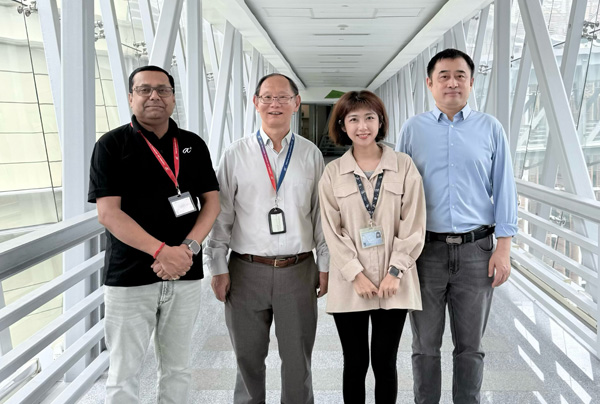
The team behind the study. From left: Dr Ramesh Kumar, Prof Wanjin Hong, Dr Sun Jialin, and Dr Kang Congbao
SINGAPORE – Scientists from the A*STAR Institute of Molecular and Cell Biology (A*STAR IMCB) have identified a new class of small-molecule inhibitors targeting the Hippo signalling pathway, offering a potential strategy to overcome drug resistance in cancer.
The study, led by Professor Wanjin Hong and his team, was published in ACS Medicinal Chemistry Letters and reports the discovery of pan-TEAD inhibitors that disrupt the YAP–TEAD interaction, a key driver of oncogenic signalling across multiple cancers.
Dysregulation of the Hippo pathway, particularly the activation of YAP/TAZ–TEAD signalling, is widely associated with tumour development and poor clinical outcomes. While targeted therapies have improved cancer treatment, resistance to drugs such as EGFR and KRAS inhibitors remains a major challenge.
To address this, the research team developed a series of covalent small molecules, including CPD10 and CPD13, which bind to TEAD proteins and block their interaction with YAP. These compounds were shown to suppress cancer cell proliferation and disrupt key oncogenic transcriptional programs driven by the YAP–TEAD complex.
Importantly, the findings demonstrate that these inhibitors enhance sensitivity to existing therapies and promote synergistic cell death in cancer models driven by KRAS and EGFR mutations, including difficult to treat EGFR mutants and drug-resistant settings. This suggests a potential strategy to overcome resistance mechanisms that limit current treatment options.
This work was carried out in collaboration with the Experimental Drug Development Centre (EDDC) and the A*STAR Bioinformatics Institute (A*STAR BII), bringing together expertise in medicinal chemistry, structural biology, computational modelling, and cellular cancer models to evaluate the therapeutic potential of targeting TEAD.
“Targeting TEAD provides a promising strategy to disrupt oncogenic signaling and overcome drug resistance. By interfering with the YAP–TEAD interaction, our work opens up new possibilities for combination therapies in cancers driven by KRAS and EGFR mutations,” said Professor Wanjin Hong, Chief Business Development Officer at A*STAR Biomedical Research Council, and Senior Investigator at A*STAR IMCB.
“CPD10 and CPD13 not only block palmitoylation but also hinder YAP binding, distinguishing them from other TEAD inhibitors. Our findings also shed light on the limited success of AXL inhibitors, highlighting the role of CTGF/CCN2 in driving EGFR signaling. This reinforces the importance of YAP/TAZ–TEAD signaling in tumor growth and drug resistance, and supports further exploration of TEAD-targeting approaches,” said Dr Ramesh Kumar, first & joint corresponding author, and Senior Scientist at A*STAR IMCB.
Further validation in in vivo tumor models will be required in the next phase of development. Building on these findings, the team is actively advancing lead optimization and harnessing AI-driven approaches, including Boltz-2, to accelerate the development of next-generation TEAD-targeting therapeutics for cancers driven by dysregulated Hippo signaling.
Study citation: Kumar, R. et al. Discovery of Pan-TEAD Inhibitors That Disrupt YAP-TEAD Interaction as a Potential Therapy for Gastric Cancers and Mutant KRAS and EGFR Lung Cancers. ACS Medicinal Chemistry Letters (2026).
A*STAR celebrates International Women's Day

From groundbreaking discoveries to cutting-edge research, our researchers are empowering the next generation of female science, technology, engineering and mathematics (STEM) leaders.
Get inspired by our #WomeninSTEM