.png?sfvrsn=c3edc68e_6)
News
Unbinding the “Undruggable”: How Molecular Glues Could Change the Way We Treat Disease
21 May 2026
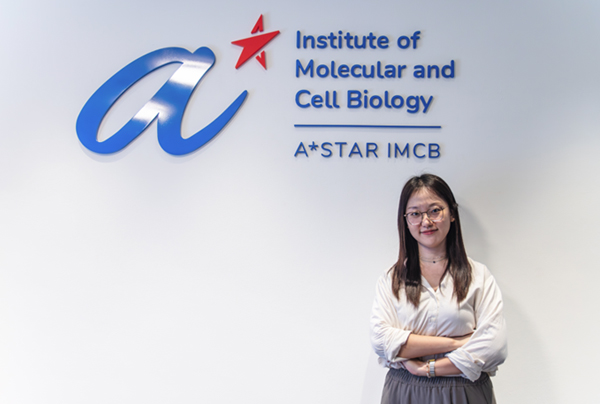
Dr Liu Shuang, Principal Investigator at A*STAR IMCB
What if the secret to fighting diseases like cancer or Alzheimer’s isn’t blocking harmful proteins but bringing them together instead?
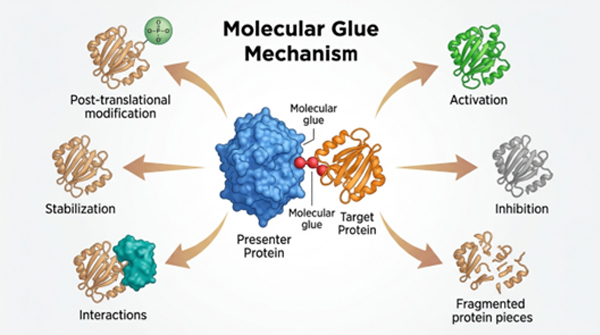
Over the past decade, scientists have been captivated by a promising new approach to treating diseases: molecular glues. These tiny molecules work at the scale of cells to bind proteins together — and in doing so, allow scientists to target disease-causing proteins that were previously considered untreatable.
Now, there is renewed hope. Researchers have developed a faster and more scalable way to identify molecular glues, opening the door to new treatments.
One of them is Dr Liu Shuang, a scientist from A*STAR Institute of Molecular and Cell Biology (A*STAR IMCB). Her discovery in 2022 — a world’s first, using a DNA-based screening method to identify molecular glues — has attracted global interest and is influencing how scientists approach new therapies.
What are molecular glues?
“Think of them as matchmakers,” says Dr Liu. “They introduce two people — in this case, two proteins — and help them become best friends, or a tag team.”
“By bringing these proteins together, molecular glues open up new possibilities. We can tag harmful proteins like garbage so the body removes them. Or we can block these proteins from activating. Sometimes, we want to do the opposite — activate or stabilise them, such as tumour suppressors, so they work better.”
Most diseases are linked to problems with proteins in our bodies. Proteins act like tiny machines that carry out essential tasks needed for cells and organs to function. When they malfunction, we need to find ways to repair or manage them.
But there is a challenge: about 80 per cent of proteins cannot be targeted by traditional drugs as they are tricky to reach. For decades, these “undruggable” proteins have defined the limits of drug discovery.
Molecular glues are beginning to change that boundary, and this is where Dr Liu’s work has been groundbreaking.
Expanding the limits of drug discovery
“We can now screen millions to billions of molecules in a day.”
By adapting an existing screening technology, Dr Liu has dramatically sped up the search for molecular glues, reducing what used to take months to a single day’s work. As a result, this has expanded how scientists can target hard-to-treat conditions.
“Combination therapies could be explored. For example, we could remove a harmful protein and stabilise a beneficial one. That might also make it harder for diseases to develop drug resistance,” she explains. “Stabilising proteins may also help in treating neurodegenerative diseases .”
On a mission to uncover solutions
A chemical biologist, Dr Liu has long been fascinated by how small molecules can be used to influence how cells communicate and respond to one another.
“I’ve always thought it was cool how cells react to each other,” she says.
That curiosity eventually led her to research molecular glues and their potential role in cancer treatment. In recent years, this has also expanded into studying its potential in treating neurodegenerative diseases like Alzheimer’s and Parkinson’s disease.
In 2022, Dr Liu’s grandmother, who had been living with dementia, passed away in China. Dr Liu had planned to visit her after completing her postdoctoral training but was unable to do so due to pandemic travel restrictions at the time. The loss left her with a deep sense of regret.
In tribute to her grandmother, Dr Liu has made it her life’s mission to uncover new solutions for neurodegenerative diseases.
“I want to use my knowledge on molecular glues to hopefully find answers about neurodegenerative diseases,” she says. “While it may take five to ten years before we see new treatments, I hope we can unlock new approaches to treating cancers and neurodegenerative diseases.”
The goal: a molecular glue database
“Most research and treatment aim to eliminate the harmful proteins. I want to do something different.”
Today, her expertise is increasingly sought after by biotech firms and academic groups to explore the potential of molecular glues in drug development.
Supported by the National Research Foundation Fellowship, Dr Liu is leading a team of scientists to deepen her research in molecular glues. Her long-term goal is to build a database that can guide the rational design of specific molecular glue drugs tailored to different diseases.
Ambitious? Perhaps.
But for Dr Liu, the question is not whether these challenges are difficult. It is what becomes possible when we stop only trying to remove what is broken, and start learning how to rewire biology itself .
A*STAR celebrates International Women's Day
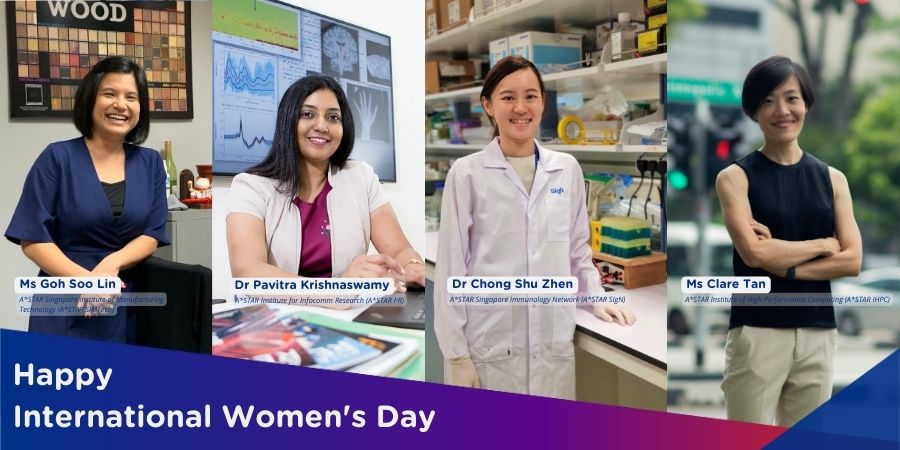
From groundbreaking discoveries to cutting-edge research, our researchers are empowering the next generation of female science, technology, engineering and mathematics (STEM) leaders.
Get inspired by our #WomeninSTEM