
It’s Time for a Fresh Starch
Contributing to Better Health Outcomes for Singapore
 The humble potato is loaded with nutrients such as vitamin C and potassium.
 Worried that eating potatoes could make you fat? After all, carbohydrates have widely been blamed for weight gain. Scientists at A*STAR have recently unveiled a new processing technique for potato food items that slows down the digestion of the humble spud, controlling the release of dietary glucose in the human body.
Potatoes are staples in many parts of the world, providing energy and essential nutrients. Yet, they are often blamed for increasing the risks of obesity and diabetes. Cooked potatoes are rapidly digested into dietary glucose, causing spikes in blood sugar levels.
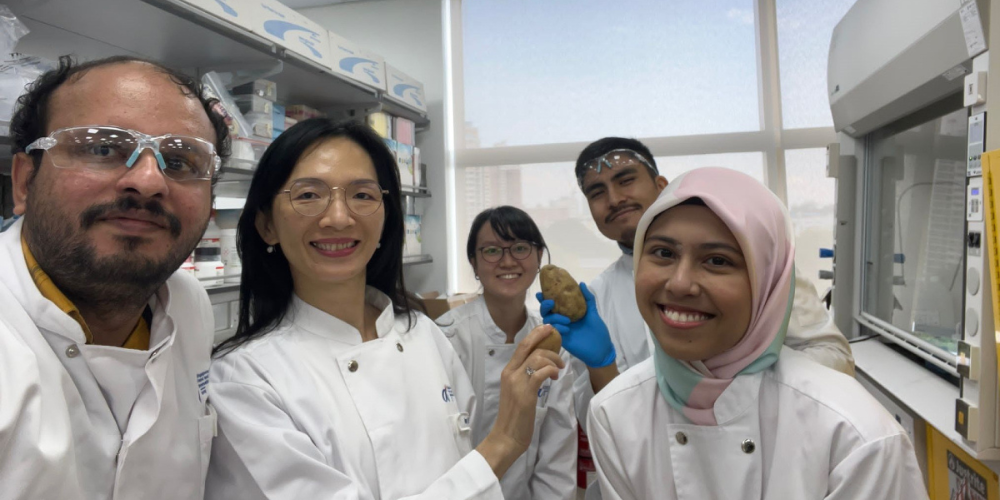 From left: Mr Rakesh Raghunathan (SIFBI), Dr Amy Lin (SIFBI), Ms Yue Shuian Tan (intern from the National University of Singapore), Dr Alvaro Ferreira-Lazarte (SIFBI) and Ms Nur Syahirah Amirruddin (SIFBI)
 What we have come up with is a simple processing technique that could further boost the positive impact of potatoes on human health
says Dr Amy Lin, Principal Investigator, Lead of the Food Carbohydrate Programme at A*STAR’s Singapore Institute of Food and Biotechnology Innovation (SIFBI).
Slow and steady
The technique starts with blanching raw potatoes in hot water with a food-grade ingredient for 30 minutes. This process pre-cooks the potatoes and causes a reaction with pectin, a water-soluble fibre found in potatoes as well as other fruits and vegetables.
According to Dr Lin, the ingredient is categorised as safe by the U.S. Food and Drug Administration.
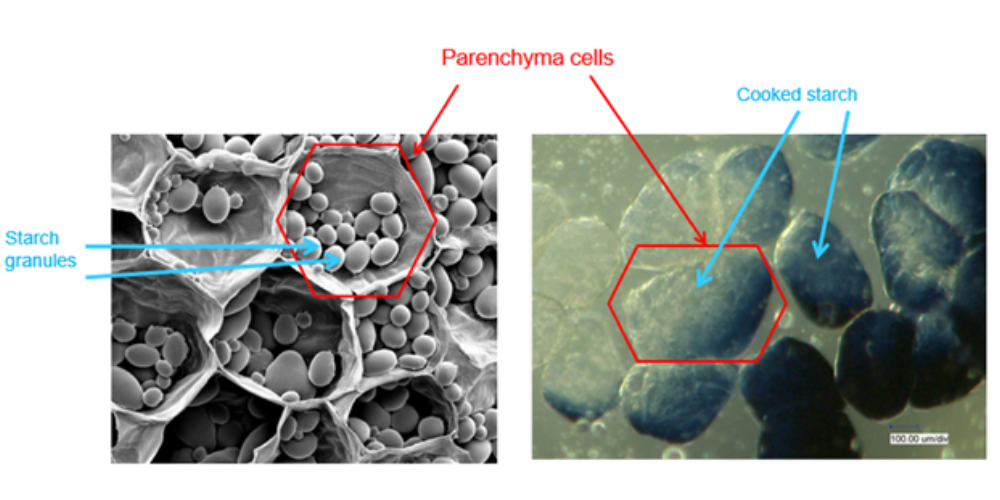 From left: Microscopic picture of potato tissue before and after (right) cooking (Image Credit: A*STAR’s SIFBI)
 Two digestive enzymes found in the human gut are responsible for starch digestion: α-amylase transforms starch to smaller molecules, while α-glucosidase converts these smaller starch molecules into glucose.
SIFBI’s new process creates a gel-like porous layer that behaves like a barrier between the potatoes’ starch granules and the enzymes. Although α-amylase can penetrate the pores in the layer to enter the potatoes’ parenchyma cells and act on the starch granules, it does so at a slower rate. The resulting smaller starch molecules also take a longer time to diffuse out of the parenchyma cells to be acted on by α-glucosidase and therefore, the conversion of starch to glucose is delayed.
Besides preventing sugar spikes in blood glucose, consuming potatoes treated with this new technique can also make you feel fuller. This reduces hunger pangs, is likely to prevent overeating and is beneficial for people who want to lose weight.
Taste-wise, the treated potatoes have a good texture. Potatoes treated with this technique can be used to make a host of culinary favourites such as chicken curry, fries, roasted potatoes and hash browns.
 From left: Dr Alvaro Ferreira-Lazarte, Ms Nur Syahirah Amirruddin, Mr Rakesh Raghunathan, Ms Yue Shuian Tan, and Dr Amy Lin.
 Dr Lin’s team comprises Research Fellow Dr Alvaro Ferreira-Lazarte, Research Officer, Mr Rakesh Raghunathan, Research Officer Ms Nur Syahirah Amirruddin, and intern Ms Yue Shuian Tan from the National University of Singapore. A former post-doctoral Research Fellow, Ms Andrea Gomez conducted the majority of the experiments related to the technique; Mr Alvaro Ferreira-Lazarte and Ms Nur Syahirah Amirruddin completed the study for our publication; former intern Ms Jei Xi Wong of the Singapore Institute of Technology and former intern Mr Rui Min Bek of Singapore Polytechnic assisted in part of the research activities.
Next steps
Our research goal is to make starchy foods healthier, as well as delicious and affordable. The techniques developed in our programme are safe, sustainable, and friendly to our environment.
Dr Lin says
With the discovery of the technology, the team is looking to reach out to companies that may be keen to leverage the new technique for processing their potato food products. This bodes well for consumers at large.
In 2022, there will be more than 1 billion obese people globally. In addition, the prevalence of diabetes worldwide is expected to reach 10.9% by 2045 from 9.3% in 2019.
Meanwhile, the team forges on to conduct clinical trials to further validate their findings and research the long-term benefits of modifying appetite and food intake.
On the back of the discovery of the technique, the team is keen to explore techniques to change other starchy foods such as rice, a staple for about half of the world’s population. Rice accounts for more than 20% of global caloric needs.