Research Focus
Her work brings the scientific community closer to creating precise, next-generation treatments for individuals living with vision loss, and offers a promising blueprint for developing RNA therapeutics for a wide range of genetic disorders.
A*STAR IMCB is proud to celebrate Dr Mok’s achievement and her continued dedication to advancing biomedical innovation.
A*STAR IMCB Researcher Honoured with the L’Oréal–UNESCO For Women in Science Award
05 Dec 2025
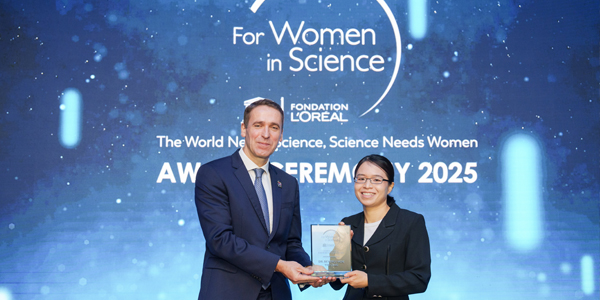
Dr Beverly Mok receiving the 2025 L’Oréal–UNESCO For Women in Science award.
Photo credit: L’Oréal Malaysia – Singapore (MYSG)
A*STAR Institute of Molecular and Cell Biology (IMCB) congratulates Senior Scientist Dr Beverly Mok on receiving the prestigious L’Oréal–UNESCO For Women in Science award. This recognition highlights her contributions to advancing RNA-based therapeutic strategies for inherited retinal diseases and other rare genetic disorders.
Advancing RNA Therapeutics for Vision Los
Advancing RNA Therapeutics for Vision Los
Dr Mok’s interest in genetic diseases began during her PhD training at Harvard, where she developed the mitochondrial base editor to enable functional interrogation of mtDNA mutations in diseases. Presenting her work at international conferences brought her into contact with patient families, whose messages of hope motivated her to explore how nucleic acid could be harnessed to treat genetic diseases more broadly.
Upon her return to Singapore for her postdoctoral work, Beverly worked closely with clinical collaborators from Translation Retinal Research Lab at IMCB to study inherited retinal diseases (IRDs). IRDs are caused by rare genetic mutations that progressively damage the retina and can lead to irreversible vision loss. Despite their severity, effective treatments for IRDs remain limited. Motivated to apply her learnings in genome editing to IRDs, her research now focuses on developing innovative RNA strategies — including RNA editing, RNA replacement and protein replacement — that leverage the eye’s unique accessibility and immune-privileged environment. These approaches have the potential to pave the way for first-of-its-kind RNA therapies for retinal disorders, and could serve as a foundation for treating a wider spectrum of genetic conditions.
Upon her return to Singapore for her postdoctoral work, Beverly worked closely with clinical collaborators from Translation Retinal Research Lab at IMCB to study inherited retinal diseases (IRDs). IRDs are caused by rare genetic mutations that progressively damage the retina and can lead to irreversible vision loss. Despite their severity, effective treatments for IRDs remain limited. Motivated to apply her learnings in genome editing to IRDs, her research now focuses on developing innovative RNA strategies — including RNA editing, RNA replacement and protein replacement — that leverage the eye’s unique accessibility and immune-privileged environment. These approaches have the potential to pave the way for first-of-its-kind RNA therapies for retinal disorders, and could serve as a foundation for treating a wider spectrum of genetic conditions.
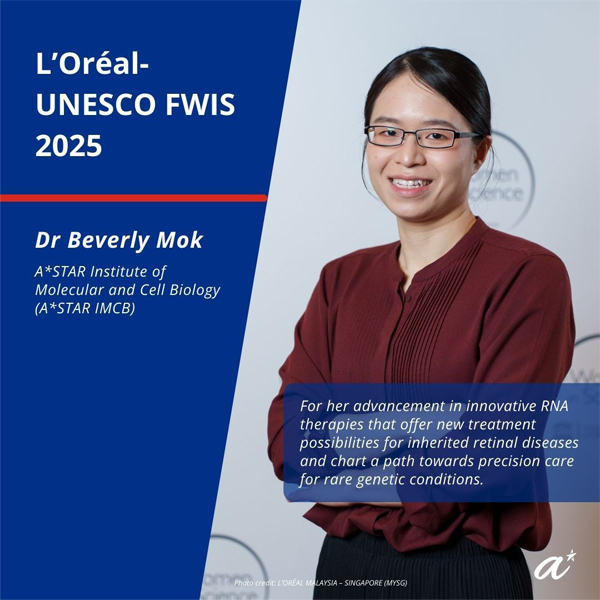
Photo credit: L’Oréal Malaysia – Singapore (MYSG)
Pushing Boundaries with Support from L’Oréal–UNESCO
With support from the L’Oréal–UNESCO For Women in Science programme, Dr Mok is working to improve the stability and delivery of RNA therapeutics, while building collaborations that can help translate laboratory advances into meaningful patient impact.
With support from the L’Oréal–UNESCO For Women in Science programme, Dr Mok is working to improve the stability and delivery of RNA therapeutics, while building collaborations that can help translate laboratory advances into meaningful patient impact.
“I hope that with the support from L’Oréal and A*STAR, we can work towards building a robust RNA reprogramming platform that could potentially treat retinal diseases and other debilitating genetic disorders,” shared Dr Beverly Mok.
Her work brings the scientific community closer to creating precise, next-generation treatments for individuals living with vision loss, and offers a promising blueprint for developing RNA therapeutics for a wide range of genetic disorders.
A*STAR IMCB is proud to celebrate Dr Mok’s achievement and her continued dedication to advancing biomedical innovation.