
Smart AI monitoring: How Respiree catches patient decline early
Respiratory parameters such as direct respiratory rate can provide an early warning of patient deterioration, but many care settings still rely on periodic manual checks, which can limit opportunities for timely intervention.
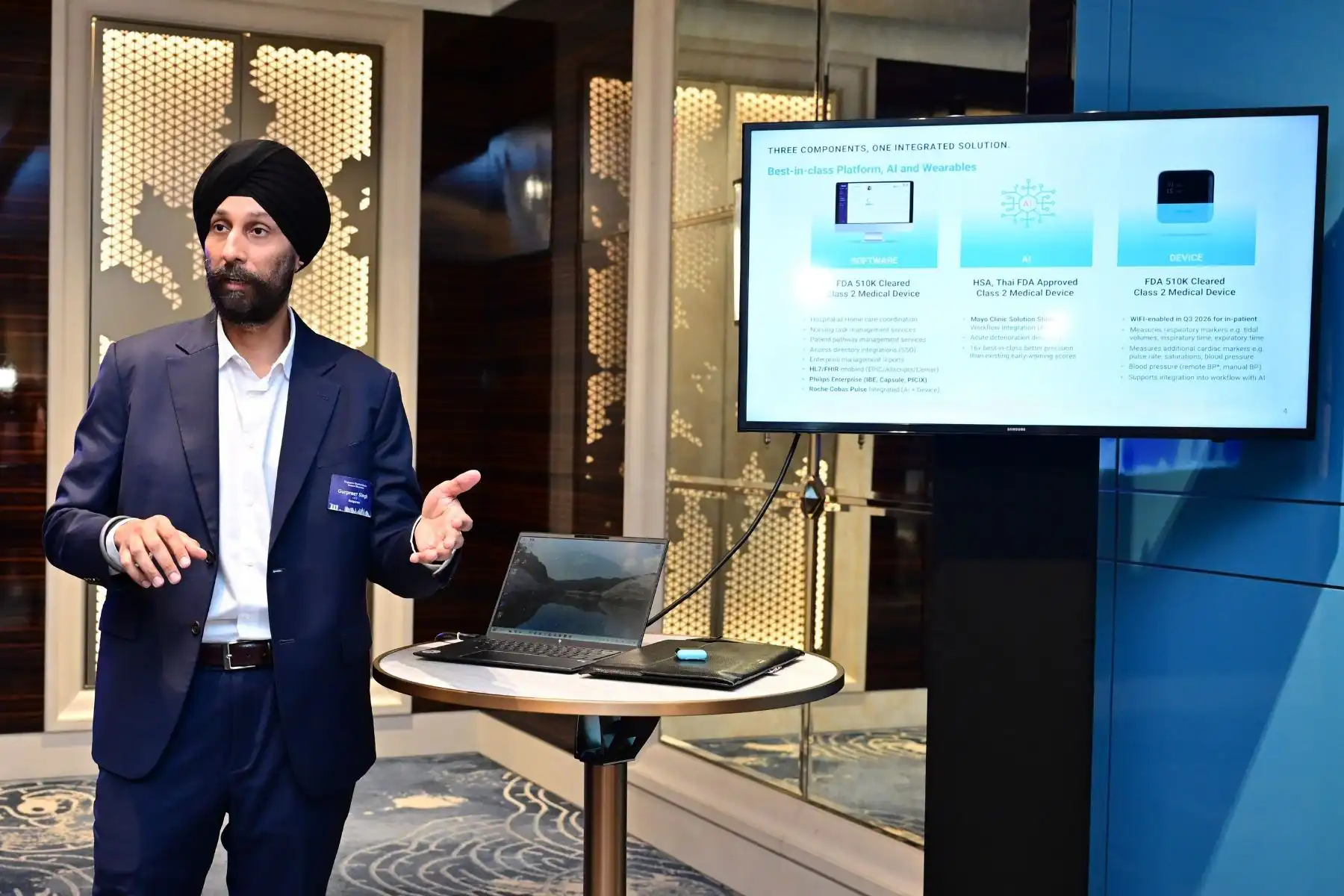
Respiree , an A*STAR MedTech spin-off founded by former A*STAR Senior Research Fellow Dr Gurpreet Singh, set out to solve this problem.
The company developed RS001, a wearable sensor; 1Bio™, a software platform for connected care and hospital interoperability; and 1Bio™ AI-Acute, an AI toolbox that analyses vital signs to identify patient deterioration. Together, these technologies enable continuous cardio-respiratory monitoring and help clinicians detect signs of deterioration earlier.

Bringing a solution like this from research into healthcare requires more than a promising prototype. A*STAR supported Respiree through key technical, clinical and commercial hurdles in the early stages, giving the company access to research capabilities, expertise and pathways needed to advance and bring this technology into the market. This support has continued as Respiree advances its platform and prepares it for wider clinical use and international growth.
The technology has since secured regulatory approval and clearances in Singapore, Australia, Europe, Malaysia, Thailand and the United States, and gained partnerships with global healthcare organisations including Philips, Mayo Clinic Solution Studio and Roche Diagnostics.
The Challenge
- High clinical need: Conditions that require frequent cardio-respiratory monitoring, such as chronic obstructive pulmonary disease (COPD), asthma, cystic fibrosis, heart failure and sepsis can worsen quickly. Early detection is critical, yet frequent cardio-respiratory monitoring can remain labour-intensive.
- Complex translation pathway: Before healthcare providers can adopt a new MedTech solution at scale, it must demonstrate clinical workflow integration, value, meet regulatory standards and integrate smoothly into existing systems and workflows.
- Turning data into meaningful alerts: Continuous monitoring creates large volumes of physiological data. There is a need for reliable analytics that can filter out noise, reduce false alarms and surface changes that clinicians can act on.
Our Innovation
Respiree’s technology grew from A*STAR’s capabilities in optical sensing and biophotonics . The research team developed an optical approach that uses light to detect subtle changes in skin and chest-wall movement. Beyond counting breaths, it captures breathing depth and respiratory effort, providing a fuller picture of a patient’s condition.
Called the RS001, the compact wearable continuously monitors respiratory signals and feeds data into Respiree’s 1Bio™ platform, which also integrates symptom questionnaires, clinical annotations and inputs from other medical devices. The 1Bio™ platform can also connect with other healthcare data systems to bring additional patient information together in one place.
Respiree also developed 1Bio™ AI-Acute, a standalone, platform-agnostic AI software that analyses physiological and clinical data to generate a probability score for impending acute deterioration. Integrated with the 1Bio™ platform, or used separately, the score is displayed as a visual trend to help clinicians identify changes in a patient’s condition and assess them alongside corresponding vital signs.
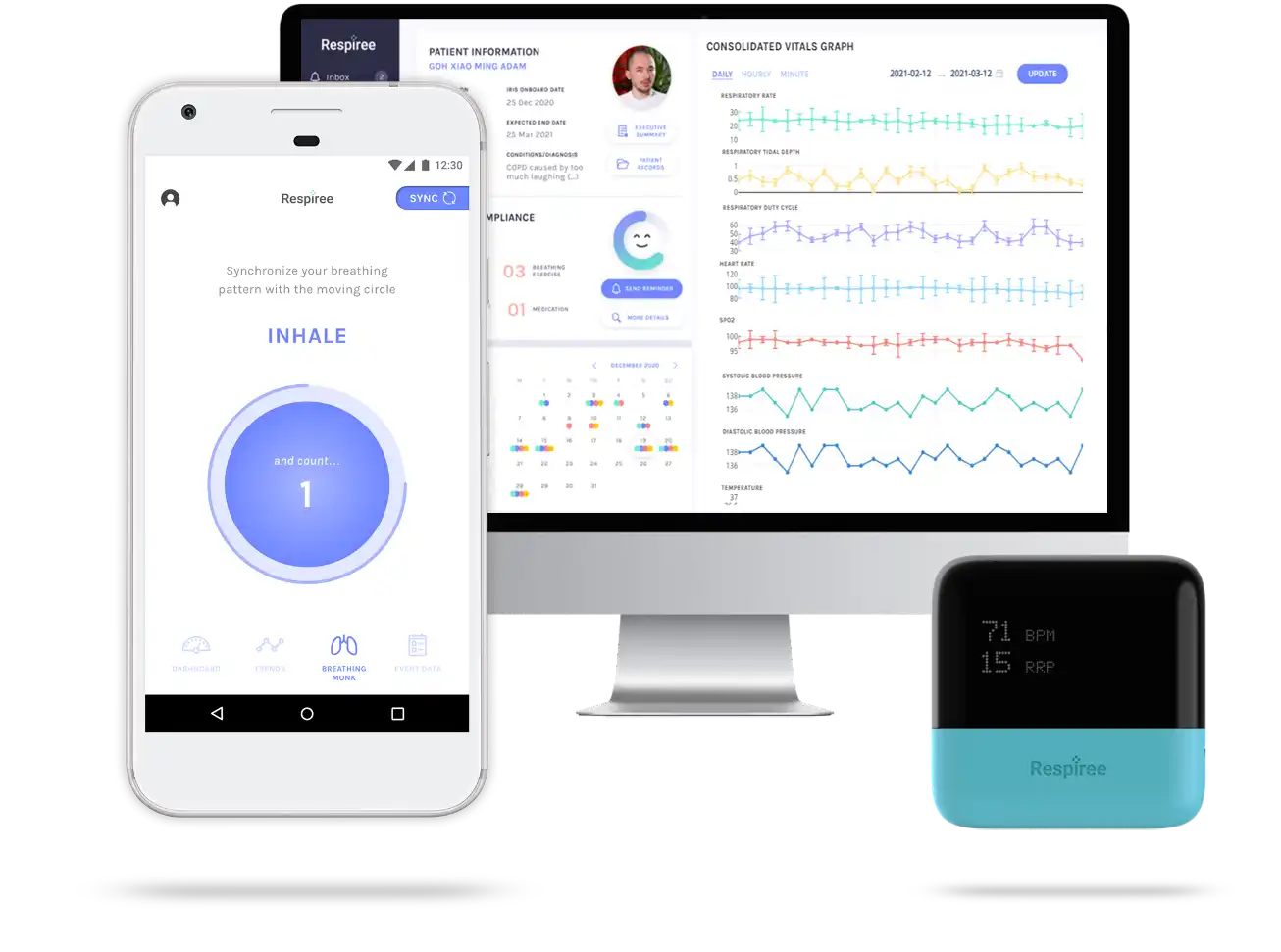
From left to right: Respiree’s 1Bio™ platform on mobile and PC, and the RS001 wearable sensor.
From early development to ongoing technology advancement, A*STAR has supported Respiree by:
- de-risking early-stage development, enabling the company to test and refine its approach using A*STAR’s laboratories, instrumentation and research expertise without having to build these capabilities from scratch;
- strengthening its scientific, clinical and data expertise, including through three T-Up engagements that embedded A*STAR R&D talent with the company to advance its algorithms, analytics, clinical integration and data infrastructure; and
- supporting commercial readiness and venture-building, through gap funding and business guidance that reduced development risk and supported technology licensing and market entry.
The Impact
Today, Respiree has progressed into a clinically validated MedTech company with international operations, global industry partnerships and real-world benefits for healthcare teams and patients.
Key outcomes include:
- More efficient, less disruptive monitoring: In a typical 40-bed general ward, the system could save nurses up to 12 hours daily by reducing routine bedside checks, allowing them to focus on patients with more urgent needs.
- Clinical adoption and regulatory validation: Following early deployment during COVID-19, which demonstrated its value in real-world care settings, Respiree has since secured regulatory approvals and clearances across key markets, supporting use across adult, paediatric, hospital and home-care settings.
Singapore: Health Sciences Authority (HSA) approval for RS001, 1Bio™ platform and 1Bio™ AI-Acute as a Class B Software as a Medical Device (SaMD), confirming that these products meet local regulatory requirements for medical devices.Australia: Therapeutic Goods Administration (TGA) clearance, enabling use in the Australian market.Europe: Conformité Européenne (CE) marking, showing that the products meet applicable European safety, health and performance requirements.United States: Food and Drug Administration (FDA) 510(k) clearance for RS001 and the 1Bio™ connected care platform, including expanded use in home environments.
- Stronger evidence and industry confidence: Respiree’s platform has reported stronger precision than conventional hospital alarms, including a peer-reviewed study with Mayo Clinic reporting an up to 16-fold improvement in precision for acute patient deterioration. Global partnerships with leading healthcare companies have supported international distribution and Asia-Pacific pilots, signalling confidence in Singapore-developed MedTech.
- Venture growth and global scale: Respiree has grown from a two-person team to close to 40 people today, with Singapore as its R&D base. It has also established a presence in Australia and the United States (US). In 2025, Respiree raised its Series A round of US$11.6 million to expand its commercial operations and US presence, including a base at the Texas Medical Center Innovation hub in Houston.
Respiree’s journey shows how Singapore-based research, supported by a strong innovation ecosystem, can be translated into a globally relevant healthcare solution. As the company scales globally while anchoring high-value R&D in Singapore, it also creates wider economic value by creating skilled jobs, attracting investment and strengthening the country’s MedTech capabilities.