Beware of scams: Government officials will never ask you to transfer money or disclose bank log-in details over a phone call.

You can also contact A*STAR via our online form or call the 24/7 ScamShield Helpline at 1799 if you are unsure if something is a scam.

Antibodies (resized)

Realise Quality Processes for Biomanufacturing

To align with EDB’s drive to expand the footprint of Singapore as a biopharma hub

Cells (resized)

Research Excellence

A centre of excellence for groundbreaking research in Proteins, Cells, and Nucleic Acids bioprocessing technologies

Partnership (resized)

Industry Collaboration

Cultivating partnerships with industry to advance innovations and translate research into industrial applications

Bioreactor (resized)

Talent Development

Providing development and training programmes to support biomanufacturing and research activities in Singapore

A*STAR Bioprocessing Technology Institute (BTI)

Who We Are

A*STAR Bioprocessing Technology Institute (BTI) focuses on advancing bioprocessing technologies and research over its 35-year history. Our current vision is to Realise Quality Processes for Biomanufacturing, with a strong emphasis on Proteins, Cells, and Nucleic Acids.


BTI’s Key Focus Areas

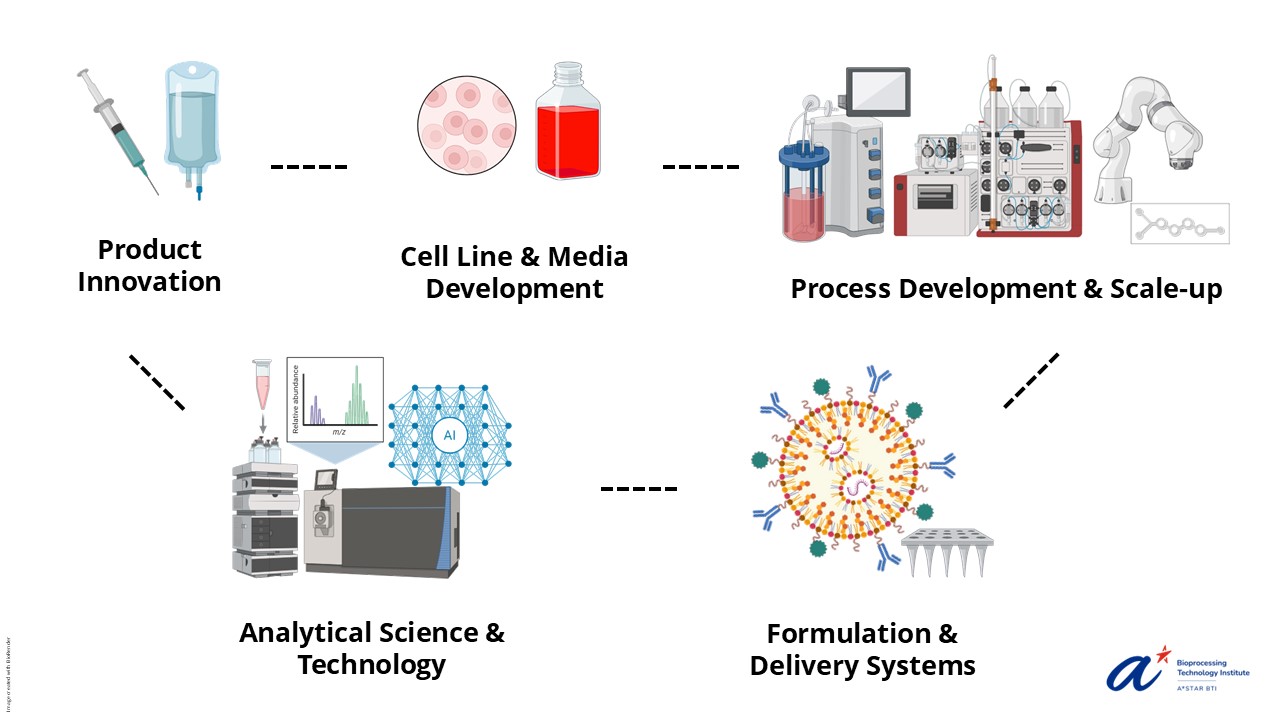
To achieve BTI’s vision of ensuring Quality Processes for Biomanufacturing, the institute develops innovative research capabilities and advanced biomanufacturing technologies. Modality-specific strategies are key to BTI achieving its mission of developing Singapore's biomanufacturing sector where asset classes are in various stages of maturity and development.

Read More

BTI Focus Area (PCN)


BTI's Core Capabilities

BTI’s core capabilities are systematically organised around its four principal divisions, which oversee 19 Enabling Research Groups, and Technology Platforms and Consortia. The matrix structure of BTI’s divisions enables the swift and flexible assembly of research teams with synergistic capabilities, allowing them to effectively address research and industry problem statements.

Read More

BTI Capabilities


Insights into LNP design for mRNA delivery

Messenger RNA (mRNA) vaccines, such as those developed for COVID-19, must be protected and safely delivered into the body’s cells to function effectively. To facilitate this, scientists use fat-like particles called lipid nanoparticles (LNPs), which are composed of four lipid components. Among these components, polyethylene glycol-conjugated lipid (PEG-lipid), plays a crucial role in stabilising the nanoparticles and enhancing their circulation in the body, despite being present in small amounts. However, how the structure and amount of PEG-lipid influence the effectiveness of mRNA delivery have not been fully understood. In our study, we investigated different types of PEG-lipid to understand how structural modifications— such as the length of the lipid tail or the amount used—affect the delivery, location, and effectiveness of the mRNA in the body. We found that excessive amounts of PEG-lipid reduced mRNA delivery efficiency. Additionally, certain types of PEG-lipids facilitated targeted delivery to specific organs, such as the liver or lymph nodes. These findings can help scientists design better mRNA vaccines in the future.

Read more: https://www.a-star.edu.sg/bti/bti-research-highlights/insights-into-lnp-design-for-mrna-delivery