Biologics Pharma Innovation Programme Singapore (BioPIPS)

BioPIPS or the Biologics Pharma Innovation Programme Singapore aims to strengthen local biomanufacturing capabilities and transform Singapore’s biologics manufacturing facilities into agile factories of the future. It works through a consortium model consisting leading biopharma companies and Singapore’s public sector R&D agencies and universities.

Vision: Transform biologics manufacturing through the introduction of new technologies and products into Singapore’s manufacturing facilities

Objectives:

  • Leverage public sector R&D capabilities to address problem statements from local biologics manufacturing facilities to enhance manufacturing productivity and operational efficiency 
  • Transform the existing biologics manufacturing operations in Singapore so that the manufacturing sites are best-in-class within their respective manufacturing network and well positioned for the introduction of new products and novel manufacturing technologies
  • Leverage strong foundation through synergies in operations, resources, learning and collaboration of technologies with PIPS

BioPIPS intro


Consortium Members

Combined Consortium Logos BioPIPS

A consortium agreement was inked on 15 March 2024 between the Agency for Science, Technology and Research (A*STAR), National University of Singapore (NUS), Nanyang Technological University, Singapore (NTU Singapore), Singapore Institute of Technology (SIT) and 3 major pharmaceutical MNCs, i.e. BioNTech Pharmaceuticals Asia Pacific Pte Ltd, GlaxoSmithKline Biologicals and Sanofi-Aventis Singapore Pte Ltd. They are also the founding Core Members of BioPIPS. The Singapore University of Technology and Design (SUTD) has also joined the consortium as its latest research performer.

The Extended Team is a diverse group consisting pharmaceutical supply chain, technology, consultancy, training and engineering companies, including SMEs and LLEs invited by the Core Members to participate in specific projects. The team comprises Aleph Digital Technologies Pte Ltd, Arcondis Pte Ltd, JM VisTec System Pte Ltd and Magorium Pte Ltd.

Interested companies are encouraged to contact the BioPIPS Programme Office to find out more about joining the consortium.

Note: Companies are listed in alphabetical order.


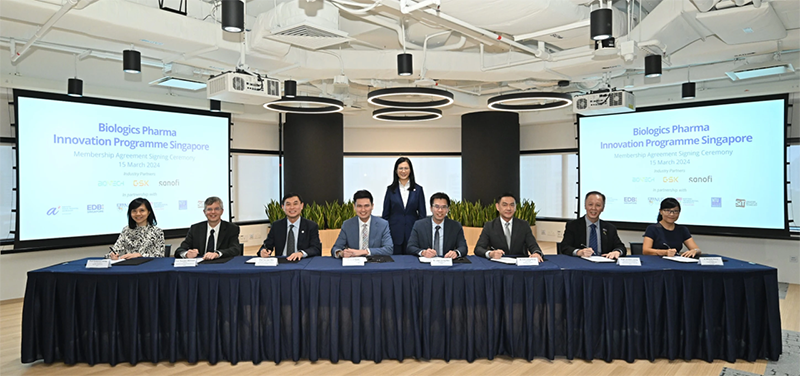
Signing Ceremony BioPIPS (800px)
BioNTech, GSK, Sanofi, NTU, NTUitive, NUS and SIT signed a membership agreement on 15 March 2024 to join the Biologics Pharma Innovation Programme Singapore (BioPIPS) consortium led by A*STAR and supported by EDB. EDB’s Cindy Koh, Executive Vice President and Member of EXCO, witnessed the membership agreement signing.


Workstreams

Sensing and Modelling

Focuses on developing and validating in-process, automated workflows to translate process performance into actionable knowledge. Specifically, the aim is to improve the accuracy and robustness of sensing technologies and facilitate the incorporation of AI and modelling approaches into manufacturing processes to enable quicker and more effective product and process control.


Sensing and Modelling (600px x 400px)

Sustainability

Focuses on technologies to achieve sustainability targets, including zero waste-to-landfill and reducing environmental footprint and greenhouse gas emissions. The workstream aims to use models to identify sustainability bottlenecks in manufacturing and supply chains, explore new technologies to reduce resource utilisation and waste generation, and rethink the expanded utility of single-use equipment through the lens of materials science and circular economy considerations.


sustainable-(600px x 400px)

Compliant Agility

Underpinning medicine supply is the trust in the efficacy and safety of the manufactured products which need to comply to regulations. This workstream focuses on removing manual tasks to achieve greater productivity in the manufacturing facilities while maintaining compliance by using solutions, e.g. robotics, automation and advanced analytics.


biorobots-concept (600px x 400px)


Application Materials for BioPIPS Grant Calls

All Letters of Intent must be submitted to BTI_BioPIPS@a-star.edu.sg by 3 April 2026, 12.00 pm (Singapore Time) through the template provided. Successful PIs will be informed and guided to develop proposals subsequently.

Please refer to the grant materials below.

About the Grant Call

This grant call is from the Compliant Agility workstream which focuses on removing manual tasks to achieve greater productivity in the manufacturing facilities while maintaining compliance by using solutions, e.g. robotics, automation and advanced analytics.

  • Problem Statement 1: Defect Detection of Single-Use Systems
  • Problem Statement 2: Redesigned Manufacturing in Compliant Agility

Problem Statement 1: Defect Detection of Single-Use Systems

This grant call seeks proposals to develop solutions which can –

  1. Automate the detection of defects within SU assemblies and bags, in particular for those listed below (see Annex A for details) but not limited to –
    a. Incomplete or mis-assembly, such as missing or incorrect components, improper component orientation
    b. Incomplete points of sealing, e.g. port seal and film seal
    c. Embedded particles (>100 μm present in SU assemblies or bags)
  2. Improve repeatability and reduce operator variability associated with manual visual inspection through the use of, but not limited to, imaging, computer vision, machine learning, optical sensing, spectroscopic methods or other relevant detection modalities
  3. Support regulatory compliance by generating objective, reproducible inspection records suitable for GMP or regulated bioprocessing environment

Problem Statement 2: Redesigned Manufacturing in Compliant Agility

This grant call seeks proposals for solutions to –

  1. Automate High-Risk Manual Operations: Develop solutions to reduce contamination risk and manual intervention in critical activities, such as –
    • Media preparation
    • Sampling
    • Equipment configuration, setup and breakdown
    • Materials and wastes handling
    Proposals can include retrofit solutions for existing isolators and legacy processes as well as greenfield concepts

  2. Minimise Contamination Across Sterile Boundaries: Design systems to safely manage robotic and materials movement between sterile and non-sterile zones through –
    • Improved barrier technologies
    • Segmented workflows
    • Controlled transfer pathways
    • Advanced environmental containment strategies
    Solutions must maintain or improve current sterility assurance levels

  3. Redesign Equipment For Robotics Operations: Redesign single-use and multi-use equipment for robotic manipulation and automated configuration by emphasising –
    • Sterilisable and low-particle materials
    • Modular and reconfigurable architecture
    • Robot-compatible interfaces
    • Simplified setup, operations and cleaning
    Proposals can explore shifts from high-volume/low-frequency batch production, e.g. ≥1000 L towards low-volume/highfrequency or hybrid batch-continuous manufacturing models

  4. Future-Ready Facility And Workflow Architecture: Propose facility concepts optimised for automation and ‘lights-out’ manufacturing, including –
    • Robotics-enabled spatial configurations
    • Separation of human and robotic workflows
    • Alternative sterilisation zoning strategies
    • Closed or near-closed production environments
    Concepts can address both greenfield facilities and transformation pathways for existing plants

  5. Define The Robotics Lifecycle In GMP Environments: Establish frameworks to manage robotic systems within regulated manufacturing environments, including –
    • Sterility and particle control
    • Maintenance and service models
    • Power and charging strategies
    • Human–robot interaction protocols
    • Compliance validation and monitoring
    Solutions must align with GMP requirements and regulatory expectations

Different types of collaboration are encouraged. Some ideas can be standalone research projects while others require pulling together different collaborators to take forward. Some of the ideas above are likely to need phasing or drawing from concepts already deployed in other industries, e.g. semiconductor, automotive or nuclear.

Eligibility

The Principal Investigator and Co-Investigators as defined in Grant Terms and Conditions must:

  1. Hold a primary appointment in a Singapore publicly funded research institution or an Institute of Higher Learning. The Principal Investigator must hold a primary appointment of at least 0.7 FTE in Singapore.
  2. Lead a laboratory or research programme which carries out research in Singapore
  3. Possess track record of leadership ability in coordinating research programmes and providing mentorship to research teams as well as having productive research outcomes. A track record in securing IRS will be advantageous.

Collaborators as defined in Grant Terms and Conditions are not eligible to receive funding. Companies can participate in projects only as collaborators.

Exceptions to the above eligibility criteria will be considered on a case-by-case basis. Please submit a request to the BioPIPS Programme Office at least 7 days before the closing date of the grant call.


Media Releases

BioPIPS consortium in Singapore expands membership, seeks to enhance productivity and sustainability in biologics manufacturing, A*STAR Press Release
18-Mar-2024

SINGAPORE – The Biologics Pharma Innovation Programme Singapore (BioPIPS) has been expanded with the addition of global immunotherapy company, i.e. BioNTech Pharmaceuticals Asia Pacific Pte Ltd. The company joins global pharmaceutical companies, i.e. GSK and Sanofi, alongside Singapore’s research organisations and Institutes of Higher Learning, i.e. Agency for Science, Technology and Research (A*STAR), Nanyang Technological University, Singapore (NTU Singapore) and its innovation and enterprise company, i.e. NTUitive, National University of Singapore (NUS) and Singapore Institute of Technology (SIT).

The consortium is led by A*STAR and supported by the Economic Development Board (EDB). It aims to grow Singapore’s capabilities in biologics manufacturing by focusing on increasing productivity and sustainability to transform the existing base of biologics production in Singapore.


Get in touch with BioPIPS

Biologics Pharma Innovation Programme Singapore (BioPIPS) Programme Office

31 Biopolis Way
#08-01 Nanos
Singapore 138669