Cell Line Development
Develop platform technologies to accelerate antibody development
The Cell Line Development group develops innovative platform technologies for the rapid generation of CHO cell lines producing high-titer, high-quality therapeutic antibodies. In addition to cell line development, we advance antibody engineering and optimization using mammalian-based platforms that enable biologically relevant screening and selection. By engineering antibodies and cells throughout the development process, we improve consistency, speed, and manufacturability to meet industrial needs. Our integrated technology suite spans antibody engineering, discovery, screening, and manufacturing cell line development, reducing development risk, shortening timelines, and enabling seamless progression from early screening to clinical-grade production.
Focus Areas
- Monoclonal and Multispecific Antibody Development
- Engineering and Production of Therapeutic Proteins
- Mammalian-Based Antibody Screening
- Rapid Generation of High-Producing CHO Cell Lines
Multicistronic Vector Cell Line Development Platform
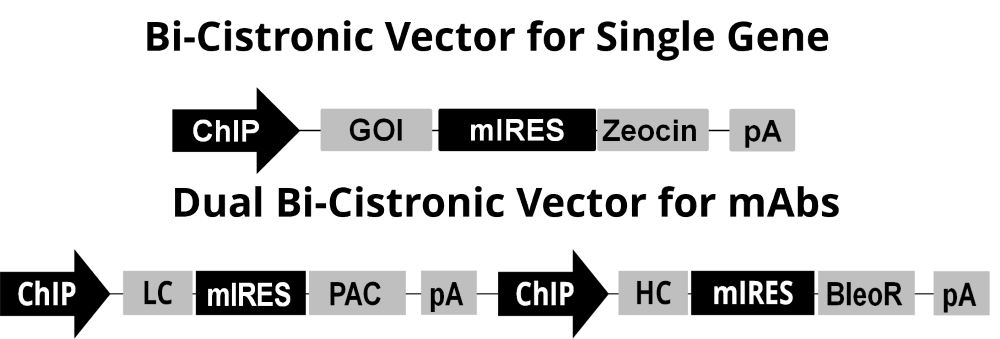
Our cell line development platform is built around proprietary multicistronic expression vector technology, enabling the rapid generation of high-producing, stable Chinese hamster ovary (CHO) cell lines for recombinant proteins and monoclonal antibodies. High performance is achieved through an integrated vector design that combines optimized vector architecture, strong chimeric promoters, and finely tuned selection marker expression, allowing stringent enrichment of top-performing producer clones early in development.
The platform consistently delivers antibody titers of 2–8 g/L in fed-batch cultures, with stable pools generated in as little as 4 weeks and clonal cell lines established within 8 weeks. Selected clones demonstrate long-term stability over more than 90 generations, supporting reliable and scalable manufacturing performance. This technology has been licensed to multiple companies and has enabled many antibodies to advance into clinical trials.
Targeted Integration Cell Line Development Platform
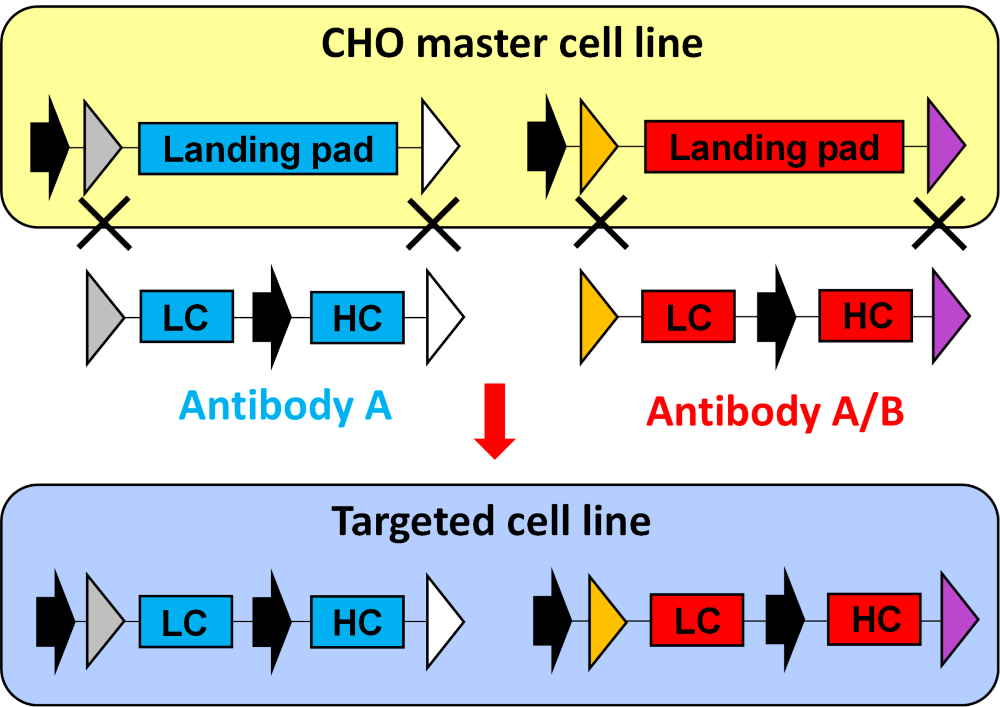
Our targeted integration cell line development platform enables precise and reproducible insertion of transgenes into defined genomic loci in Chinese hamster ovary (CHO) cells. By eliminating the positional effects and clonal variability associated with random integration, the platform delivers consistent, stable expression and reduces the need for extensive clone screening.
The most distinctive advantage is speed, reducing cell line development to just 9 weeks from transfection to research cell bank (RCB). In addition to enabling high-titer, stable production of monoclonal antibodies, this platform is particularly well suited for complex modalities, including bispecific antibodies and protein nanoparticle vaccines. The technology has been licensed to multiple companies and has supported the production of over 200 molecules for partner programs.
CHO Simultaneous Display and Secretion Platform
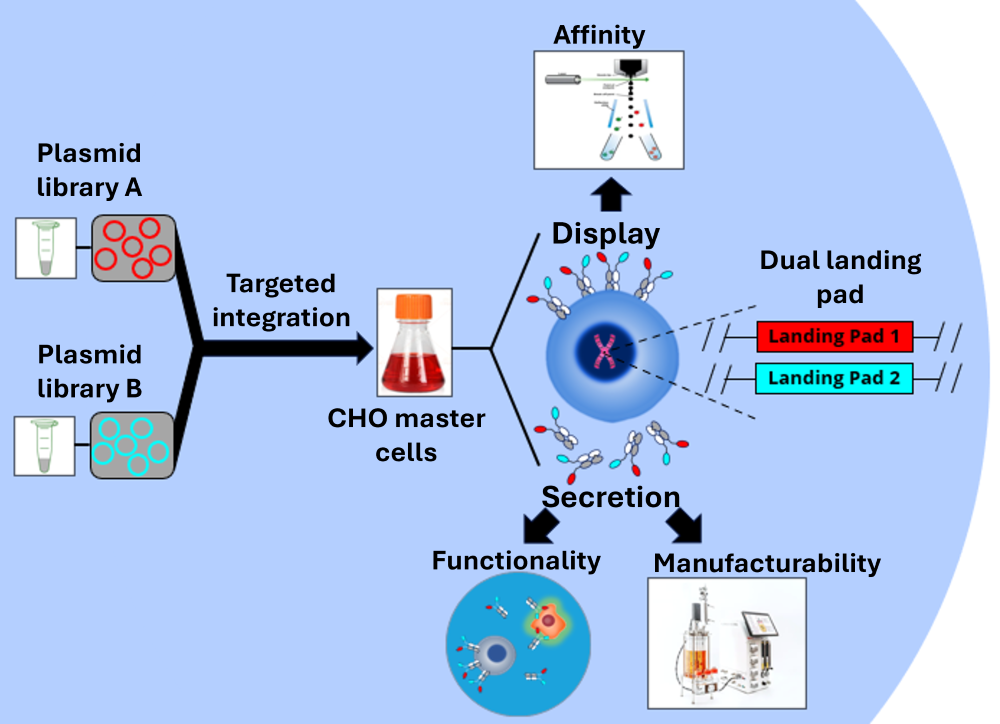
Our CHO simultaneous display and secretion platform enables rapid discovery and optimization of full-length monoclonal and bispecific antibodies with native, human-like post-translational modifications. A proprietary dual-expression system allows antibodies to be both displayed on the cell surface and secreted from the same cell. This enables high-throughput screening of binding strength, affinity balance, and functional activity for complex bispecific formats. Selected clones can be directly advanced to developability assessment without recloning or format switching.
This platform is particularly well suited for bispecific modalities such as T-cell engagers (e.g. CD3 × tumor antigen), dual immune checkpoint antibodies, and receptor–ligand blocking bispecifics, where correct chain pairing, stoichiometry, and functional geometry are critical. Compared with phage and yeast display systems, which are limited to antibody fragments, our platform expresses intact bispecific antibodies in a mammalian system, improving biological relevance and reducing development risk. Enhanced targeted integration ensures consistent expression and high display capacity, supporting efficient bispecific antibody maturation and lead selection. The platform has been successfully deployed in internal A*STAR programs and is licensed to multiple industry partners.
The Team





Our Track Record
Featured Publications
- Jessica P.Z. NG, Mariati, Han Kee Ong, Xuezhi Bi, Matthew Chang, Yuansheng Yang (2025) Optimizing Co-Expression Strategies for the Simultaneous Display and Secretion of Monoclonal Antibodies in CHO Cells. Scientific Reports 15(1): 42508
- Jessica P.Z. Ng, Mariati, Jiawu Bi, Matthew Wook Chang and Yuansheng Yang (2025) A targeted integration-based CHO cell platform for simultaneous antibody display and secretion. Antibodies 14(2): 38
- Ngan T B Nguyen, Hau Wan Leung, Kuin Tian Pang, Shi Jie Tay, Ian Walsh, Andre B H Choo and Yuansheng Yang (2023) Optimizing effector functions of monoclonal antibodies via tailored N-glycan engineering using a dual landing pad CHO targeted integration platform. Scientific Reports 13(1): 15620
- Han Ping Loh, Farouq Bin Mahfut, Serene W Chen, Yuhan Huang, Jianxin Huo, Wei Zhang, Kong Peng Lam, Shengli Xu, and Yuansheng Yang (2023) Manufacturability and functionality assessment of different formats of T-cell engaging bispecific antibodies. mAbs 15(1): 2231129
- Han Kee Ong, Ngan T.B. Nguyen, Jiawu Bi and Yuansheng Yang (2022) Vector design for enhancing expression level and assembly of knob-into-hole based FabscFv-Fc bispecific antibodies in CHO cells. Antibody Therapeutics, 5(4):288-300.
Landmark Patent & IP
- Engineered furin cleavage sequences for co-expression of multiple genes in mammalian cells (2024)
- System for targeted nucleic acid integration (2024)
- Recombinant heparan sulfate (2023)
- Expression systems for protein production and screening (2022)
- Novel promoters for high level expression (2020)
- Mutated internal ribosomal entry site (IRES) for controlled gene expression (2017)
- Modified human CMV promoters that are resistant to gene silencing (2015)
- IRES mediated multicistronic vectors (2014)