From Left: Dr Zhang Wei, Dr Bi Xuezhi, Nuruljannah Dzulkiflie, Ivy Low, Dr Kok Yee Jiun, Dr Nattha Ingavat, Dr Loh Han Ping, Wang Xinhui, Farouq Mahfut, Dr Yang Yuansheng, Ong Han Kee
Science
Bispecific antibodies are an emerging class of next-generation medicines that can recognize and bind to two different disease targets simultaneously, offering new treatment options for diseases such as cancer. Over 15 bispecific antibodies have already reached the market, while many more are currently under development. However, these molecules are often more structurally complex than conventional monoclonal antibody drugs, making them more challenging to manufacture and maintain in a stable form. Many bispecific antibodies rely on short peptide linkers that act like molecular "bridges" to connect different parts of the molecule. Suboptimal linkers and the presence of unstable domains can compromise the stability of bispecific antibodies, potentially affecting product quality, safety, and effectiveness. In this study, researchers at A*STAR's Bioprocessing Technology Institute (BTI) investigated how a model bispecific antibody behaves under stress conditions and identified regions that are particularly vulnerable to degradation. These findings provide important insights for guiding the development and design of more robust and manufacturable antibody therapeutics.
Societal Impact
Bispecific antibodies represent one of the fastest-growing classes of biotherapeutics, with an increasing number of products entering clinical development and reaching the market. However, their structural complexity can lead to stability issues that may delay development, increase manufacturing costs, or result in late-stage product failures. By identifying vulnerable regions within bispecific antibodies that are prone to degradation, this study provides valuable knowledge to help researchers and biopharmaceutical companies assess and address stability risks at an early stage of development. Such insights can support the design of more robust and manufacturable antibody therapeutics, potentially reducing development timelines, minimizing costly reformulation efforts, and improving manufacturing success rates. Ultimately, these advances could accelerate the delivery of safer and more effective bispecific antibody medicines to patients while strengthening the competitiveness of the biopharmaceutical industry.
Technical Summary
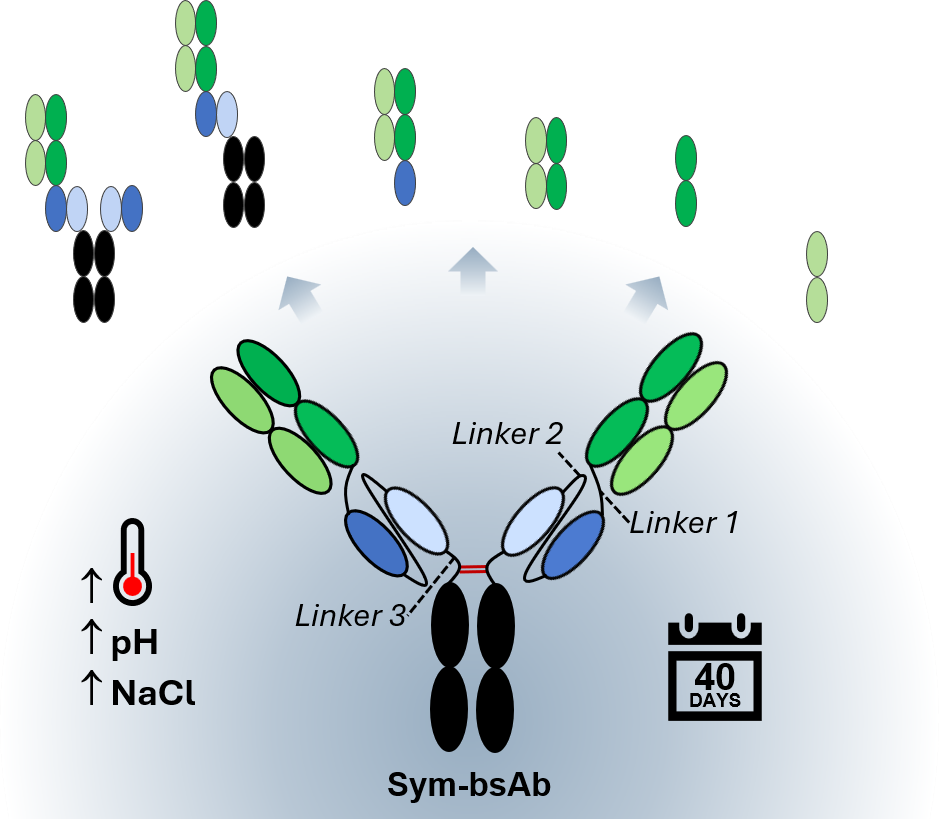
We investigated the structural stability of a model symmetric bispecific antibody (Sym-bsAb; (FabscFv)2-Fc format) containing G4S and G4 linker sequences under forced degradation conditions. Following Protein A purification, the molecule was subjected to thermal stress (40 °C) under buffer conditions spanning formulation- and process-relevant pH (5.5–8.5) and ionic strengths (0–500 mM NaCl). Protein integrity and fragmentation were monitored using orthogonal analytical approaches, including SEC-HPLC, non-reducing SDS-PAGE, and intact mass LC-MS. Thermal stress resulted in progressive loss of monomeric species, accompanied by increases in both high- and low-molecular-weight species. Fragmentation was markedly exacerbated under alkaline conditions, while ionic strength exerted a comparatively smaller effect, except under the highest pH and salt condition tested (50 mM Tris, pH 8.5, 500 mM NaCl).
To elucidate the molecular origins of degradation, stressed samples were fractionated by SEC and characterized by intact mass analysis. LC-MS revealed sequential clipping events within the interdomain G4S linker connecting the Fab and scFv domains, and the G4 linker connecting the scFv and Fc domains, identifying these flexible linker regions as key structural liabilities. Additional degradation pathways included fragmentation at interchain cystinyl residues and cleavage at C-terminal asparagine residues proximal to linker regions. Collectively, these findings demonstrate that flexible linker sequences can represent vulnerable hotspots for stress-induced fragmentation in symmetric bispecific antibodies, highlighting the importance of linker architecture, sequence selection, and overall molecular design in improving bsAb stability and manufacturability.
AI generated.
Figure 1: By studying how a bispecific antibody breaks down under stress, BTI researchers uncovered weak spots in linker regions, providing insights to guide the development of more stable and manufacturable next-generation antibody medicines.
References
Ingavat, N., et al., Structural stability of symmetric bispecific antibodies: a case study showing potential compromise near linker regions. Scientific Reports, 2026. 16(1): p. 9715.