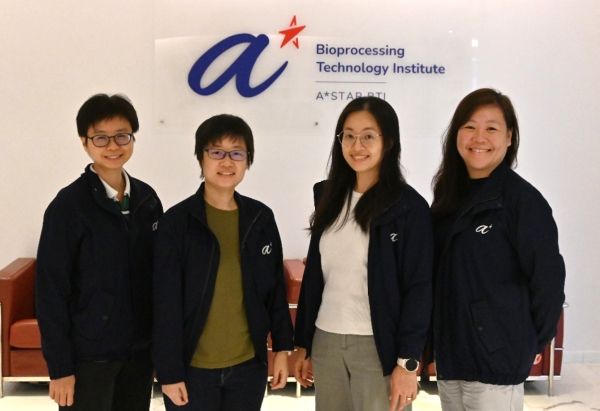
From Left: Dr Ho Ying Swan, Chen Shuwen, Esther Peh, Dr Ho Yin Ying
Science
Biologic medicines, such as therapeutic antibodies, are often produced using Chinese Hamster Ovary (CHO) cells. These cells act like tiny factories that manufacture proteins needed to treat diseases. To meet the growing demand for these medicines, scientists need to improve how CHO cells grow and how efficiently they produce proteins. One important but less understood factor is the role of lipids, or fats, which are essential building blocks of cell membranes and help regulate many cellular functions. In this research, we used advanced lipid analysis techniques to study how different cell culture media and feeding strategies change the lipid composition of CHO cells, including specific lipid species and sterols. The problem we aimed to address was the limited understanding of how these lipid changes affect cell performance and protein production. By identifying lipid patterns linked to different culture conditions, our work provides insights that can help scientists design better culture media and manufacturing processes, leading to more efficient, consistent, and cost-effective production of life-saving biologic medicines.
Societal Impact
The production of biologic medicines relies heavily on CHO cells, making improvements in cell culture efficiency highly valuable to both the healthcare and biopharmaceutical sectors. Our study provides new insights into how lipid composition, particularly specific lipid species and sterols, change under different culture media and feeding strategies, offering a scientific basis for developing more effective manufacturing processes. By enabling better media design and process control, these findings could help improve protein production yield, batch-to-batch consistency, and reduce manufacturing costs and resource consumption. For industry, this may translate into more efficient and robust biomanufacturing operations, while for policymakers and the public, it supports the development of a more resilient and cost-effective biopharmaceutical supply chain. Ultimately, these advances have the potential to improve access to life-saving biologic medicines by making their production more reliable, scalable, and affordable.
Technical Summary
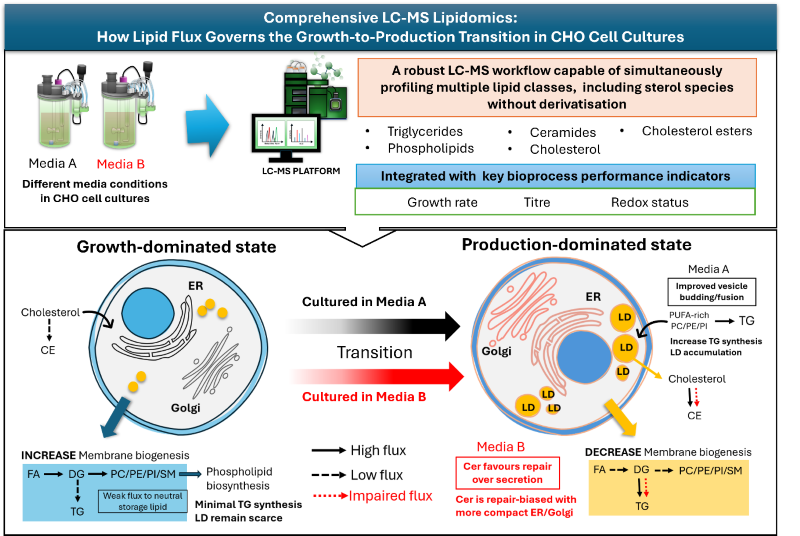
This study provides one of the most comprehensive LC–MS-based lipidomic characterisation of CHO cell culture to date by integrating detailed analyses of lipid classes including triglycerides, phospholipids, ceramides, cholesterol and cholesterol esters, with key bioprocess performance indicators such as growth rate, titre and redox status. Beyond establishing key associations between lipid composition and bioprocess performance indicators, the authors propose a mechanistic, two-phase lipid-flux model that links the transition from a growth-dominated state to a production-dominated state with coordinated lipid remodelling. Notably, cells cultured under the higher-performing media condition exhibited a pronounced shift toward triglycerides and cholesterol esters accumulation, polyunsaturated fatty acids (PUFAs)-enriched membrane remodelling, and enhanced lipid storage dynamics, which were associated with improved productivity and growth. The study also introduces a robust LC-MS workflow capable of simultaneously profiling multiple sterol classes without derivatisation, addressing a longstanding analytical gap and expanding the toolkit available for systems-level bioprocess characterisation.
From a biologics manufacturing perspective, the impact of this work extends beyond descriptive lipidomics. The findings position lipid metabolism as a critical and previously underutilized lever for cell culture optimisation, offering actionable biomarkers and mechanistic targets for media development, clone selection, and advanced process control strategies. Importantly, the work provides a scientific basis for engineering media and feeding strategies that promote favourable lipid-flux redistribution, potentially enabling higher product yield, improved process consistency, and reduced manufacturing costs. As the industry continues to pursue more efficient and sustainable production of increasingly complex biologics, these findings represent a significant contribution toward transforming lipidomics from a research tool into a practical driver of biomanufacturing innovation.
References
Chen, S., Peh, E. K. L., Mahfut, F. B., Yang, Y. S., Ho, Y. Y., & Ho, Y. S. (2026). Comprehensive Lipidomic Analysis of Recombinant Protein-Producing CHO Cell Cultures: Insights for Media and Process Development. Mass spectrometry (Tokyo, Japan), 15(1), A0192. https://doi.org/10.5702/massspectrometry.A0192