
Science
Seafood is one of the most widely consumed foods worldwide, yet mislabelling remains a major problem. Seafood fraud can pose health risks, reduce consumer trust, and harm the environment. There is a strong need for fast and reliable methods to identify seafood products in both markets and restaurants. In this study, we show that N-glycans, naturally occurring sugar molecules, can be used to distinguish different fish species, including barramundi, red snapper, and red tilapia. This approach provides an accurate and practical method for seafood authentication.
Societal Impact
Ion mobility–mass spectrometry (IM-MS) is a powerful analytical technique that is increasingly used to study important biological molecules such as proteins, sugars, and lipids. Some sugars, known as glycans, can carry modifications (such as O-acetylation) that create molecules with the same chemical formula but different structures. These structural differences vary between fish species. In this work, we show that these glycan structural patterns can be reliably detected using IM-MS and used to accurately identify fish species. This approach overcomes key limitations of current authentication methods and provides a more robust tool to combat seafood mislabelling. By improving the accuracy of seafood identification, this method supports consumer protection, food transparency, and sustainable fisheries.
Technical Summary
In this study, liquid chromatography–ion mobility–mass spectrometry (LC-IM-MS) was employed to characterize the N-glycan profiles of three commercially relevant fish species: barramundi and snapper, together with tilapia, a common adulterant encountered in markets and restaurants. Principal component analysis (PCA) revealed clear separation and reliable identification of the three species based on the relative abundances of O-acetylated sialic acid–containing N-glycans. In addition, ion mobility–derived drift times and collision cross section (CCS) values of species-specific ions were determined, highlighting distinct glycan signatures and marked differences in their relative intensities among the samples.
For the first time, we demonstrate an LC-IM-MS–based strategy for differentiating fish species using O-acetylated sialic acid (O-Ac-Sia)–containing N-glycan fragments. The high consistency of these O-Ac-Sia N-glycan signatures in both raw and heat-treated fish muscle tissues enables species identification across multiple stages of the supply chain, from harvesting to consumer purchase in markets and restaurants. This work establishes food glycomics as a robust alternative to DNA barcoding for seafood authentication. The refined LC-IM-MS glycomics workflow presented here serves as a proof-of-concept and can be further extended to authenticate additional seafood species through the identification and quantification of O-Ac-Sias.
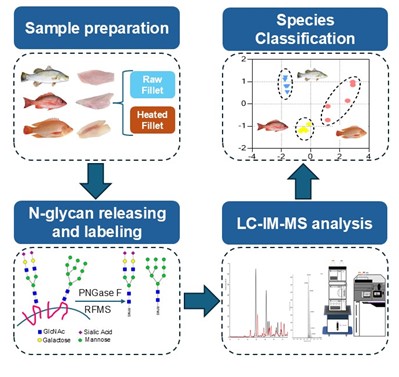
Figure 1. Glycomics-based workflow for fish authentication of fish species by employing liquid chromatography ion mobility-mass spectrometry analysis.
References
Walsh, I., Ruethers, T., Chiin, S. L., Teo, G., Tay, S. J., Wan, C., Pang, K. T., Chia, S., Lopata, A. L., & Qiu, B. (2025). Differentiation of Fish Species Based on O-Acetylated N-Glycan Fragments Using LC-IM-MS to Combat Seafood Adulteration. Applied Food Research, 101428.