A research team led by Prof Ivor Tsang from A*STAR's Centre for Frontier AI Research (CFAR), has been awarded at the AI for Materials Discovery Grand Challenge for the project titled "Design Beyond What You Know: Material Informed Differential Generative AI (MIDGAI) for Light-Weight High-Entropy Alloys and Multi-functional Composites".
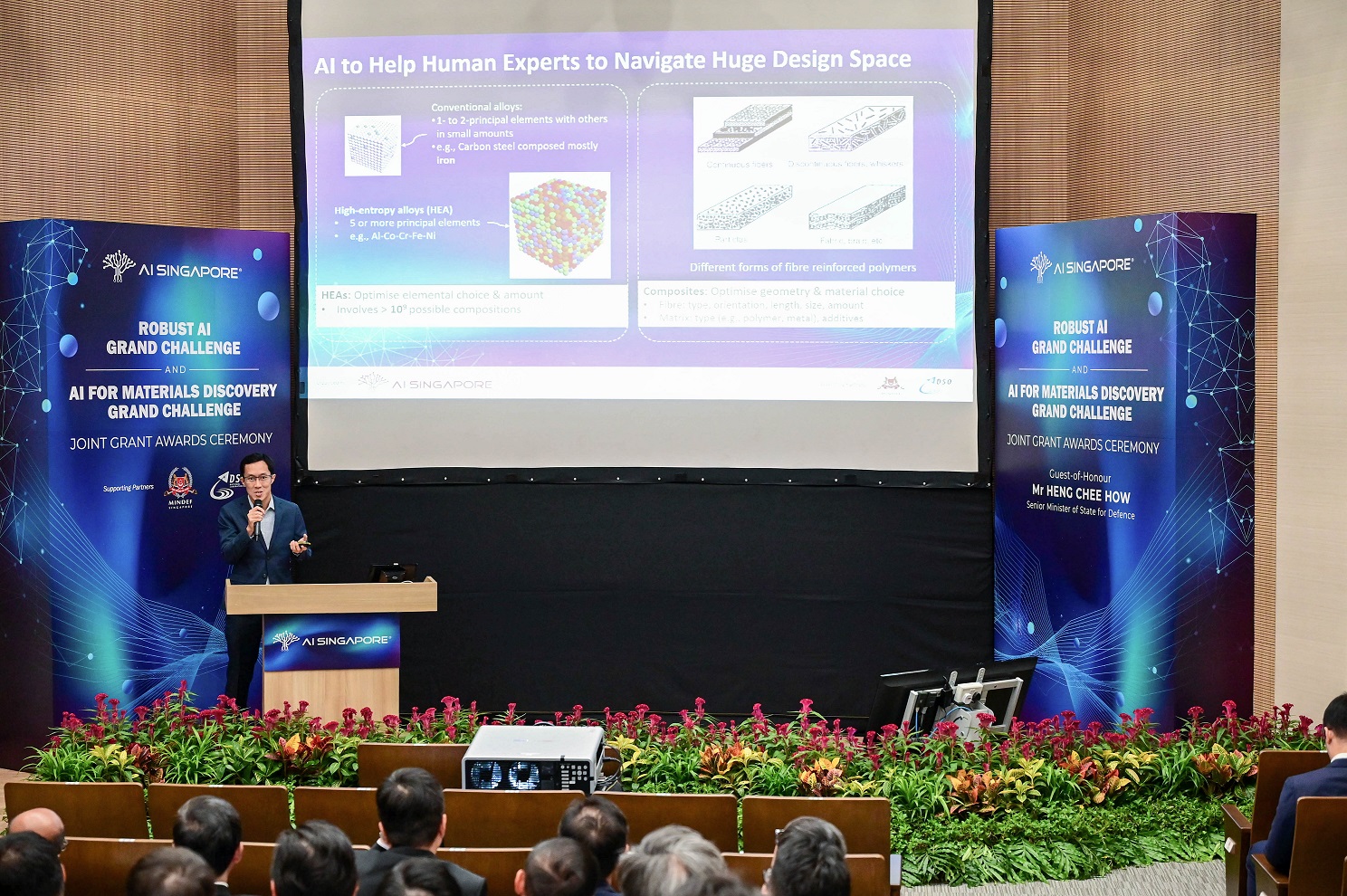
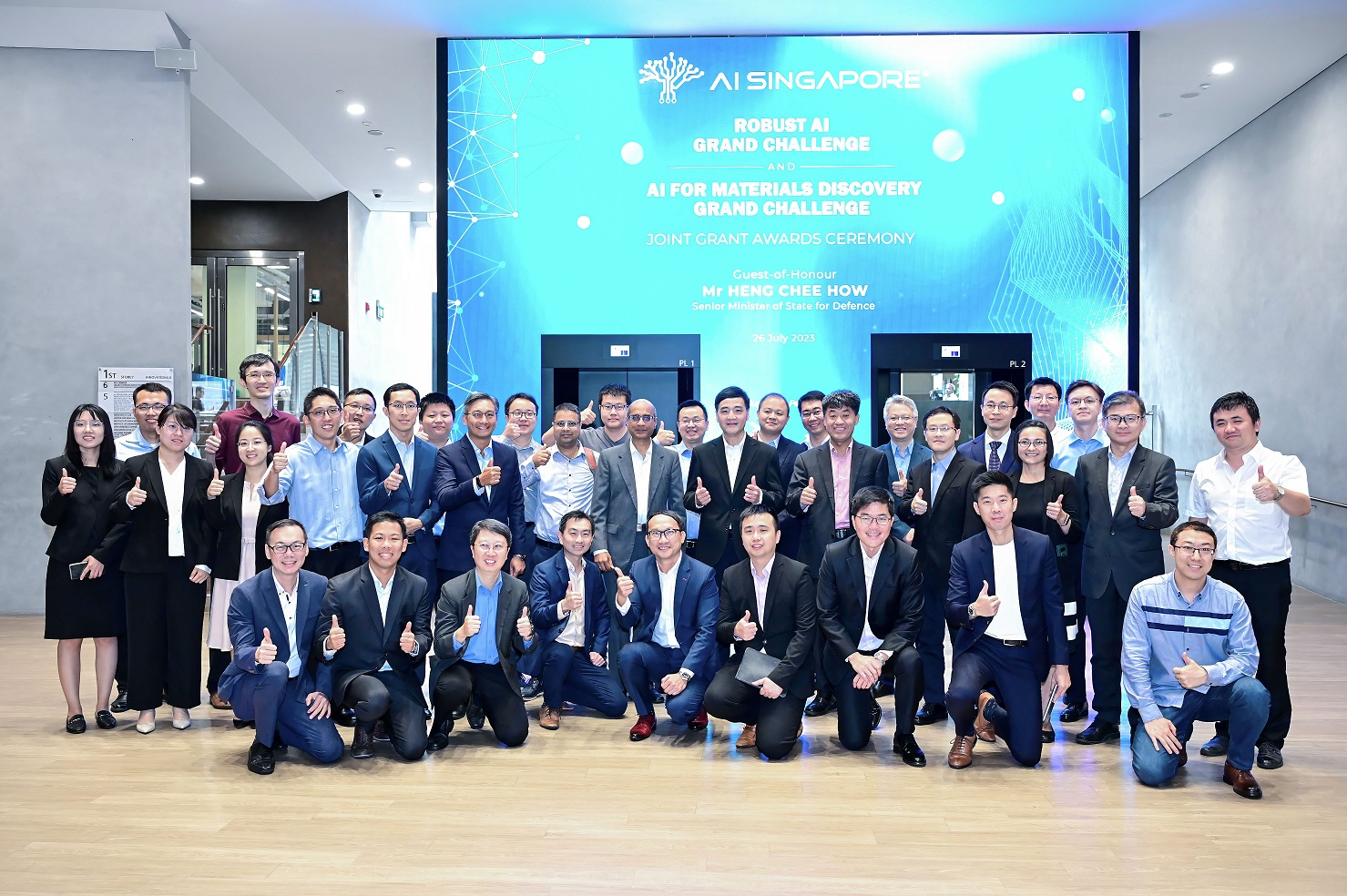
Relying on human intuition, conventional approaches to discover advanced materials for technological breakthroughs are expensive and slow. While AI could potentially shorten discovery cycles, AI in materials science is currently limited by task-specific models and narrow data ranges, often yielding only incremental improvements. The AI for Materials Discovery Grand Challenge, organised by AI Singapore in collaboration with the Future Systems and Technology Directorate, MINDEF Singapore, and DSO National Laboratories, aims to encourage the development of innovative approaches that assist scientists with efficient exploration of materials to generate high-potential candidates.
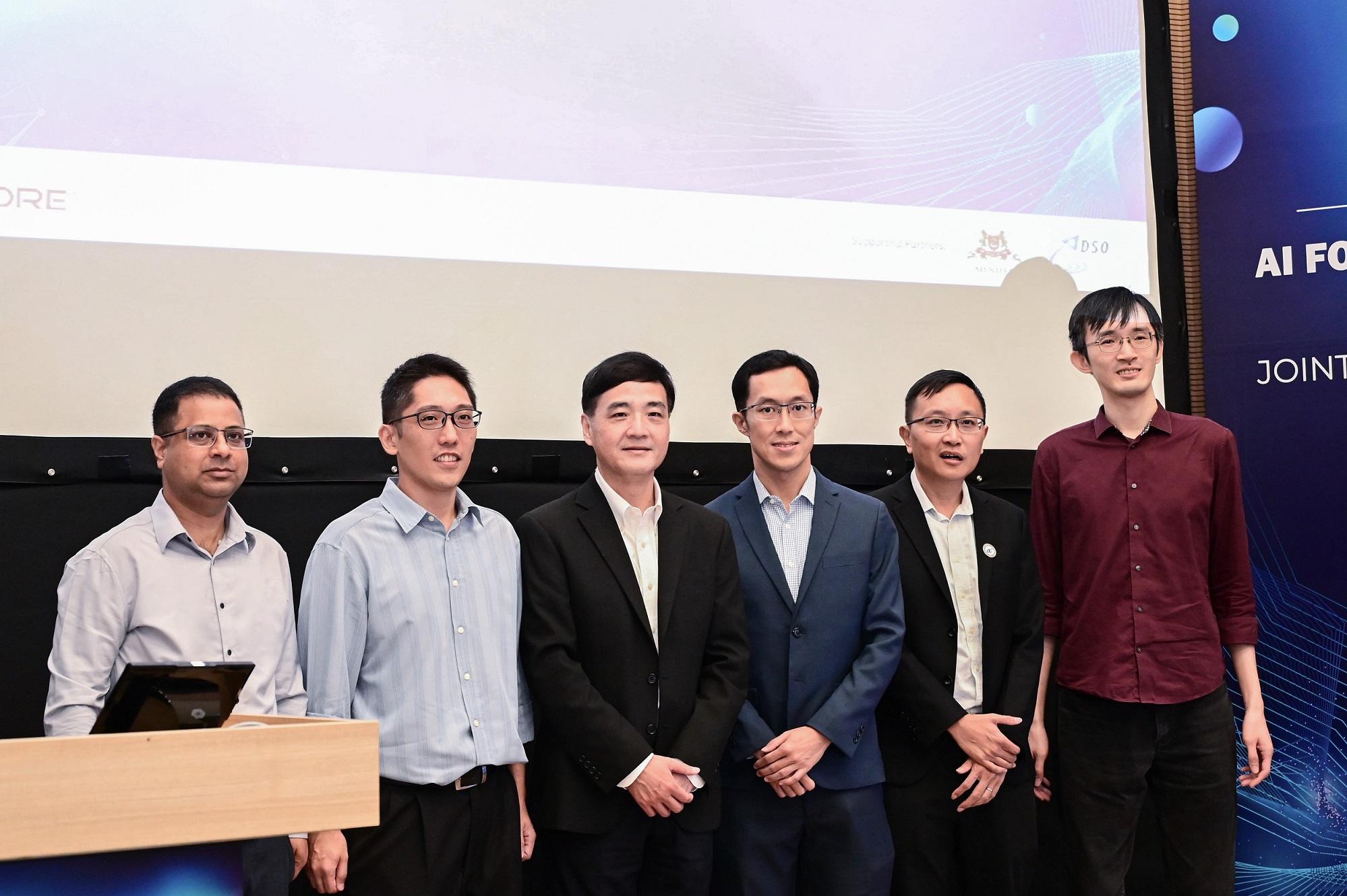 Recipient Team for project titled - Design Beyond What You Know: Material Informed Differential Generative AI (MIDGAI) for Light-Weight High-Entropy Alloys and Multi-functional Composites
(Left to Right): Dr Mohit Sharma; Dr Ng Chee Koon; Mr Heng Chee How, Senior Minister of State for Defence; Dr Tan Teck Leong; Dr Lim Yee Fun; Dr Leong Zhidong
Combining expertise in AI and materials science, researchers from CFAR, Institute of High Performance Computing (IHPC), Institute of Materials Research and Engineering (IMRE), Nanyang Technological University (NTU), and the University of California, San Diego (UCSD) will develop a Materials-Informed Differential Generative AI (MIDGAI) framework to overcome these limitations and enable the discovery of new breakthroughs in (i) advanced alloys and (ii) multifunctional composites with 50% weight reduction. The MIDGAI framework combines the strengths of two types of AI models: generative models (GMs) and discriminative models (DMs). This combination allows us to enhance robustness and overcome data scarcity, to efficiently explore a wider range of materials. Unlike existing GMs that rely on and are limited by post-hoc incorporation of expert knowledge, MIDGAI incorporates domain knowledge upfront to build a consistent design space in reduced dimensions, enabling more controllable, directed, and efficient explorations of the material design spaces through advanced optimisation algorithms.
With MIDGAI, the team aims to discover and prototype new light-weight materials that could significantly outperform current materials in terms of properties such as density, mechanical properties, thermal and electrical conductivities.
The generative AI framework can accelerate the development of novel materials by using open-source datasets and data obtained from in-house high-throughput experiments and simulations. This framework will have the potential to be generalized to different material classes and will be capable of generating novel materials that meet multiple desired properties and design criteria for various industries and applications (e.g., aerospace, transport, green buildings). This will be demonstrated on high-entropy alloys and composite materials as a start, where we aim to develop light-weight prototypes with tailored properties that are suitable for dual-use applications.
Congratulations to the team!
Principal Investigator
Prof Ivor Tsang, Director of CFAR
Co-Principal Investigators
IHPC: Prof Zhang Yong-Wei, Dr Tan Teck Leong
IMRE: Dr Lim Yee Fun, Dr Mohit Sharma, Dr Ng Chee Koon
NTU: Asst Prof Kedar Hippalgaonkar, Prof Gao Huajian, Prof Ong Yew Soon
Collaborator
UCSD: Prof Shyue Ping Ong
Photos: AI Singapore