
Ms Alicia Yap
Platform Lead (Asian Skin Biobank)
Email: alicia_yap@a-star.edu.sg
Research Themes: Biobanking, Asian skin, Skin health, Skin ageing, Skin disease, 3D skin models
Biography:
Ms Alicia Yap is the Head of Operations at the Asian Skin Biobank (ASB). She earned her Bachelor’s in Life Sciences from the National University of Singapore (NUS) and Master’s in Neuroscience from the Yong Loo Lin School of Medicine, under the NUS Research Scholarship. She then joined the Institute of Medical Biology (IMB), where she elucidated the roles of opsins and opioids in skin homeostasis and supported studies on androgenetic alopecia initiated by the Clinical Research Unit for Skin Allergy & Regeneration (CRUSAR). Trained in ISO 17025, she developed an interest in Laboratory Management and subsequently joined the IMB skin bank started by the founding Executive Director Professor Birgitte Lane. Apart from being actively involved in biobanking activities, she supervised laboratory operation, identified gaps in workflows and implemented solutions to increase efficiency and reliable outcomes. Importantly, she oversaw the development of the small, specialized bank of human skin samples into what is now known as ASB, a Ministry of Health registered tissue bank that houses a large repertoire of human skin materials from more than 150 local donors. Today, ASB serves as a bridge between clinicians and researchers to accelerate research findings, deepen understanding of Asian skin health and enable the development of new therapeutics.
Research interest:
ASB provides high quality and ethnically diverse human primary skin cells and tissues for the local and global research community. This empowers researchers to generate reproducible and functional 2D and 3D in vitro Asian skin models. In ASB, standard operating procedures (SOPs), batch records and corrective and preventive action (CAPA) are implemented. This not only ensures consistency and reproducibility in cell and tissue quality, but also addresses root causes, mitigates and prevents the recurrence of an abnormal event. Thanks to our clinical partners, ASB now hosts an extensive collection of human primary skin samples from surgical waste tissues that range from over hundreds of square centimeters to as small as one square centimeters. Skin samples from healthy local donors have helped researchers understand skin health and ageing in Asians better. ASB is now actively building a resource of biological materials derived from skin disease patients, with the vision to catalyze the development and movement of novel therapeutics from lab to market.
ASB is steadily supporting research locally and abroad. This would not have been possible without the exceptional support of the following local tertiary hospitals and institutions.
• KK Women’s and Children’s Hospital
• National Skin Centre
• National University Hospital
• Singapore General Hospital
• SingHealth Tissue Repository
• Tan Tock Seng Hospital
• Woodlands Hospital
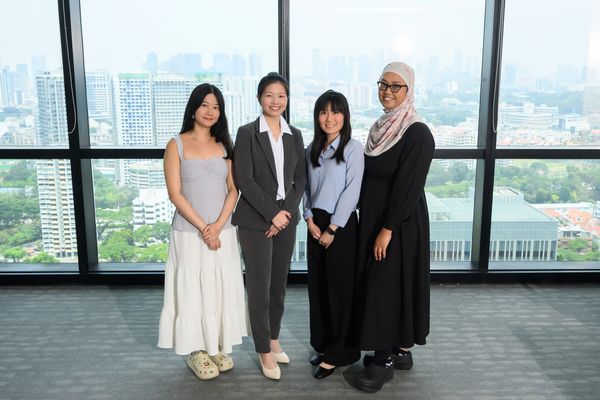
ASB Team
Left to Right:
Nathania Chan, Alicia Yap, Joycelyn Lee, Aishah Alimat
Recent publications (ASB acknowledged)
1. Chin JS, Tan MLL, Lim PLK, Sharma B, Yeo A, Aw YB, Ng YZ, Bonnard C, Becker DL, Mok P. Secretome from prolonged high-density human Wharton's jelly stem cell culture accelerates wound healing in both in vitro and in vivo models. Int Wound J. 2025 May;22(5):e70033. doi: 10.1111/iwj.70033. Erratum in: Int Wound J. 2025 Jun;22(6):e70706. doi: 10.1111/iwj.70706. PMID: 40320827; PMCID: PMC12050407.
2. Tham KC, Lim SS, Bonnard C, Common JEA. Protocol to reconstruct an in vitro 3D full-thickness skin equivalent model with collagen I in 6- and 12-well inserts. STAR
3. Tan SH, Liu S, Teoh SH, Bonnard C, Leavesley D, Liang K. A sustainable strategy for generating highly stable human skin equivalents based on fish collagen. Biomater Adv. 2024 Apr;158:213780. doi: 10.1016/j.bioadv.2024.213780. Epub 2024 Jan 24. PMID: 38280287.
4. Lim PLK, Balakrishnan Y, Goh G, Tham KC, Ng YZ, Lunny DP, Leavesley DI, Bonnard C. Automated Electrical Stimulation Therapy Accelerates Re-Epithelialization in a Three-Dimensional In Vitro Human Skin Wound Model. Adv Wound Care (New Rochelle). 2024 May;13(5):217-234. doi: 10.1089/wound.2023.0018. Epub 2024 Feb 6. PMID: 38062745.
5. Robinson KS, Toh GA, Firdaus MJ, Tham KC, Rozario P, Lim CK, Toh YX, Lau ZH, Binder SC, Mayer J, Bonnard C, Schmidt FI, Common JEA, Zhong FL. Diphtheria toxin activates ribotoxic stress and NLRP1 inflammasome-driven pyroptosis. J Exp Med. 2023 Oct 2;220(10):e20230105. doi: 10.1084/jem.20230105. Epub 2023 Aug 29. PMID: 37642997; PMCID: PMC10465786.