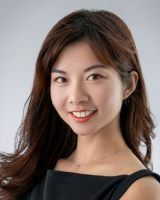
Wang Qiongqiong
Research Area
- Multimodal LLMs
- Paralinguistic AI
1. MERaLiON Team. Unlocking Cognitive Capabilities and Analyzing the Perception-Logic Trade-off. arXiv, 2026.
2. J. Wong, M. Huzaifah, H. Sailor, S. Sun, K. Tan, B. Wang, Q. Wang, W. Zhang, X. Zou, N. Chen, and A. Aw. Train Multi-modal LLM to Understand Diverse Speech Paralinguistics by Distilling from Teacher with Meta-information Prompt. AAAI, 2026.
3. J. Wong, M. Huzaifah, H. Sailor, S. Sun, K. Tan, B. Wang, Q. Wang, W. Zhang, X. Zou, N. Chen, and A. Aw. Diversity and Complementarity of Speech Encoders Across Diverse Tasks in a Multi-modal Large Language Model. ASRU, 2025.
4. Q. Wang, H. Sailor, J. Wong, T. Liu, S. Sun, W. Zhang, M. Huzaifah, N. Chen, and A. Aw. Incorporating Contextual Paralinguistic Understanding in Large Speech-Language Models. ASRU, 2025.
5. W. Zhang, Y. He, G. Lin, Z. Liu, S. Sun, B. Wang, X. Zou, J. Wong, Q. Wang, H. Sailor, N. Chen, and A. Aw. Beyond Classification: Towards Speech Emotion Reasoning with Multitask AudioLLMs. IJCNLP-ACL, 2025.
6. J. Meng, H. Sailor, Q. Wang, T. Liu, K. Lee, and X. Wang. Exploring Audio-Visual Fusion Methods in Foundation Model-Based Deception Detection. APSIPA ASC, 2025.
7. T. Liu, R. Tao, Q. Wang, Y. Jiang, H. Sailor, K. Zhang, J. Lin, and H. Li. Interpolating Speaker Identities in Embedding Space for Data Expansion. APSIPA ASC, 2025.
8. Q. Wang, H. Sailor, T. Liu, W. Zhang, M. Huzaifah, N. Lertcheva, S. Sun, N. Chen, J. Wu, and A. Aw. Benchmarking Contextual and Paralinguistic Reasoning in Speech-LLMs: A Case Study with In-the-Wild Data. Findings of EMNLP, 2025.
9. Q. Wang, H. Sailor, T. Liu, and A. Aw. Contextual Paralinguistic Data Creation for Multi-Modal Speech-LLM: Data Condensation and Spoken QA Generation. Interspeech, 2025.
10. M. Huzaifah, G. Lin, T. Liu, H. Sailor, K. Tan, T. Vangani, Q. Wang, J. Wong, J. Wu, N. Chen, and A. Aw. MERaLiON-SpeechEncoder: Towards a Speech Foundation Model for Singapore and Beyond. arXiv, 2024.
11. M. Huzaifah, T. Liu, H. Sailor, K. Tan, T. Vangani, Q. Wang, J. Wong, N. Chen, and A. Aw. Towards a Speech Foundation Model for Singapore and Beyond. arXiv, 2024.
12. Q. Wang, H. Sailor, K. Lee, K. Ma, K. Goh, and W. Boh. Using Twitter Dataset for Social Listening in Singapore. IEEE Access, 2024.
13. T. Liu, K. Lee, Q. Wang, and H. Li. Golden Gemini is All You Need: Finding the Sweet Spots for Speaker Verification. IEEE/ACM Transactions on Audio, Speech, and Language Processing (TASLP), 2024.
14. Q. Wang and K. Lee. Cosine Scoring with Uncertainty for Neural Speaker Embedding. IEEE Signal Processing Letters, 2024.
15. T. Liu, I. Kukanov, Z. Pan, Q. Wang, H. Sailor, and K. Lee. Towards Quantifying and Reducing Language Mismatch Effects in Cross-Lingual Speech Anti-Spoofing. IEEE Spoken Language Technology Workshop (SLT), 2024.
16. A. Guragain, T. Liu, Z. Pan, H. Sailor, and Q. Wang. Speech Foundation Model Ensembles for the Controlled Singing Voice Deepfake Detection Challenge 2024. IEEE Spoken Language Technology Workshop (SLT), 2024.
17. Z. Pan, T. Liu, H. Sailor, and Q. Wang. Attentive Merging of Hidden Embeddings from Pre-trained Speech Model for Anti-spoofing Detection. Interspeech, 2024.
18. T. Liu, K. Lee, Q. Wang, and H. Li. Disentangling Voice and Content with Self-supervision for Speaker Recognition. NeurIPS, 2023.
19. Q. Wang, K. Lee, and T. Liu. Incorporating Uncertainty from Speaker Embedding Estimation to Speaker Verification. ICASSP, 2023.
20. Q. Wang, K. Okabe, K. Lee, and T. Koshinaka. Generalized Domain Adaptation Framework for Parametric Back-End in Speaker Recognition. IEEE Transactions on Information Forensics and Security (TIFS), 2023.
21. K. Lee et al. I4U System Description for NIST SRE'20 CTS Challenge. arXiv, 2022.
22. Q. Wang, K. Lee, and T. Liu. Scoring of Large-Margin Embeddings for Speaker Verification: Cosine or PLDA? Interspeech, 2022.
23. K. Lee, Q. Wang, and T. Koshinaka. Xi-vector Embedding for Speaker Recognition. IEEE Signal Processing Letters, 2021.
24. Q. Wang, K. Lee, T. Koshinaka, K. Okabe, and H. Yamamoto. Task-aware Warping Factors in Mask-based Speech Enhancement. EUSIPCO, 2021.
25. K. Lee, H. Yamamoto, K. Okabe, Q. Wang, L. Guo, T. Koshinaka, J. Zhang, and K. Shinoda. NEC-TT System for Mixed-Bandwidth and Multi-Domain Speaker Recognition. Computer Speech & Language, 2020.
26. K. Lee, K. Okabe, H. Yamamoto, Q. Wang, L. Guo, T. Koshinaka, J. Zhang, K. Ishikawa, and K. Shinoda. NEC-TT Speaker Verification System for SRE'19 CTS Challenge. Interspeech, 2020.
27. Q. Wang and K. Lee. Using Multi-resolution Feature Maps with Convolutional Neural Networks for Anti-spoofing in ASV. Odyssey Speaker and Language Recognition Workshop, 2020.
28. Q. Wang, K. Okabe, K. Lee, and T. Koshinaka. A Generalized Framework for Domain Adaptation of PLDA in Speaker Recognition. ICASSP, 2020.
29. K. Lee et al. I4U Submission to NIST SRE 2018: Leveraging from a Decade of Shared Experiences. Interspeech, 2019.
30. K. Lee, H. Yamamoto, K. Okabe, Q. Wang, L. Guo, T. Koshinaka, J. Zhang, and K. Shinoda. The NEC-TT 2018 Speaker Verification System. Interspeech, 2019.
31. K. Lee, Q. Wang, and T. Koshinaka. The CORAL+ Algorithm for Unsupervised Domain Adaptation of PLDA. ICASSP, 2019.
32. Q. Wang, K. Okabe, K. Lee, H. Yamamoto, and T. Koshinaka. Attention Mechanism in Speaker Recognition: What Does It Learn in Deep Speaker Embedding? IEEE Spoken Language Technology Workshop (SLT), 2018.
33. Q. Wang, K. Okabe, S. Mahto, and K. Takafumi. Investigation of Speaker Verification Performance Using Air and Ear Microphones in Various Acoustic Conditions. IEICE Society Conference, 2018.
34. Q. Wang and T. Koshinaka. Unsupervised Discriminative Training of PLDA for Domain Adaptation in Speaker Verification. Interspeech, 2017.
35. Q. Wang and K. Shinoda. A Regression Approach to Emotion Estimation in Spontaneous Speech. Acoustical Society of Japan (ASJ) Autumn Meeting, 2016.
36. Q. Wang, H. Yamamoto, and T. Koshinaka. Domain Adaptation Using Maximum Likelihood Linear Transformation for PLDA-Based Speaker Verification. ICASSP, 2016.