BII
  • About
    • Overview
    • Executive Director's Message
    • BII Yearbooks
  • People
    • Principal Investigators
    • Early Career Researchers
      • Research Focus
    • Adjunct Scientists
    • Biocomputing Centre
    • Corporate Services
    • Business Development
  • Research
    • Overview
    • Biomolecular Sequence to Function Division
      • Computational Biology & Omics Lab
      • Function and Structure of RNA
      • Protein Sequence Analysis
      • Molecular Innovations and AI Integrations
      • Systems and Synthetic Biology
    • Biomolecular Structure to Mechanism Division
      • Atomistic Simulations and Design in Biology
      • Computational Chemical Biology and Fragment-Based Design
      • Multiscale Simulation, Modelling and Design
      • Physics and Evolution of Biological Macromolecules
      • Structure-based Ligand Discovery and Design
    • Cellular Image Informatics Division
      • Complex Cellular Phenotype Analysis
      • Intelligent Digital and Molecular Pathology 
      • Computer Vision and Pattern Discovery
      • Single-Cell Multi/Spatial-Omics and Precision Immunology
      • Advanced Spatial Omics with Quantum and Generative AI
    • BioMedical DataHub Division
      • BioMedical Data Architecture & Repository
      • Clinical Data Engagement
      • Research Data Integration
      • Data Science for Population Health
      • Data Management 
  • Media
    • BII Highlights
    • BII PI Seminar Day 2021
    • BII Scientific Conference 2022
    • BII Scientific Conference 2023
    • BII Scientific Conference 2024
  • Publications
  • More+
    • Join Us
      • Careers
      • Graduate Research
      • Internship Opportunities
    • Webtools
    • Contact Us
    • BII For Industry Partners
      • BII software for commercial licensing
  • Home
  • A*STAR BII
  • Media
  • BII Highlights
  • Feature
  • About
    • Overview
    • Executive Director's Message
    • BII Yearbooks
  • People
    • Principal Investigators
    • Early Career Researchers
      • Research Focus
    • Adjunct Scientists
    • Biocomputing Centre
    • Corporate Services
    • Business Development
  • Research
    • Overview
    • Biomolecular Sequence to Function Division
      • Computational Biology & Omics Lab
      • Function and Structure of RNA
      • Protein Sequence Analysis
      • Molecular Innovations and AI Integrations
      • Systems and Synthetic Biology
    • Biomolecular Structure to Mechanism Division
      • Atomistic Simulations and Design in Biology
      • Computational Chemical Biology and Fragment-Based Design
      • Multiscale Simulation, Modelling and Design
      • Physics and Evolution of Biological Macromolecules
      • Structure-based Ligand Discovery and Design
    • Cellular Image Informatics Division
      • Complex Cellular Phenotype Analysis
      • Intelligent Digital and Molecular Pathology 
      • Computer Vision and Pattern Discovery
      • Single-Cell Multi/Spatial-Omics and Precision Immunology
      • Advanced Spatial Omics with Quantum and Generative AI
    • BioMedical DataHub Division
      • BioMedical Data Architecture & Repository
      • Clinical Data Engagement
      • Research Data Integration
      • Data Science for Population Health
      • Data Management 
  • Media
    • BII Highlights
    • BII PI Seminar Day 2021
    • BII Scientific Conference 2022
    • BII Scientific Conference 2023
    • BII Scientific Conference 2024
  • Publications
  • Join Us
    • Careers
    • Graduate Research
    • Internship Opportunities
  • Webtools
  • Contact Us
  • BII For Industry Partners
    • BII software for commercial licensing
Agency for Science, Technology and Research (A*STAR)
PartnershipsCareersSuppliersContact UsWhistleblowing
  • Report Vulnerability
  • Privacy Statement
  • Terms & Conditions
  • Featured

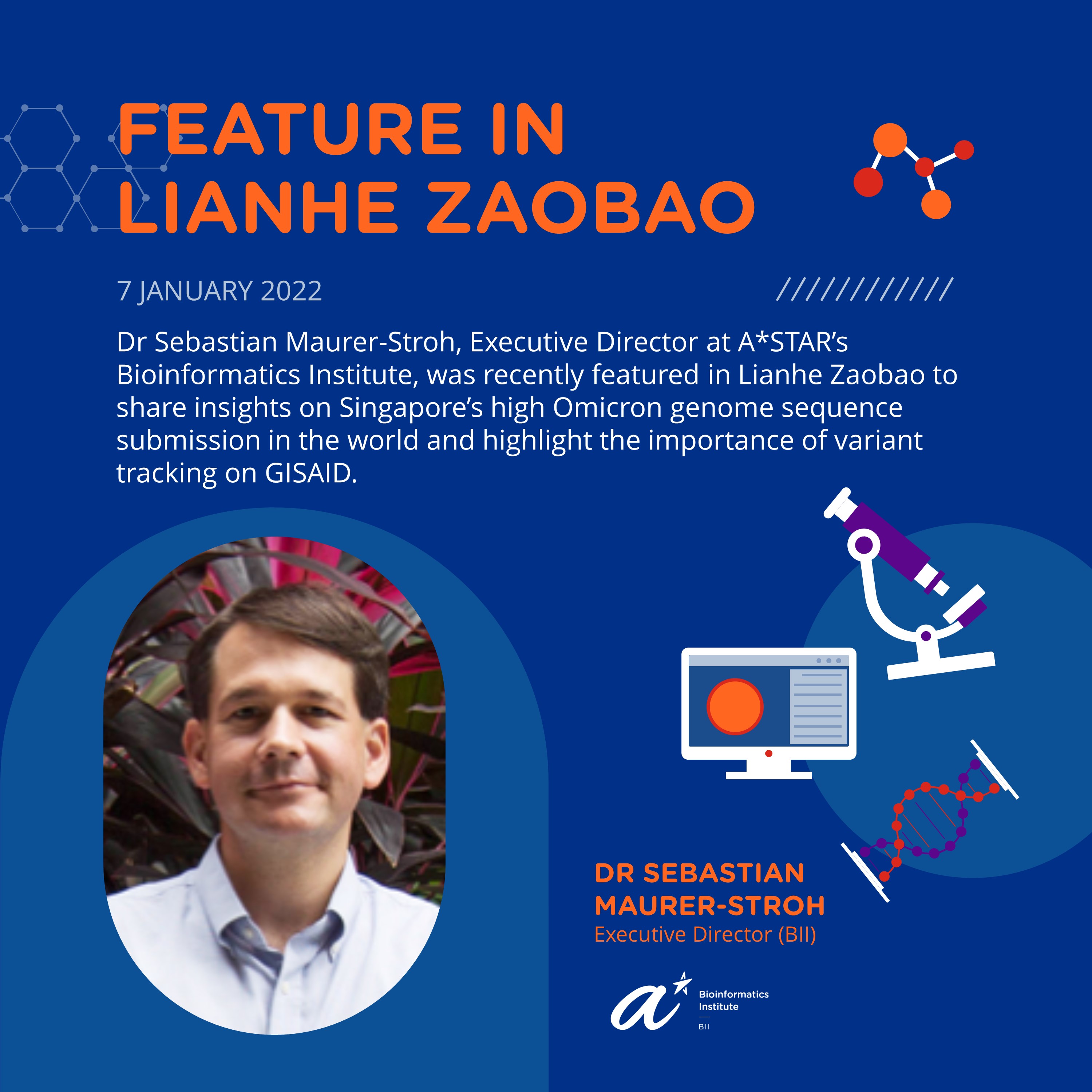
    Lianhe Zaobao Feature - Sebastian Maurer-Stroh
    07 Jan 2022
    • Whatsapp
    • Telegram
    • Facebook
    • Twitter
    • Email
    • Linked In

    Feature Lianhe Zaobao_Sebastian_7 Jan 2022

    Nearly half of the local virus gene sequences in the past four weeks are Omicron.


    Singapore submitted a total of 387 Omicron genome sequences to the global GISAID database in the past four weeks, accounting for 48.3% of all sequences submitted. Singapore is ranked 18th in the world with the most Omicron genome sequences submissions.


    Dr Sebastian Maurer-Stroh, Executive Director at A*STAR’s Bioinformatics Institute, explained that the number of genome sequences submitted by Singapore does not reflect all the COVID-19 cases in Singapore. The genome sequences include imported and locally transmitted cases, and the majority of the Omicron cases detected have been from travellers so far.


    He pointed out that in December last year, the number of genome sequences submitted to GISAID in a single month had exceeded 1 million worldwide, surpassing the total number in the first year of the pandemic. "The tracking of Omicron strains can assist international public health policy makers to map and observe the speed and pattern of transmission of the Omicron variant.," he said. "It is important to know which variant the patients have been infected with to judge the relative severity of the variant. This data is coming through now and will guide new rules or responses.”


    Also reported in: Lianhe Zaobao Online (View)