Research Spotlight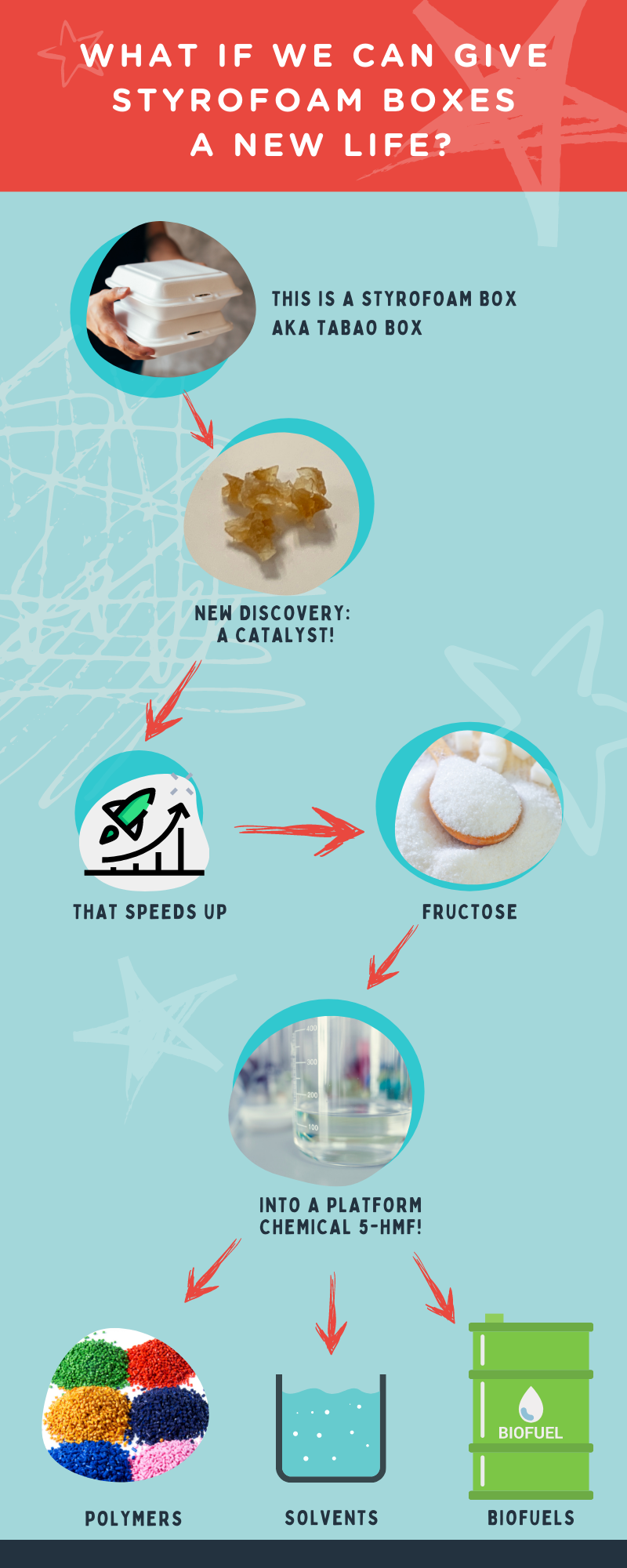 Polystyrene (PS) is a non-biodegradable plastic that is commonly used for food packaging as Styrofoam boxes. Instead of being disposed of in landfills or incinerated after use, IMRE's scientists wondered if they could make use of Styrofoam boxes from used food packaging and give these waste plastics a new lease of life by turning them into more valuable catalysts.
This process of converting waste to value-added products is called upcycling or valorisation. IMRE's team of scientists, led by Dr. Jason Lim, was particularly keen on converting the polystyrene into catalysts that are beneficial for the synthesis of other industrially useful chemicals. This is an application that is still unexplored for upcycled Polystyrene. The chemistry to turn waste Polystyrene into catalysts was also straightforward and quick to perform. The team decided to use the Polystyrene-derived catalysts to transform fructose (a common sugar) into the chemical 5-hydroxymethylfurfural (5-HMF), which can be used as a precursor for many useful products such as solvents and polymers.
What are the potential applications for this technology?
The team showed that one of the catalysts derived from polystyrene could be reused up to four times to convert fructose to 5-HMF, further improving the sustainability. The easy availability of abundant Polystyrene from food packaging also potentially allows it to be used for large-scale conversion of fructose to 5-HMF. The lack of heavy metals in the catalyst design also makes it more environmentally benign. These Polystyrene-derived catalysts contain acidic functional groups, and hence can potentially be used to catalyse other chemical transformations and are not limited to 5-HMF formation.
For more information, read the full publication on ScienceDirect
A New Life for Waste Polystyrene: a versatile system for biomass conversion
15 Sep 2021
Polystyrene (PS) is a non-biodegradable plastic that is commonly used for food packaging as Styrofoam boxes. Instead of being disposed of in landfills or incinerated after use, IMRE's scientists wondered if they could make use of Styrofoam boxes from used food packaging and give these waste plastics a new lease of life by turning them into more valuable catalysts.This process of converting waste to value-added products is called upcycling or valorisation. IMRE's team of scientists, led by Dr. Jason Lim, was particularly keen on converting the polystyrene into catalysts that are beneficial for the synthesis of other industrially useful chemicals. This is an application that is still unexplored for upcycled Polystyrene. The chemistry to turn waste Polystyrene into catalysts was also straightforward and quick to perform. The team decided to use the Polystyrene-derived catalysts to transform fructose (a common sugar) into the chemical 5-hydroxymethylfurfural (5-HMF), which can be used as a precursor for many useful products such as solvents and polymers.
What are the potential applications for this technology?
The team showed that one of the catalysts derived from polystyrene could be reused up to four times to convert fructose to 5-HMF, further improving the sustainability. The easy availability of abundant Polystyrene from food packaging also potentially allows it to be used for large-scale conversion of fructose to 5-HMF. The lack of heavy metals in the catalyst design also makes it more environmentally benign. These Polystyrene-derived catalysts contain acidic functional groups, and hence can potentially be used to catalyse other chemical transformations and are not limited to 5-HMF formation.
For more information, read the full publication on ScienceDirect