IMRE
  • About Us
    • Message From Executive Director
    • Mission, Vision & Core Values
    • Leadership Team
  • Research Departments
    • Advanced Biomaterials
    • Advanced Characterisation and Instrumentation
    • Advanced Optical Technologies
    • Electronic Materials
    • Energy Materials
    • National Quantum Federated Foundry
    • Polymer Composite
    • Sensors & Flexible Electronics
    • Structural Materials
  • News and Highlights
    • Accolades
    • Features
    • Press Releases
    • Publicity Highlights
    • Research Spotlight
  • A*STAR IMRE Events
  • ARAP with A*STAR IMRE
  • Contact Us
  • Home
  • A*STAR IMRE
  • News and Highlights
  • Research Spotlight
  • A*STAR IMRE
  • About Us
    • Message From Executive Director
    • Mission, Vision & Core Values
    • Leadership Team
  • Research Departments
    • Advanced Biomaterials
    • Advanced Characterisation and Instrumentation
    • Advanced Optical Technologies
    • Electronic Materials
    • Energy Materials
    • National Quantum Federated Foundry
    • Polymer Composite
    • Sensors & Flexible Electronics
    • Structural Materials
  • News and Highlights
    • Accolades
    • Features
    • Press Releases
    • Publicity Highlights
    • Research Spotlight
  • A*STAR IMRE Events
  • ARAP with A*STAR IMRE
  • Contact Us
Agency for Science, Technology and Research (A*STAR)
PartnershipsCareersSuppliersContact UsWhistleblowing
  • Report Vulnerability
  • Privacy Statement
  • Terms & Conditions
  • Research Spotlight

    Producing colorful 3D prints without dyes or pigments
    25 Sep 2019
    • Whatsapp
    • Telegram
    • Facebook
    • Twitter
    • Email
    • Linked In

    Structural color 3D printing by shrinking photonic crystals

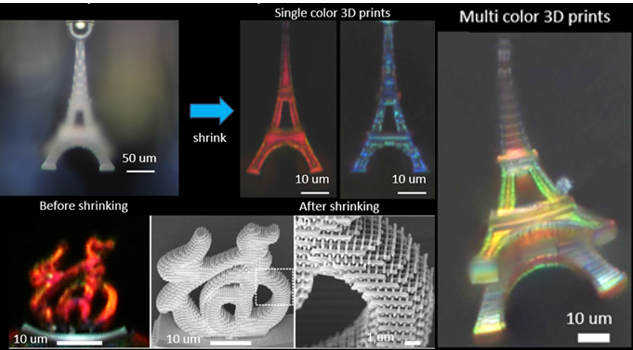
    Led by Assoc. Prof. Joel Yang, researchers from IMRE, SUTD, NUS and Caltech have collaborated in an interesting discovery of generating highly miniaturized yet colorful 3D printed objects without pigments or dyes. Instead, the team relied on structural color. Compared with pigments and dyes relying on chemical composition, structural colours are high-resolution, permanent, and eco-friendly. One could learn from some butterflies and beetles which have evolved to derive complex colors and patterns by nanostructuring biopolymers.

    They printed, among other models, probably the world’s smallest colorful 3D model of the Eiffel Tower. The 3D models are made of a finely printed mesh of transparent polymer, forming photonic crystals. These mostly hollow designs start off colorless but remarkably shrink down in size by about 5 times when heated and produce a wide range of colours in the process. These 3D prints were produced using a method called two-photon polymerization lithography (TPL) that employs femtosecond pulsed lasers focused to a tight spot and scanned in all 3 dimensions to create complex geometry.

    Reference:
    Yejing Liu et al., "Structural color three-dimensional printing by shrinking photonic crystals", Nature Communications 10, 4340 (2019)

    Link to online version of paper in Nature Communications.