
NEWS AND EVENTS
Launch of A*STAR SIFBI AND NUS Synthetic Biology Joint Lab
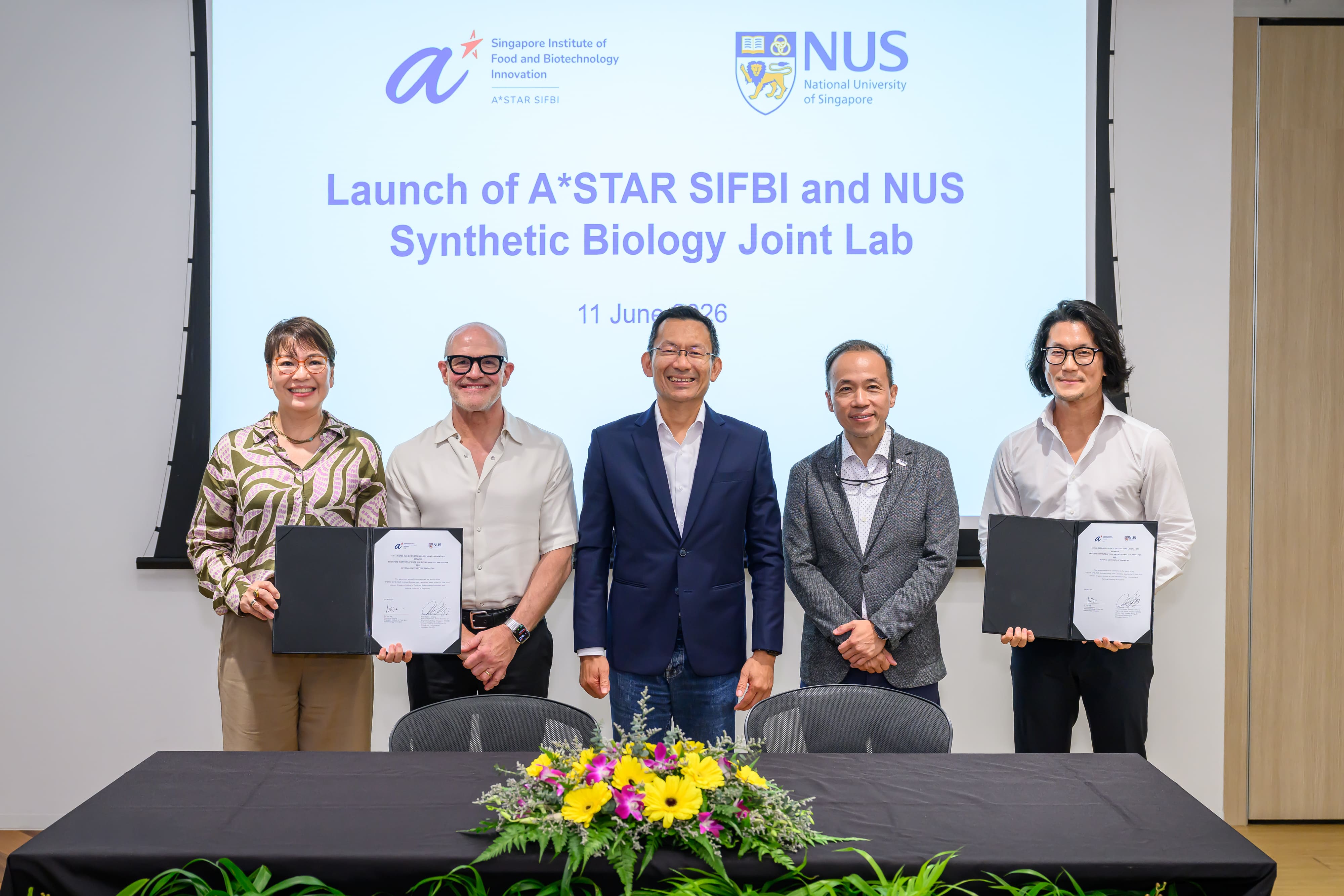
11 JUNE 2026
A*STAR AND NUS LAUNCH JOINT LAB TO ACCELERATE TRANSLATION OF SYNTHETIC BIOLOGY INTO REAL-WORLD APPLICATIONS
SINGAPORE – As industries seek more sustainable ways to produce ingredients, chemicals and materials, synthetic biology is opening up new routes to make useful compounds by engineering biological systems such as microbes and enzymes. The Agency for Science, Technology and Research (A*STAR) and the National University of Singapore (NUS) have launched a joint laboratory to help turn these research advances into commercially viable products.
The launch comes as global demand for such bio-based alternatives accelerates. The bioeconomy is projected to contribute up to US$4 trillion annually within the next decade, driven by a broad shift away from petrochemical-based production[1].
The new A*STAR SIFBI-NUS Synthetic Biology Joint Lab is established by the A*STAR Singapore Institute of Food and Biotechnology Innovation (A*STAR SIFBI) and the NUS Synthetic Biology for Clinical and Technological innovation (NUS SynCTI). It will support efforts to strengthen translation in emerging technologies and grow the bioeconomy.
The joint laboratory brings together A*STAR SIFBI's capabilities in bioprocess development and scale-up, and NUS' strengths in fundamental science, interdisciplinary research and talent development. Its initial focus will be on nutrition and consumer care, with broader applications spanning advanced materials and health. It will support companies in co-developing testing and validating sustainable, synthetic alternatives to conventional chemical manufacturing.
A*STAR Chief Executive Officer, Mr Beh Kian Teik, said, “For Singapore to capture opportunities in the bioeconomy, we need to move strong science closer to market. This joint lab is one way A*STAR and NUS are closing that gap, by working with industry to develop bio-based solutions that can be scaled into products, including for ingredients, chemicals and materials.”
Led by Professor Jay Keasling, a pioneer in synthetic biology, the joint lab will focus on three areas to accelerate industry translation:
- Faster design: AI-guided enzyme and pathway engineering to shorten development timelines
- Scalable production: Industrially deployable microbial platforms to produce complex molecules at scale
- New molecules: Access to novel bio-based compounds for ingredients and functional applications
Further details are provided in Annex A.
Strengthening Singapore’s Role in the Emerging Bioeconomy
The bioeconomy encompasses industries that use biological systems and biotechnology to produce chemicals, ingredients and materials. It is reshaping how goods are made at a fundamental level. The global market for bio-based chemicals alone is expected to exceed US$200 billion by 2030, while synthetic biology, a key enabling technology, is projected to grow to over US$60 billion in 2030[2],[3].
This shift is evident in the food and nutrition space where bio-based ingredients are opening up vast new catalogues of sustainable sources. This transition allows industry players to strengthen their supply chains by diversifying the source of their ingredients and embracing the latest technologies. For example, in the production of ingredients such as omega-3 lipids, companies are reducing reliance on imported marine sources. Advances in synthetic biology, combined with artificial intelligence (AI) and large-scale data analysis, are accelerating the discovery and production of complex molecules that were previously difficult to make at commercial scale.
Mr Jermaine Loy, Managing Director of the Singapore Economic Development Board said, “As the chemicals sector adopts greener alternatives, industrial biotechnology offers companies a credible pathway to diversify raw material sources and develop novel, sustainable products. The A*STAR SIFBI-NUS Synthetic Biology Joint Lab will strengthen Singapore's capabilities in this emerging area, bringing together world-class R&D and industry translation to advance bioeconomy innovation from Singapore.”
Building the Next Generation of Talent
Beyond research and industry engagement, the lab will serve as a training ground for Singapore's future scientists and engineers in areas such as synthetic biology, metabolic engineering, AI-guided biological design, and industrial biomanufacturing. Joint supervision arrangements, internships and fellowships are designed to develop researchers who can operate at the interface of academia and industry. Professionals with such skills are increasingly in demand as more companies build in-house biotechnology capabilities.
"NUS brings strengths in foundational science and interdisciplinary research. Especially relevant to this joint lab is our strong and established research track record and presence in the synthetic biology space, an example being NUS SynCTI," said Professor Aaron Thean, NUS Deputy President (Academic Affairs) and Provost. "The joint lab gives our scientists a direct pathway to translate their work into practical outcomes, while equipping students and early-career researchers with valuable skills needed to operate across research and industry settings."
Over time, the lab aims to catalyse technology licensing, start-up formation and new partnerships to build a pipeline of talent and ideas that will support the long-term growth of Singapore's bio-based innovation ecosystem.
– END –
About the Agency for Science, Technology and Research (A*STAR)
The Agency for Science, Technology and Research (A*STAR) is Singapore's lead public sector R&D agency. Through open innovation, we collaborate with our partners in both the public and private sectors to benefit the economy and society. As a Science and Technology Organisation, A*STAR bridges the gap between academia and industry. Our research creates economic growth and jobs for Singapore, and enhances lives by improving societal outcomes in healthcare, urban living, and sustainability. A*STAR plays a key role in nurturing scientific talent and leaders for the wider research community and industry. A*STAR’s R&D activities span biomedical sciences to physical sciences and engineering, with research entities primarily located in Biopolis and Fusionopolis. For ongoing news, visit www.a-star.edu.sg.
Follow us on
Facebook | LinkedIn | Instagram | YouTube | TikTok
About A*STAR Singapore Institute of Food and Biotechnology Innovation (A*STAR SIFBI)
A*STAR Singapore Institute of Food and Biotechnology Innovation (A*STAR SIFBI) is a translational institute dedicated to being an innovation engine for health and well-being, with a focus on the Asian phenotype. We leverage our core capabilities in synthetic biology, food science, and digestive health to develop innovative solutions for nutrition and consumer care. These innovations translate into impactful outcomes in proactive health, including value-added ingredients such as nutraceuticals and bioactives through biomanufacturing, supporting national priorities in food resilience and healthy longevity. Our two strategic pillars are: 1) Sustainable value-added ingredients innovation, and 2) Optimizing health and wellbeing in Asian phenotype. Through strategic public-private partnerships, both locally and globally, SIFBI's innovations contribute to a healthier and more resilient future. Learn more about SIFBI.
About the National University of Singapore (NUS)
The National University of Singapore (NUS) is Singapore’s flagship university, which offers a global approach to education, research and entrepreneurship, with a focus on Asian perspectives and expertise. We have 15 colleges, faculties and schools across three campuses in Singapore, with more than 40,000 students from 100 countries enriching our vibrant and diverse campus community. We have also established more than 20 NUS Overseas Colleges entrepreneurial hubs around the world.
Our multidisciplinary and real-world approach to education, research and entrepreneurship enables us to work closely with industry, governments and academia to address crucial and complex issues relevant to Asia and the world. Researchers in our faculties, research centres of excellence, corporate labs and more than 30 university-level research institutes focus on themes that include energy; environmental and urban sustainability; treatment and prevention of diseases; active ageing; advanced materials; risk management and resilience of financial systems; Asian studies; and Smart Nation capabilities such as artificial intelligence, data science, operations research and cybersecurity.
For more information on NUS, please visit nus.edu.sg.
About NUS Synthetic Biology for Clinical and Technological Innovation (NUS SynCTI)
The National University of Singapore Synthetic Biology for Clinical and Technological Innovation (NUS SynCTI) is the focal research entity for synthetic biology at NUS. NUS SynCTI operates as a highly interdisciplinary research centre that amalgamates leading Principal Investigators from the NUS Yong Loo Lin School of Medicine, Faculty of Science, College of Design and Engineering, School of Computing and Faculty of Arts and Social Sciences. Through research collaborations with renowned international institutes and the industry, NUS SynCTI strives to create new knowledge and develop foundational technologies in synthetic biology and groom future generations of highly skilled researchers endowed with basic science and translational research capabilities.
For more information on NUS SynCTI, please visit syncti.org.
Annex A: About the A*STAR SIFBI-NUS Synthetic Biology Joint Lab
Unlike conventional research labs that focus mainly on discovery or manufacturing, the joint lab is designed to connect both ends of the process. The joint lab will help companies move from identifying promising biological routes to testing whether these can work at pilot scale. Its work will focus on three areas:
- Faster design: AI-guided enzyme and pathway engineering
The lab brings together machine learning and biological data, allowing scientists to identify the most promising design to test and prioritise. By reducing the need for lengthy trial-and-error, it significantly shortens development timelines from months to weeks or minutes[4],[5], enabling companies to move faster from concept to validated candidates and reducing the time and cost to bring new products to market.
- Scalable production: Industrially deployable fungal host systems
The lab enables the development of engineered fungal “cell factories” that can produce complex molecules efficiently from simple nutrients. Designed to be scalable, the platform can be readily adopted across applications from ingredients to consumer care and advanced materials, allowing companies to integrate it directly into product development without costly redevelopment.
- New molecules: Access to novel bio-based compounds
The lab engineers fungal systems to generate novel molecules, compounds found in many clinically important drugs and functional ingredients, opening access to a new class of ingredients and bioactives that were previously too complex or costly to produce commercially.
The lab will be led by Professor Jay Keasling as Lead Principal Investigator. He is a professor at the University of California, Berkeley, and is widely credited with pioneering the use of yeast to produce complex molecules. His lab continues to advance technologies that convert renewable resources into biofuels, bioproducts, and next-generation bioactives.
[1] NatureFinance and Getúlio Vargas Foundation. The Global Bioeconomy: Preliminary Stocktake of G20 Strategies and Practices: A Contribution to the Brazilian G20 Presidency’s Global Initiative on Bioeconomy. Prepared for the G20 Initiative on Bioeconomy (GIB), May 2024.
[2] Green Chemicals Global Overview 2024–2030. Research and Markets, November 2024.
[3] The Business Research Company. Synthetic Biology Market Report 2026. Published January 2026.
[4] Singh, N., Lane, S., Yu, T. et al. A generalized platform for artificial intelligence-powered autonomous enzyme engineering. Nat Commun 16, 5648 (2025).
[5] Rapp, J.T., Bremer, B.J. & Romero, P.A. Self-driving laboratories to autonomously navigate the protein fitness landscape. Nat Chem Eng 1, 97–107 (2024).
A*STAR celebrates International Women's Day
From groundbreaking discoveries to cutting-edge research, our researchers are empowering the next generation of female science, technology, engineering and mathematics (STEM) leaders.
Get inspired by our #WomeninSTEM