Plasma Physics, Diagnostics & Interactions
To enable commercial fusion power, FEAT is developing technologies and predictive capabilities to sustain high-performance fusion plasmas for longer durations. This requires accurate measurement and control of the plasma, efficient heating and current drive, and effective management of heat and particle exhaust. Our work spans reactor-compatible plasma diagnostics and data analysis to support plasma monitoring, modelling of microwave heating and current drive, and plasma-material interactions linking plasma conditions to material erosion. Together, these capabilities address key challenges in the reliable and sustained operation of future fusion power plants.
Plasma Diagnostics
We are developing reactor-compatible plasma diagnostic systems and analysis methods to measure and reconstruct key plasma parameters for fusion experiments. We combine diagnostic system design, physics-based modelling and data-driven approaches to enable real-time assessment of plasma behaviour and detailed post-mortem analysis. Our work spans diagnostic hardware development and optimization, synthetic diagnostics, and artificial intelligence for plasma state reconstruction and prediction.
Core Capabilities:
- Microwave diagnostics, including Doppler backscattering (DBS), reflectometry, electron-cyclotron emission (ECE), interferometry
- Diagnostic hardware design, integration and optimisation
- Diagnostic modelling and synthetic diagnostics
- Signal processing and plasma parameter reconstruction
- AI for fusion plasma analysis and prediction
- Plasma heating and current drive systems
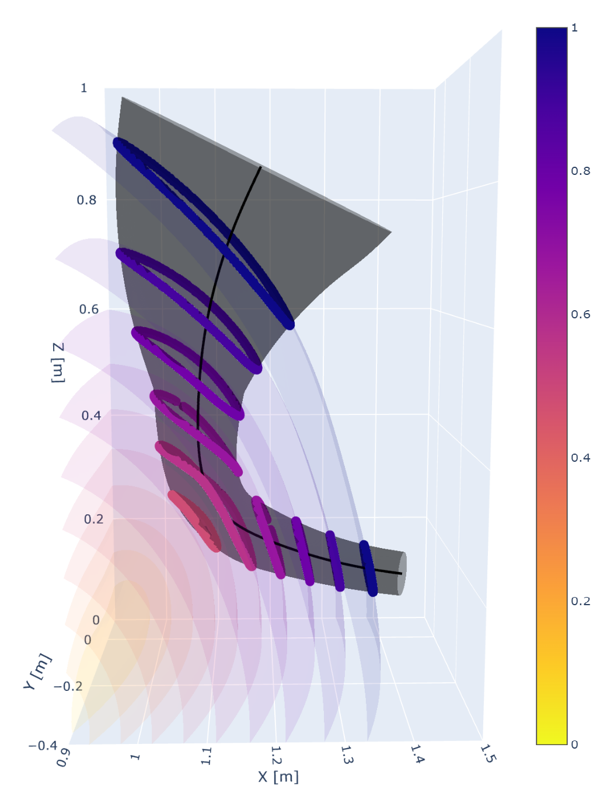
A beam-tracing simulation of a Gaussian beam propagating through a tokamak plasma, calculated by the Scotty Code
Plasma-Material Interactions
Future fusion devices must sustain intense particle and heat loads without excessive damage to plasma-facing surfaces or contamination of the plasma by eroded material. We address this challenge by developing predictive capabilities to connect plasma edge and divertor conditions with material response, erosion, impurity generation and transport, and ultimately predict their consequences on plasma performance and component lifetime.
Core Capabilities:
- Integrated plasma-material interaction modelling
- Edge, scrape-off layer and sheath modelling
- Plasma-facing material erosion and sputtering prediction
- Atomistic modelling of plasma-material interactions using Monte Carlo and molecular dynamics
- Impurity transport and redeposition modelling
- Data-driven surrogate models for rapid prediction