NMC
  • About A*STAR NMC
    • NMC Leadership Team
    • Organisation Chart
    • SI Units Realisation
    • National Measurement System
      • International Participation
  • Research & Development
    • Collaborations
      • Natural gas transmission pipeline leakage detection (Collaborators – SP Powergrid & NUS)
      • Real-time Monitoring and Characterization of Particle Count and Indoor Environmental Quality with Integrated Low-cost Sensors (Collaborator – BCA)
      • Traceable Characterisation of Internal Surface Roughness
      • Dimensional Measurement of Internal Features of Additive Manufacturing Parts
    • Laboratories
      • Acoustics and Vibration
      • Chemical
      • Mass & Force
      • Pressure & Flow
      • Temperature and Humidity
      • Electrical
      • Length and Dimensional
      • Optical Radiation
      • Time & Frequency
      • RF & Microwave
  • Service & Consultancy
    • Calibration & Measurement
    • Measurement Skills Training Courses
    • Proficiency Testing
    • Technical Assessments
  • World Metrology Day 2026
  • News & Articles
    • Media Highlights
    • Research Spotlight
    • Accolades
    • Events
  • Contact Us
    • Students
  • Home
  • A*STAR NMC
  • News & Articles
  • Media Highlights
  • A*STAR NMC
  • About A*STAR NMC
    • NMC Leadership Team
    • Organisation Chart
    • SI Units Realisation
    • National Measurement System
      • International Participation
  • Research & Development
    • Collaborations
      • Natural gas transmission pipeline leakage detection (Collaborators – SP Powergrid & NUS)
      • Real-time Monitoring and Characterization of Particle Count and Indoor Environmental Quality with Integrated Low-cost Sensors (Collaborator – BCA)
      • Traceable Characterisation of Internal Surface Roughness
      • Dimensional Measurement of Internal Features of Additive Manufacturing Parts
    • Laboratories
      • Acoustics and Vibration
      • Chemical
      • Mass & Force
      • Pressure & Flow
      • Temperature and Humidity
      • Electrical
      • Length and Dimensional
      • Optical Radiation
      • Time & Frequency
      • RF & Microwave
  • Service & Consultancy
    • Calibration & Measurement
    • Measurement Skills Training Courses
    • Proficiency Testing
    • Technical Assessments
  • World Metrology Day 2026
  • News & Articles
    • Media Highlights
    • Research Spotlight
    • Accolades
    • Events
  • Contact Us
    • Students
Agency for Science, Technology and Research (A*STAR)
PartnershipsCareersSuppliersContact UsWhistleblowing
  • Report Vulnerability
  • Privacy Statement
  • Terms & Conditions
  • Media Highlights

    Leap second added - NMC provides a commentary on this phenomenon
    01 Jul 2015
    • Whatsapp
    • Telegram
    • Facebook
    • Twitter
    • Email
    • Linked In
    2015 Leap Second added - a commentary by NMC
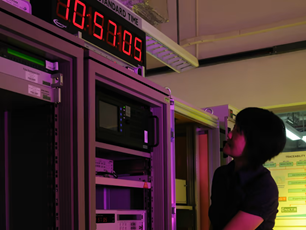
    In Photo: Dr Liu Yan Ying at NMC’s Time Lab

    At exactly 07:59:59 am on July 1, 2015, one extra second was added to your day. Why? And how does that change anything? 

    As the centre which oversees the national measurement standards in Singapore, NMC is more than familiar with this phenomenon. Our resident expert, Dr Liu Yan Ying, provides expert commentary on the leap second in 2015 on Today Online. 

    The phenomenon, called a “leap second”, takes place every few years, where an additional second is inserted to the time scale maintained by atomic clocks from around the world, or UTC (Coordinated Universal Time). The addition, which is implemented every few years, prevents days from getting longer as the Earth’s rotation continually slows down due to factors such as the moon’s gravitational pull and earthquakes.

    In 2015, in particular, the effect would be more apparent due to the day of occurrence, Dr Liu explains “In the past, leap seconds happened during weekends (and) holidays, when most people were not working. ... This year, (the leap second) is expected to affect more on financial sectors because it’s during (trading) time,”. 

    This commentary given is indicative of NMC’s role in Singapore in better understanding and preparing of such phenomenon, assisting with placing mitigating measures for such occurrences which deters disruptions and inconveniences caused. Examples of such inconveniences can be seen in past leap seconds, “During the last leap second on June 30, 2012, more than 400 Qantas flights were delayed when the airline’s check-in system crashed, while websites such as Reddit, Mozilla and LinkedIn experienced glitches because the systems could not cope with the extra time.” 

    At NMC, the time and frequency lab was incepted in 1981 and begun taking reference from UTC. Since then, the leap second has occurred more than 20 times. Since 1997, NMC has contributing to UTC and has been part of these global adjustments of the second.

    Full article/Source: https://www.todayonline.com/singapore/leap-second-clocks-read-075960-july-1

    Also Worth Reading
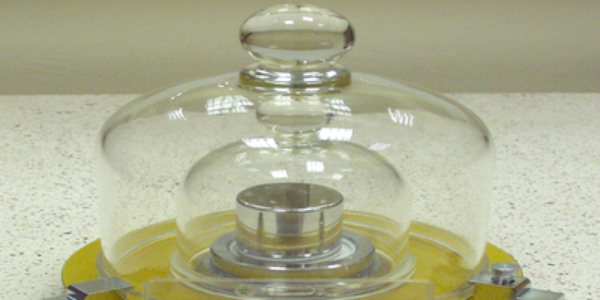
    "What's in a kilogram?", Straits Times
    "What's in a kilogram?", Straits Times
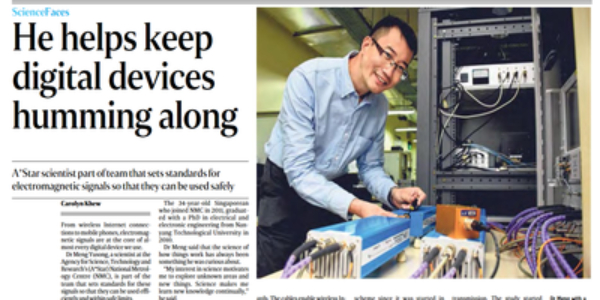
    "He helps keep digital devices humming along", STRAITS TIMES
    "He helps keep digital devices humming along", STRAITS TIMES
    [Media Release, EMA] Integrated Leakage Detection and Localisation Model for Natural Gas Pipelines
    [Media Release, EMA] Integrated Leakage Detection and Localisation Mod...
    Launch of World’s First National Standard for Bunker Mass Flow Metering
    Launch of World’s First National Standard for Bunker Mass Flow Meterin...