INTRODUCTION
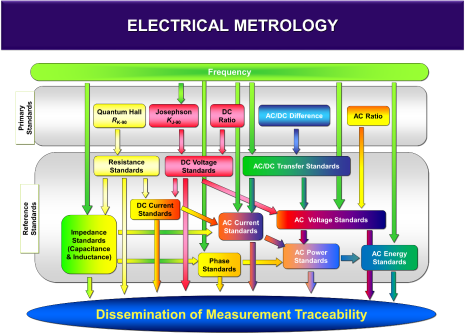
The Electrical Metrology Laboratory involves in the development, maintenance and dissemination of measurement standards in the fields of electrical direct current (DC) and low frequency alternating current (AC) quantities that form the basis of Singapore electrical measurement traceability chains to the SI units.
Our realisation and dissemination of the units of electrical measurement ensure that industries and other users have access to accurate and reliable measurements. We work in advancing measurement science, conducting R&D in measurement technology, evolving measurement capabilities, and providing measurement solutions to support industry’s technological innovation and competitiveness. Some of the key focus areas of the laboratory include:
Dissemination of Traceability & Metrology Expertise
- Research and development for the realization and maintenance of electrical units
- Precision calibration and measurement of electrical parameters direct traceable to national standards
- Measurement uncertainty and reliability analyses
- Design and verification of bespoke measurement systems
- Metrology capability and competency development and consultancy
Metrology for Energy Grid
- Energy efficiency and power system condition monitoring and analysis
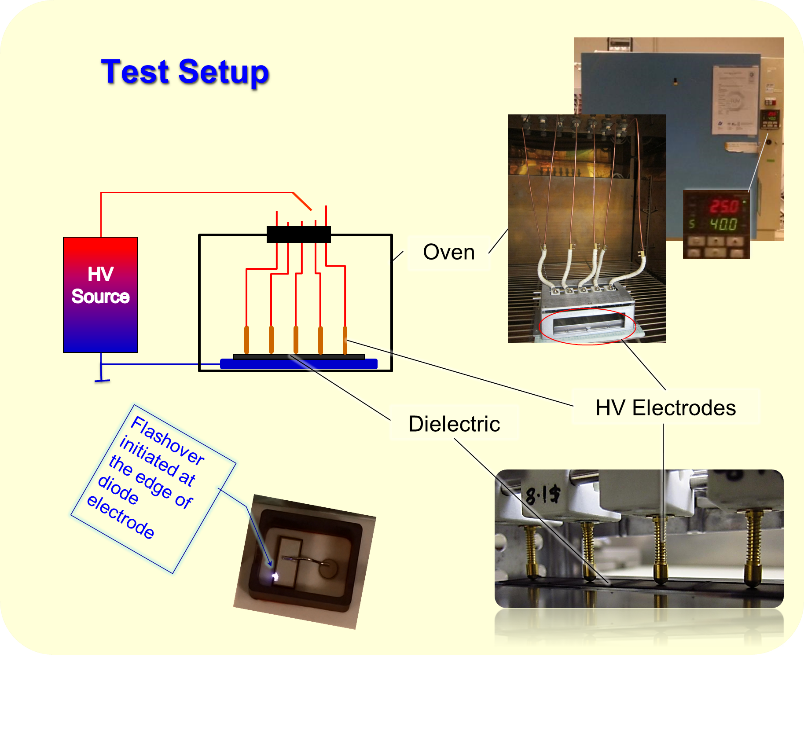
- Measurement of high voltage, electrostatic discharge detection and electrical breakdown
Metrology for Electrical Characterisation
- Electrical measurement & characterisation of material properties, sensors and devices
LATEST NEWS
- A new high voltage system which extends NMC's capability in AC high voltage from 100 kV to 200 kV at an accuracy of 0.05%. It will provide measurement traceability to local industry in relevant measurements and tests. It will also be used to carry out high voltage withstanding tests for insulation material developments and aerospace apparatus designs.
- Resistance bridges are crucial for resistance thermometers measurements. Very often, the linearity of the resistance measurement range needs to be correctly accounted for to achieve a low measurement uncertainty. Using a resistance bridge calibrator, the ratio indicated by a resistance bridge can be validated to perform a check of the linearity of the resistance bridge. NMC is now providing the linearity validation for ac and dc resistance thermometry bridges to the industry.
- NMC organised a proficiency test (PT) on resistance measurement using 100 Ω and 10 kΩ standard resistors starting from third quarter of 2018 to first quarter of 2019. The resistance values were typical PT100 (100 Ω PRT) and thermistor (10 k Ω) values that are typically used by temperature measurement for Green Mark M&V so that accredited laboratories, ESCO or building facility management companies can tap on the opportunity to verify their capability and instrumentation’s performance.
MEASUREMENT STANDARDS AND DISSEMINATION
The ampere, symbol A, is the SI unit of electric current. It is defined by taking the fixed numerical value of the elementary charge e to be 1.602 176 634 x 10–19 when expressed in the unit C, which is equal to A s, where the second is defined in terms of ∆ⱱCs.
(∆ⱱCs : the caesium frequency.)
The high accuracy realisation of the ampere directly in terms of its definitions is difficult and time consuming. The practical realizations of the ampere are now obtained through combinations of realizations of the volt, the unit of electromotive force, and ohm, the unit of resistance. The SI unit of volt and ohm are reproduced at NMC’s electrical metrology laboratory via Josephson and quantum Hall effects respectively to indirectly realise the ampere that is significantly more reproducible and stable than a few parts in 107.