SIMTech
  • About A*STAR SIMTech
    • Overview
    • Management
  • Research
    • 4 R&D Themes
    • Autonomous Manufacturing
    • Next-Gen Manufacturing Processes
    • Resilient Value Chain
    • Net Zero Manufacturing
    • Research Collaborations
  • Industry
    • Working with Us
    • Industry Collaborations
    • Collaborative Industry Development
    • Technology Licensing
    • Technology Upgrade
  • Industry Pillars
    • Aerospace Pillar
    • Biomedical Manufacturing & FMCG Pillar
    • Energy Pillar
    • Semiconductor Equipment & Factory Solutions Pillar
  • Innovation Factory
    • Overview
      • History
    • Services
    • Our Work
    • Our Team
    • Contact IF
  • More+
    • Additive Innovation Centre (AIC)
      • About AIC
      • Integrated End-to-End AM Solutions
      • Pilot Batch Production
      • Technologies
      • Events
      • Highlights
      • Contact AIC
    • Model Factory at A*STAR SIMTech
      • Overview
      • Key Features
      • Research
      • Technology
      • Learning
      • Partners
      • Visits/Contacts
    • Knowledge Transfer Office (KTO)
      • About KTO
      • Courses by Skills
        • Advanced Manufacturing Processes
        • Digital Manufacturing and AI
        • Sustainable Manufacturing
        • MedTech Manufacturing
        • Strategy and Transformation
        • Manufacturing Automation and Robotics
      • Course Directory
      • SkillsFuture Career Transition Programme
      • MasterClasses
      • Enterprise Transformation Project (ETP) With Mentorship Support Grant (MSG)
      • Course Registration Form for Public Classes
      • Customised Courses Request Service
      • Schedules Viewer
      • Training Venues
      • eAttendance (via Singpass)
      • Collaterals
    • News & Events
      • Press Releases
      • Industry Updates
      • SIMTech Manufacturing Matters
      • Manufacturing Matters
      • SIMTech 30th Anniversary
      • Events
    • Students
    • Contact Us
  • Home
  • A*STAR SIMTech
  • News & Events
  • SIMTech Manufacturing Matters
  • Features
  • A*STAR SIMTech
  • About A*STAR SIMTech
    • Overview
    • Management
  • Research
    • 4 R&D Themes
    • Autonomous Manufacturing
    • Next-Gen Manufacturing Processes
    • Resilient Value Chain
    • Net Zero Manufacturing
    • Research Collaborations
  • Industry
    • Working with Us
    • Industry Collaborations
    • Collaborative Industry Development
    • Technology Licensing
    • Technology Upgrade
  • Industry Pillars
    • Aerospace Pillar
    • Biomedical Manufacturing & FMCG Pillar
    • Energy Pillar
    • Semiconductor Equipment & Factory Solutions Pillar
  • Innovation Factory
    • Overview
      • History
    • Services
    • Our Work
    • Our Team
    • Contact IF
  • Additive Innovation Centre (AIC)
    • About AIC
    • Integrated End-to-End AM Solutions
    • Pilot Batch Production
    • Technologies
    • Events
    • Highlights
    • Contact AIC
  • Model Factory at A*STAR SIMTech
    • Overview
    • Key Features
    • Research
    • Technology
    • Learning
    • Partners
    • Visits/Contacts
  • Knowledge Transfer Office (KTO)
    • About KTO
    • Courses by Skills
      • Advanced Manufacturing Processes
      • Digital Manufacturing and AI
      • Sustainable Manufacturing
      • MedTech Manufacturing
      • Strategy and Transformation
      • Manufacturing Automation and Robotics
    • Course Directory
    • SkillsFuture Career Transition Programme
    • MasterClasses
    • Enterprise Transformation Project (ETP) With Mentorship Support Grant (MSG)
    • Course Registration Form for Public Classes
    • Customised Courses Request Service
    • Schedules Viewer
    • Training Venues
    • eAttendance (via Singpass)
    • Collaterals
  • News & Events
    • Press Releases
    • Industry Updates
    • SIMTech Manufacturing Matters
    • Manufacturing Matters
    • SIMTech 30th Anniversary
    • Events
  • Students
  • Contact Us
Agency for Science, Technology and Research (A*STAR)
PartnershipsCareersSuppliersContact UsWhistleblowing
  • Report Vulnerability
  • Privacy Statement
  • Terms & Conditions
  • Features

    From Coffee Beans to Cups

    15 Jan 2020
    • Whatsapp
    • Telegram
    • Facebook
    • Twitter
    • Email
    • Linked In

    Composites recycled from coffee grounds improve environmental sustainability
    coffee_beans1a

    In the sustainable circular economy, things that are conventionally treated as waste in a linear economy is now a resource. A case in point is spent coffee grounds.

    Coffee, a widely drunk beverage around the world, uses much coffee beans in its brewing.  This continuously generates great amount of spent coffee grounds. The estimated world coffee consumption is 161.93 million bags of coffee in coffee year 2017/18. This is an increase of 1.8 per cent as compared with coffee year 2016/17 [1]. With almost 50 per cent of the world coffee production used for soluble coffee preparation, up to 6 million tons of spent coffee ground (SCG) are generated annually [2].

    Nowadays, the most common way to discard spent coffee ground is through landfills and incineration. However, this will cause direct effect on the environment due to the enormous amount of methane and carbon dioxide produced when coffee ground decomposes. To minimise its impact on the environment, it is important to repurpose coffee ground into something useful. Since spent coffee grounds are cellulosic material that are insoluble, it can be applied in composites in the same manner as other cellulosic material as fillers, such as wood chips and other natural fibres. 


    Producing composites from coffee waste is an effective method to reduce plastic consumption and food wastes


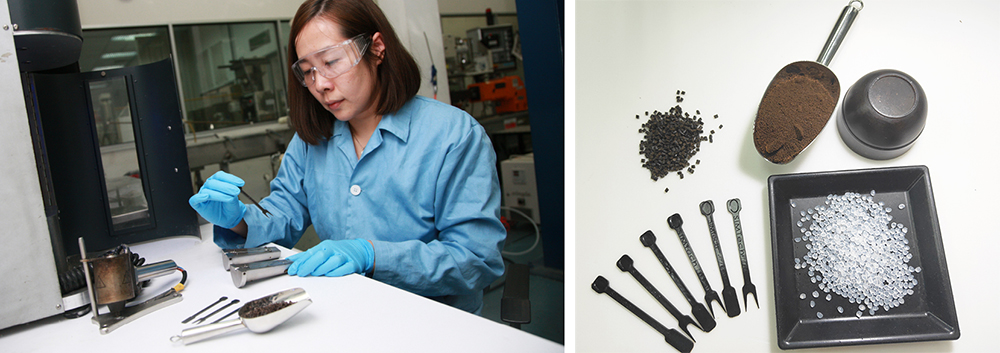
    This is exactly what SIMTech has achieved. A thermoplastic-based recycled coffee ground composite is developed. Sustainable in-house processing routes have been designed and tested to  verify its reliability for application in coffee cups. Further modification also helped to improve adhesion between polymers and coffee grounds resulting in more durable products. The environmental footprint of coffee cups has also been investigated during the study in comparison with single used plastic and paper cup. Better sustainability of coffee cups has been observed after certain washing cycles. Applications of the coffee composites include the manufacture of non-structured components as well as household articles. 


    For enquiries, please contact 
    Dr Ng Sum Huan Gary, Acting Deputy Director, SEAC 
    Email: shng@SIMTech.a-star.edu.sg

    Web: www.a-star.edu.sg/SIMTech-SMC

    seac_icon


    Notes
    1 International Coffee Organisation. (2018). Coffee Market Report. Retrieved from: http:// www. ico.org 
    2 Tokimoto, T, Kawasaki, N, Nakamura, T, Akutagawa, J, & Tanada, S (2005). Removal of lead ions in drinking water by coffee grounds as vegetable biomass. Journal of Colloid and Interface Science, 281(1), 56-61