HealthTEC - IMRE Webinar Series: Future of Health Sensing Materials & Technology - Session II
We are delighted to announce the session II of “Future of Health Sensing Materials & Technologies” webinar series on Skin-integrated Sensors. This webinar series is co-organized by Institute of Materials Research and Engineering (IMRE), A*STAR and Singapore Health Technologies Consortium (HealthTEC). The webinar will be held on 26th February 2021, 10.00 – 11.30 am.
Webinar description:
Flexible, skin-like sensors are the future of healthcare. Recent advances in research especially with respect to the discovery of novel materials and miniaturization of sensors, have made the development of wearable skin sensors possible for applications such as continuous and remote monitoring of health, non-invasive diagnosis of disease, and management of skin care and wound healing etc. In this session, the speakers will discuss on the latest developments of skin-interfaced sensors that are conformal as well as how nanoparticles and microfluidics are transformed into wearable solutions for health and wellness personalised applications.
We look forward to seeing you there! For any enquires, please do not hesitate to approach HealthTEC (healthtec@nus.edu.sg) or Ady Suwardi (ady_suwardi@imre.a-star.edu.sg).
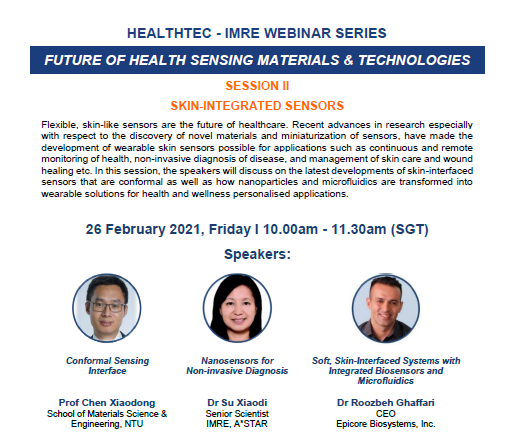
About the Speakers:
Prof Chen Xiaodong, School of Materials Science & Engineering, NTU
Prof Chen is the President’s Chair Professor in the School of Materials Science and Engineering, Professor of Chemistry (by courtesy) and Professor of Medicine (by courtesy) at the Nanyang Technological University, Singapore (NTU). He is the Director of Innovative Centre for Flexible Devices (iFLEX) at NTU and the Director of Max Planck – NTU Joint Lab for Artificial Senses. He received his B.S. degree (Honours) in chemistry from the Fuzhou University, China, in 1999, M.S. degree (Honours) in physical chemistry from the Chinese Academy of Sciences in 2002, and PhD degree (Summa Cum Laude) in biochemistry from the University of Münster, Germany, in 2006. After his postdoctoral fellow training at the Northwestern University, USA, he joined NTU as a National Research Foundation (NRF) Fellow and Nanyang Assistant Professor (NAP) in 2009 in (MSE). He was promoted to Associate Professor with tenure in 2013, and Full Professor in 2016. Professor Chen’s research focuses on developing soft materials for applications in flexible devices, energy storage, and healthcare.
Dr Su Xiaodi, IMRE, A*STAR
Dr Su received her PhD from Nankai University, China (1995). She joined the Institute of Materials Research & Engineering in 1998. Currently, she is a Senior Scientist in the Soft Material Department. She is also an Adjunct Associate Professor in the Department of Chemistry, NUS. Her research expertise include nanomaterials based biosensors and advanced analytical technologies for chemical, biochemical, and biological analysis. She received an Outstanding University Researcher Award in 1999 for her postdoc research work in National University of Singapore (NUS).
Dr Roozbeh Ghaffari, Epicore Biosystems Inc.
Dr Ghaffari graduated from MIT with BS and MEng degrees in Electrical Engineering and received his PhD in biomedical engineering from the Harvard-MIT Division of Health Sciences and Technology. He is currently the Director of Translational Research at Northwestern University’s Querrey-Simpson Institute for Bioelectronics and is a Research Associate Professor in the Department of Biomedical Engineering. In 2017, Dr Ghaffari co-founded and has served as a CEO of Epicore Biosystems, a health solutions company commercializing ambulatory wearable microfluidic devices for tracking health and hydration biomarkers. Prior to Epicore Biosystems, Dr Ghaffari co-founded and served as a CTO of the wearable health technology company, MC10, where he led the development and launch of the BioStamp Wearable System for tracking movement disorders in remote clinical trials. His contributions in soft bioelectronics, biosensors, microfluidics and neuroscience have been recognized with the MIT 100K Grand Prize, IEEE Spectrum Emerging Technology Prize, and the MIT Technology Review Magazine’s Top 35 Innovators Under 35. He has published over 100 academic papers and is an inventor of over 50 patents issued.