Yinghui LI
Biography
Dr Yinghui Li received her PhD in Medical Science from the Karolinska Institutet in 2013 and conducted her postdoctoral stint at the Institute of Molecular and Cell Biology, A*STAR. During her early career, Dr Li discovered that de novo NF-κB sites were generated in the hotspot TERT promoter mutation, linking inflammation to the reactivation of telomerase in cancer cells. She received the Singapore NRF Fellowship in 2018 and started her group in Nanyang Technological University Singapore, focusing on understanding how inflammation-driven signalling shapes transcriptional programs and chromatin function in cancer. During this term, several studies by her group have uncovered the mechanisms through which inflammatory signals including the TWEAK/Fn14 and non-canonical NF-κB pathways alter the cancer cell epigenome and transcriptome to drive cancer progression and treatment resistance. She was also selected as an EMBO Global Investigator and joined the EMBO Global Investigator Network in 2025.
Dr Li currently leads a multi-disciplinary research program in inflammation signalling, cancer epigenomics and RNA biology, integrating molecular, cell biology, computational and functional genomics approaches to uncover regulatory mechanisms driving oncogenesis and therapeutic resistance. Her ongoing research is supported by multiple competitive grants from the National Medical Research Council and Singapore Therapeutics Development Review. She joined A*STAR SIgN in Aug 2026 to lead the Inflammation, Epigenetics and Translational Oncology Laboratory, focusing on the discovery and characterization of novel targets in cancer and inflammatory diseases.
Main Appointments
- Principal Scientist, Singapore Immunology Network (SIgN, A*STAR, Singapore)
- Adjunct Principal Investigator, Institute of Molecular and Cell Biology (IMCB, A*STAR, Singapore)
- EMBO Global Investigator Network, Programme member (2025-2028)
Awards and Grants
2026 - National Medical Research Council Open Fund-Individual Research Grant (OF-IRG25jul)
2026 - Singapore Therapeutics Development Review Pre-Pilot Grant
2025 - EMBO Global Investigator
2025 - National Medical Research Council Open Fund-Individual Research Grant (OF-IRG24jul)
2018 - National Research Foundation (NRF) Fellowship
2017 - National Medical Research Council Open Fund-Young Investigator Research Grant (OF-YIRG)
Research Focus
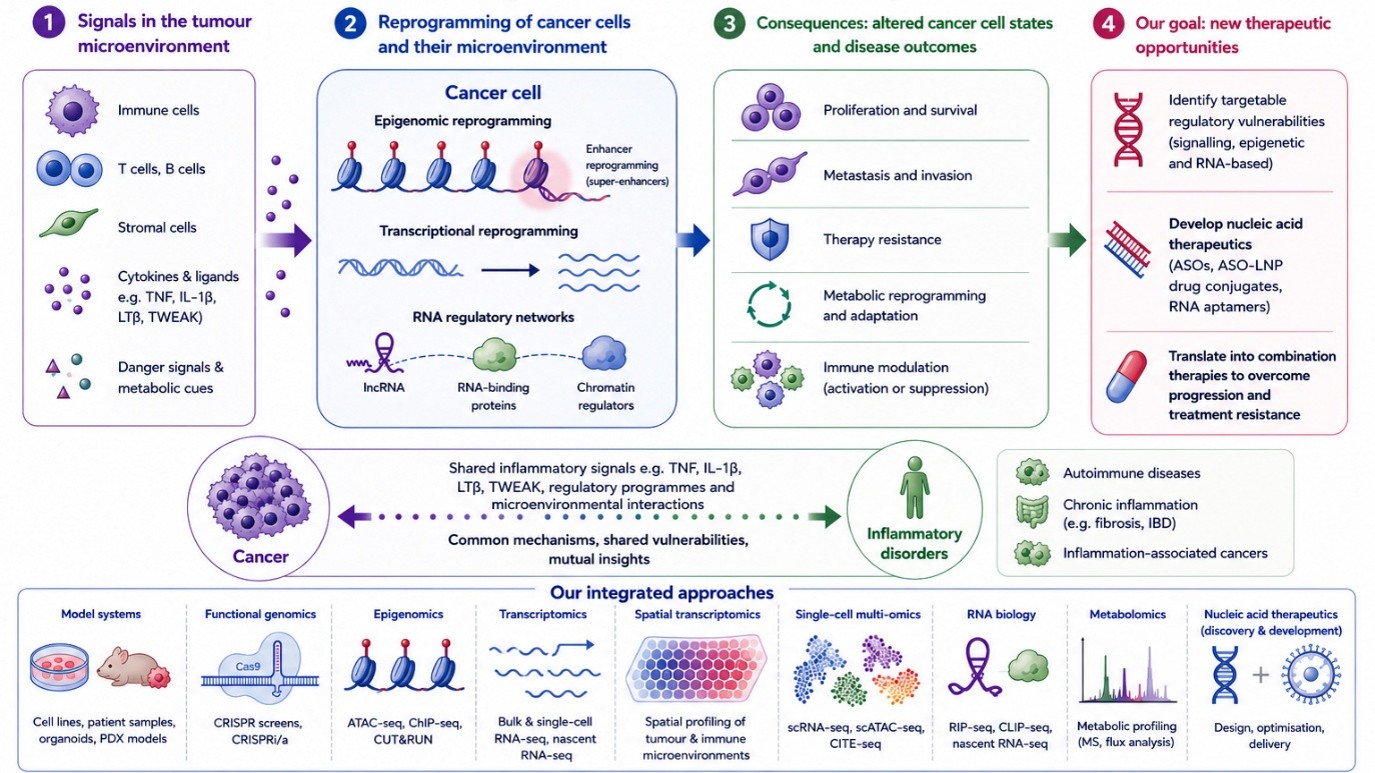
Our laboratory investigates how immune and inflammatory signals within the tumour microenvironment shape cancer cell-intrinsic regulatory programs, and how these altered cell states influence tumour progression and therapeutic response. We are also interested in deciphering the shared molecular mechanisms linking chronic inflammatory disorders and cancer, with the aim of identifying common regulatory vulnerabilities across disease contexts.
Key questions we are investigating
I. How do immune and inflammatory signals reprogram cancer cells and the tumour microenvironment?
We investigate how inflammatory pathways remodel transcriptional, epigenetic and metabolic programs to establish disease-promoting cell states. Our work spans signalling networks including the non-canonical NF-κB and TWEAK/Fn14 pathways, and increasingly incorporates single-cell and spatial transcriptomics to study these processes within complex tissue microenvironments (Sim & Li, Communications Biology, 2023; Ang et al., Nature Communications, 2024; Sim et al., Nature Communications, 2024; Ang et al., Cancer Letters, 2025).
II. How do these regulatory states drive adaptation and treatment resistance?
We study how inflammatory signalling enables tumour cells to adapt to metabolic, microenvironmental and therapeutic stress. Our work has linked non-canonical NF-κB signalling to metabolic adaptation and drug resistance in diffuse large B-cell lymphoma (Lim et al., Leukemia, 2023) and identified epigenetic and RNA regulatory mechanisms associated with treatment resistance in multiple myeloma (Ang et al., Nature Communications, 2024; Deka et al., Nature Communications, 2025).
III. What regulatory mechanisms are shared between inflammatory disorders and cancer?
Persistent inflammatory signalling can drive pathological cell states across multiple diseases. We seek to define the shared signalling, epigenetic and RNA regulatory programs that underpin chronic inflammation and cancer, and determine whether vulnerabilities identified in one disease context can inform therapeutic strategies in another.
IV. Can we translate these vulnerabilities into next-generation nucleic acid therapeutics?
We are developing nucleic acid-based strategies to selectively target disease-driving RNAs and RNA–protein interactions. As a proof of concept, we have developed steric antisense oligonucleotides that disrupt the PLUM–EZH2 interaction and restore treatment sensitivity in drug-resistant myeloma models (Deka et al., Nature Communications, 2025) (PCT patent application filed).
At A*STAR SIgN, we aim to define how immune and inflammatory microenvironments generate targetable regulatory states across cancer and inflammatory diseases, and translate these discoveries into novel nucleic acid and combination therapeutic strategies.
Lab Members
| Postdocs (Ph.D) |
|---|
| Jean-Michel Carter |
| Ita Novita Sari |
| Bryan Ng Yik Loong |
Publications
Publications_Yinghui LI (last updated on 31 August 2026)