SIMTech
  • About A*STAR SIMTech
    • Overview
    • Management
  • Research
    • 4 R&D Themes
    • Autonomous Manufacturing
    • Next-Gen Manufacturing Processes
    • Resilient Value Chain
    • Net Zero Manufacturing
    • Research Collaborations
  • Industry
    • Working with Us
    • Industry Collaborations
    • Collaborative Industry Development
    • Technology Licensing
    • Technology Upgrade
  • Industry Pillars
    • Aerospace Pillar
    • Biomedical Manufacturing & FMCG Pillar
    • Energy Pillar
    • Semiconductor Equipment & Factory Solutions Pillar
  • Innovation Factory
    • Overview
      • History
    • Services
    • Our Work
    • Our Team
    • Contact IF
  • More+
    • Additive Innovation Centre (AIC)
      • About AIC
      • Integrated End-to-End AM Solutions
      • Pilot Batch Production
      • Technologies
      • Events
      • Highlights
      • Contact AIC
    • Model Factory at A*STAR SIMTech
      • Overview
      • Key Features
      • Research
      • Technology
      • Learning
      • Partners
      • Visits/Contacts
    • Knowledge Transfer Office (KTO)
      • About KTO
      • Courses by Skills
        • Advanced Manufacturing Processes
        • Digital Manufacturing and AI
        • Sustainable Manufacturing
        • MedTech Manufacturing
        • Strategy and Transformation
        • Manufacturing Automation and Robotics
      • Course Directory
      • SkillsFuture Career Transition Programme
      • MasterClasses
      • Enterprise Transformation Project (ETP) With Mentorship Support Grant (MSG)
      • Course Registration Form for Public Classes
      • Customised Courses Request Service
      • Schedules Viewer
      • Training Venues
      • eAttendance (via Singpass)
      • Collaterals
    • News & Events
      • Press Releases
      • Industry Updates
      • SIMTech Manufacturing Matters
      • Manufacturing Matters
      • SIMTech 30th Anniversary
      • Events
    • Students
    • Contact Us
  • Home
  • A*STAR SIMTech
  • News & Events
  • SIMTech Manufacturing Matters
  • Features
  • A*STAR SIMTech
  • About A*STAR SIMTech
    • Overview
    • Management
  • Research
    • 4 R&D Themes
    • Autonomous Manufacturing
    • Next-Gen Manufacturing Processes
    • Resilient Value Chain
    • Net Zero Manufacturing
    • Research Collaborations
  • Industry
    • Working with Us
    • Industry Collaborations
    • Collaborative Industry Development
    • Technology Licensing
    • Technology Upgrade
  • Industry Pillars
    • Aerospace Pillar
    • Biomedical Manufacturing & FMCG Pillar
    • Energy Pillar
    • Semiconductor Equipment & Factory Solutions Pillar
  • Innovation Factory
    • Overview
      • History
    • Services
    • Our Work
    • Our Team
    • Contact IF
  • Additive Innovation Centre (AIC)
    • About AIC
    • Integrated End-to-End AM Solutions
    • Pilot Batch Production
    • Technologies
    • Events
    • Highlights
    • Contact AIC
  • Model Factory at A*STAR SIMTech
    • Overview
    • Key Features
    • Research
    • Technology
    • Learning
    • Partners
    • Visits/Contacts
  • Knowledge Transfer Office (KTO)
    • About KTO
    • Courses by Skills
      • Advanced Manufacturing Processes
      • Digital Manufacturing and AI
      • Sustainable Manufacturing
      • MedTech Manufacturing
      • Strategy and Transformation
      • Manufacturing Automation and Robotics
    • Course Directory
    • SkillsFuture Career Transition Programme
    • MasterClasses
    • Enterprise Transformation Project (ETP) With Mentorship Support Grant (MSG)
    • Course Registration Form for Public Classes
    • Customised Courses Request Service
    • Schedules Viewer
    • Training Venues
    • eAttendance (via Singpass)
    • Collaterals
  • News & Events
    • Press Releases
    • Industry Updates
    • SIMTech Manufacturing Matters
    • Manufacturing Matters
    • SIMTech 30th Anniversary
    • Events
  • Students
  • Contact Us
Agency for Science, Technology and Research (A*STAR)
PartnershipsCareersSuppliersContact UsWhistleblowing
  • Report Vulnerability
  • Privacy Statement
  • Terms & Conditions
  • Features

    Fight Climate Change Through Energy Profile Optimisation

    15 Apr 2021
    • Whatsapp
    • Telegram
    • Facebook
    • Twitter
    • Email
    • Linked In

    Visualising thermal flow behaviour using simulation for better system design
    April2021_SEAC1

    One of the ways to address climate change is to look at how the manufacturing industry and commercial sectors are utilising energy. It is common for manufacturing and facilities management equipment designers to oversize its capacity to ensure the supplies of resources are sufficient given limited information or a lack of understanding on energy demands. Most of the energy generated are used for heating and cooling purposes, leading to high non-productive energy usages and losses. 

    There are other ways to improve energy efficiency including

    1. Using new methods and materials in heating such as three-dimensional induction heating elements versus conventional oil heating. This enables more effective heat transfer management and significantly reduces energy consumption.
    2. Precision measurements that enable us to understand better on the energy maps to address hotspots and reduce waste heat and non-productive usages.
    3. Understanding human behaviours and its usage patterns for smarter and accurate control.
    April2021_SEAC2

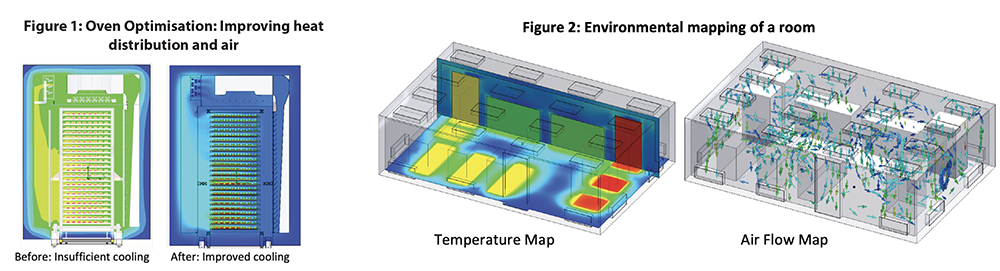
    Figures 1 and 2 show the case studies we had worked on to simulate both temperature and airflow to improve energy efficiency within an oven and a room respectively. In the case of a simulation of an oven as shown in Fig 1, the air flow distribution can be studied and improved through strategic placement of ducts and louvres. Subsequently, the requirements for cooling and heating of the air can be approximated for the given loading condition within the oven allowing, new materials to be explored. Various loading conditions can be simulated to determine if the heating and cooling modules are sufficient for the intended conditions. With this information, the oven can be better designed.

    In Fig 2, the simulation and analysis of a room is carried out to help identify hot spots and to understand how it would affect the surroundings. The strategic placements of solutions, such as air-conditioning units or fans, to aid in the cooling of the room can then be determined. In addition, the rearrangement of the room layout to better optimise the air flow within can be studied. Different thermal insulating barriers and air vent louvres designs can be proposed. With a proper analysis, a suitable HVAC system can be sized while still ensuring thermal comfort for people working in the room.   

    Companies can leverage on SIMTech’s capabilities in modelling, simulation and analysis to validate their products and processes design to achieve the common sustainability goals towards a better energy profile. In this way, improving profitability and environmental impact can be achieved hand in hand.


    For enquiries, please contact
    Dr Ng Sum Huan Gary, Deputy Director, SEAC 
    Email: shng@SIMTech.a-star.edu.sg

    Web: www.a-star.edu.sg/SIMTech-SEAC

    seac_icon