.png?sfvrsn=d3a97fa3_12)
News
12 Papers Accepted at AAAI-26
The Association for the Advancement of Artificial Intelligence (AAAI) is the premier scientific society dedicated to advancing the scientific understanding of the mechanisms underlying thought and intelligent behaviour and their embodiment in machines. Returning for its 40th edition, AAAI-26 will take place from 20 – 27 January 2026 at the Singapore Expo.
A total of 12 papers from A*STAR Centre for Frontier AI Research (A*STAR CFAR) have been accepted at AAAI-26.
Congratulations to the following scientists on this achievement:
- Prof Ivor Tsang, Director, A*STAR CFAR
- Prof Ong Yew Soon, Chief Artificial Intelligence (AI) Scientist and Advisor
- Dr Joey Zhou, Deputy Director and Principal Scientist
- Dr Basura Fernando, Principal Scientist
- Dr He Tiantian, Senior Scientist
- Dr Yan Ming, Senior Scientist
- Dr Zhang Hao, Senior Scientist
- Dr He Yang, Scientist
- Dr Shi Yaxin, Scientist
- Dr Qiang Hangwei, Scientist
- Dr Zhang Jie, Scientist
- Ms Yang Hong, Senior Research Engineer
List of accepted papers:
- Correspondence Coverage Matters for Multi-Modal Dataset Distillation
Zhuohang Dang*, Minnan Luo, Chengyou Jia*, Hangwei Qian, Xinyu Zhang*, Xiaojun Chang, Ivor Tsang
We introduce ProCo, a multi-modal dataset distillation method that enhances correspondence coverage to improve generalisation and efficiency, outperforming existing approaches even under reduced distillation budgets. - GenMatLab: A Generative Platform for Inverse Materials Design (Demo Track)
Hangwei Qian, Yang He, Yaxin Shi, Ivor Tsang
In this demo, we present GenMatLab, a user-friendly web platform that makes the latest AI techniques accessible for inverse materials design. The platform integrates data analysis and generative modelling into an easy-to-use interface, enabling researchers, material domain experts, and practitioners to adopt AI methods without requiring advanced coding expertise. - MAGIC: Mastering Physical Adversarial Generation in Context through Collaborative LLM Agents
Yun Xing*, Nhat Chung***, Jie Zhang, Yue Cao***, Ivor Tsang, Yang Liu, Lei Ma, Qing Guo**
MAGIC is a framework using multi-modal LLM agents to create robust physical adversarial patches for driving scenarios. Three agents collaborate: a generation agent crafts deceptive patches using prompt engineering; a deployment agent selects context-aware placement strategies; and a self-examination agent iteratively reviews and refines attacks. Evaluated on nuImage and real-world scenes, MAGIC effectively compromises YOLO and DETR detectors. - Robust Semi-paired Multimodal Learning for Cross-modal Retrieval
Yang Qin, Yuan Sun, Xi Peng, Dezhong Peng, Joey Tianyi Zhou, Xiaomin Song, Peng Hu
Cross-modal retrieval often requires large-scale paired data, which is costly to collect. This paper studies semi-paired cross-modal learning (SPL), which uses a small amount of paired data together with a large amount of unpaired data to improve retrieval performance in practical settings. - Poisoned Distillation: Injecting Backdoors into Distilled Datasets Without Raw Data Access
Ziyuan Yang, Ming Yan, Yi Zhang, Joey Tianyi Zhou
This work presents the first demonstration that attackers can intercept dataset distribution, inject backdoors into distilled datasets, and redistribute them — without needing access to the raw data. - PKR-QA: A Benchmark for Procedural Knowledge Reasoning with Knowledge Module Learning
Thanh-Son Nguyen, Hong Yang, Tzeh Yuan Neoh**, Hao Zhang, Ee Yeo Keat**, Basura Fernando
PKR-QA introduces a benchmark for answering questions about procedural tasks requiring structured reasoning. Knowledge Module Learning (KML) is a neurosymbolic approach that learns procedural relations through neural modules and composes them with LLMs. - Learning Structurally Stabilised Representations for Lossless DNA Storage
Ben Cao*, Xue Li, Tiantian He, Bin Wang, Shihua Zhou, Xiaohu Wu, Qiang Zhang
This paper introduces a new representation learning framework for lossless DNA storage integrating Reed-Solomon error correction with biologically stabilised single-stranded encoding. It is the first GNN-based approach to achieve higher density, durability, and lower error rates across diverse data types. - Diffusion Reconstruction-based Data Likelihood Estimation for Core-Set Selection
Mingyang Chen, Jiawei Du, Bo Huang, Yi Wang, Xiaobo Zhang, Wei Wang
The authors propose using diffusion models to estimate data likelihood via reconstruction deviation, grounded in ELBO theory. The resulting scoring criterion outperforms baselines on ImageNet, achieving near full-data performance with only 50% of data. - Exploiting Geometric Structures for Modelling Multi-Agent Behaviours: A New Thinking
Bohao Qu***, Xiaofeng Cao, Bing Li*, Menglin Zhang*, Tuan-Anh Vu*, Di Lin, Qing Guo**
HMAR is a hyperbolic representation learning framework embedding multi-agent trajectories into a Poincaré ball to preserve hierarchical structure. It enables effective contrastive learning and achieves superior performance on Overcooked and Pommerman benchmarks. - Pushing Rendering Boundaries: Hard Gaussian Splatting
Qingshan Xu, Jiequan Cui, Xuanyu Yi, Yuxuan Wang, Yuan Zhou, Yew-Soon Ong, Hanwang Zhang
Hard Gaussian Splatting (HGS) introduces hard Gaussians that address blurring and needle-like artefacts in 3D scenes, achieving state-of-the-art rendering quality while maintaining real-time performance. - NeuSpring: Neural Spring Fields for Reconstruction and Simulation of Deformable Objects from Videos
Qingshan Xu, Jiao Liu, Shangshu Yu, Yuxuan Wang, Yuan Zhou, Junbao Zhou, Jiequan Cui, Yew-Soon Ong, Hanwang Zhang
NeuSpring enables reconstruction and physical simulation of deformable objects from video data using Neural Spring Fields, supporting more accurate modelling of real-world dynamics. - Scale-Net: A Hierarchical U-Net Framework for Cross-Scale Generalization in Multi-Task Vehicle Routing
Suyu Liu, Zhiguang Cao, Nan Yin, Yew-Soon Ong
Scale-Net is a unified neural solver addressing scalability and cross-task generalisation for Vehicle Routing Problems. It captures multi-scale graph features efficiently while reducing the computational demands of attention mechanisms.
More on AAAI-26.
A*STAR celebrates International Women's Day
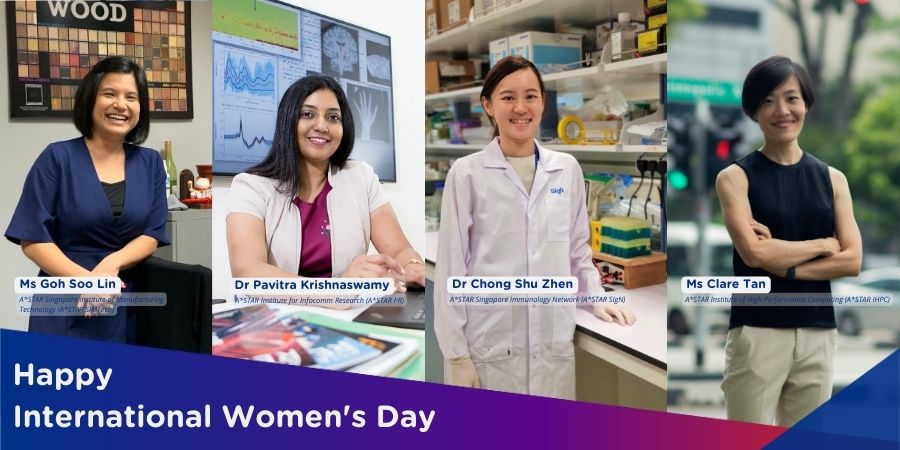
From groundbreaking discoveries to cutting-edge research, our researchers are empowering the next generation of female science, technology, engineering and mathematics (STEM) leaders.
Get inspired by our #WomeninSTEM