.png?sfvrsn=d3a97fa3_12)
News
14 Papers Accepted at NeurIPS 2025
The 39th annual conference on Neural Information Processing Systems (NeurIPS 2025) is an interdisciplinary conference that brings together researchers in machine learning, neuroscience, statistics, optimisation, computer vision, natural language processing, life sciences, natural sciences, social sciences, and other adjacent fields.
A total of 14 papers from A*STAR Centre for Frontier AI Research (A*STAR CFAR) will be presented at NeurIPS 2025. Congratulations to the following scientists on this achievement:
- Prof Ivor Tsang, Director, A*STAR CFAR
- Prof Ong Yew Soon, Chief Artificial Intelligence (AI) Scientist and Advisor
- Dr Joey Zhou, Deputy Director and Principal Scientist
- Dr Atsushi Nitanda, Principal Scientist
- Dr Basura Fernando, Principal Scientist
- Dr Yin Haiyan, Early Career Investigator
- Dr Feng Zeyu, Senior Scientist
- Dr Du Jiawei, Senior Scientist
- Dr He Yang, Scientist
- Dr Lyu Yueming, Scientist
- Dr Qian Hangwei, Scientist
- Dr Zhang Jie, Scientist
- Dr Zhang Xin, Scientist
List of accepted papers:
| 1. | Beyond Modality Collapse: Representations Blending for Multimodal Dataset Distillation Xin Zhang, Ziruo Zhang*, Jiawei Du, Zuozhu Liu, Joey Tianyi Zhou We propose RepBlend, a novel MDD framework that mitigates modality collapse by enhancing intra-modal diversity through representation blending and balancing cross-modal alignment via symmetric projection trajectory matching, achieving state-of-the-art retrieval performance and up to 6.7× speedup on Flickr30K and MS-COCO. |
| 2. | PandaPose: 3D Human Pose Lifting from a Single Image via Propagating 2D Pose Prior to 3D Anchor Space Jinghong Zheng, Changlong Jiang, Yang Xiao, Jiaqi Li, Haohong Kuang, Hang Xu, Ran Wang, Zhiguo Cao, Min Du, Joey Tianyi Zhou We propose PandaPose, a 3D human pose lifting framework that mitigates error propagation and self-occlusion by introducing a unified 3D anchor space with joint-wise anchors, depth-aware feature lifting, and anchor-feature interaction, achieving a 14.7% error reduction over state-of-the-art methods on Human3.6M and superior performance on MPI-INF-3DHP and 3DPW. |
| 3. | SCOPE: Saliency-Coverage Oriented Token Pruning for Efficient Multimodal LLMs Jinhong Deng*, Wen Li, Joey Tianyi Zhou, Yang He SCOPE is a novel visual token pruning method that jointly models saliency and coverage to iteratively select the most informative tokens, reducing redundancy while preserving semantic completeness, and achieving superior performance on Multimodal LLMs. |
| 4. | Statistical Analysis of the Sinkhorn Iterations for Two-Sample Schrödinger Bridge Estimation Ibuki Maeda, Rentian Yao, Atsushi Nitanda We derive a statistical error bound for Schrödinger bridges trained with Sinkhorn methods on empirical distributions and present a neural network–based implementation of this approach with theoretical guarantees. This result further justifies other important Schrödinger bridges methods through the previously unnoticed connection between them. |
| 5. | Machine Unlearning via Task Simplex Arithmetic Junhao Dong***, Hao Zhu, Yifei Zhang, Xinghua Qu, Yew-Soon Ong, Piotr Koniusz We introduce Visual Language Models (VLMs) unlearning by a closed-form ensemble of infinite number of functions with parameters uniformly sampled from a task arithmetic simplex. |
| 6. | Robust SuperAlignment: Weak-to-Strong Robustness Generalisation for Vision-Language Models Junhao Dong***, Cong Zhang, Xinghua Qu, Piotr Koniusz, Zejun MA, Yew-Soon Ong We propose the first robust weak-to-strong generalisation framework to elicit robust knowledge from a strong student VLM in an unsupervised scheme. |
| 7. | Solving Discrete (Semi) Unbalanced Optimal Transport with Equivalent Transformation Mechanism and KKT-Multiplier Regularisation Weiming Liu, Xinting Liao, Jun Dan, Fan Wang, Hua Yu, Junhao Dong***, Shunjie Dong, Lianyong Qi, Yew-Soon Ong We propose Equivalent Transformation Mechanism with KKT-Multiplier Regularisation for solving SemiUOT and UOT. |
| 8. | You Only Communicate Once: One-shot Federated Low-Rank Adaptation of MLLM Binqian Xu***, Haiyang Mei, Zechen Bai, Jinjin Gong, Rui Yan, Guo-Sen Xie, Yazhou Yao, Basura Fernando, Xiangbo Shu This work introduces YOCO, the first method to achieve true one-shot federated learning for multimodal LLMs by using implicit global supervision with directional regularisation, cutting communication to ~0.03% of multi-round FL while outperforming existing one-shot and multi-round methods. |
| 9. | CoFFT: Chain of Foresight-Focus Thought for Visual Language Models Xinyu Zhang***, Yuxuan Dong, Lingling Zhang, Chengyou Jia, Zhuohang Dang, Basura Fernando, Jun Liu, Mike Zheng Shou We propose CoFFT, a training-free approach that enhances VLM reasoning by iteratively aligning visual focus with reasoning progression, reducing interference and hallucinations from irrelevant image content. |
| 10. | InstructFlow: Adaptive Symbolic Constraint-Guided Code Generation for Long-Horizon Planning Haotian Chi***, Zeyu Feng, Yueming Lyu, Chengqi Zheng***, Linbo Luo, Yew-Soon Ong, Ivor Tsang, Hechang Chen, Yi Chang, Haiyan Yin We present InstructFlow, a multi-agent framework for robotic manipulation that builds hierarchical instruction graphs, generates executable code, and adapts through constraint-driven feedback. This dynamic, interpretable flow enhances long-horizon task decomposition, failure recovery, and robustness in constraint-sensitive scenarios. |
| 11. | DepthVanish: Optimizing Adversarial Interval Structures for Stereo-Depth-Invisible Patches Yun Xing*, Yue Cao***, Nhat Chung***, Jie Zhang, Ivor Tsang, Ming-Ming Cheng, Yang Liu, Lei Ma, Qing Guo** We expose stereo depth vulnerabilities and show naïve repeated textures fail physically. By introducing striped intervals – jointly optimised with textures, we achieve effective real-world attacks, especially binary patterns—successfully misleading state-of-the-art stereo depth systems. |
| 12. | AngleRoCL: Angle-Robust Concept Learning for Physically View-Invariant Adversarial Patches Wenjun Ji, Yuxiang Fu, Luyang Ying, Deng-Ping Fan, Yuyi Wang, Ming-Ming Cheng, Ivor Tsang, Qing Guo** We examine angle robustness of text to image adversarial patches and introduce AngleRoCL, which learns a generalisable text concept to guide T2I models, producing patches with substantially improved viewpoint-resistant attacks. |
| 13. | Mask Image Watermarking Runyi Hu, Jie Zhang, Shiqian Zhao, Nils Lukas, Jiwei Li, Qing Guo**, Han Qiu, Tianwei Zhang We present MaskMark, a simple, efficient, and flexible framework for image watermarking. |
| 14. | Physics-Constrained Diffusion for Lightweight Composite Material Design (Workshop Paper) Hangwei Qian, Yang He, Bingjin Chen, Mohit Sharma, Ivor Tsang We propose a physics-constrained diffusion model tailored for composite material design. |
* denotes former student at A*STAR CFAR
** denotes former researcher at A*STAR CFAR
*** denotes current student at A*STAR CFAR
(accurate at the time of posting)
Learn more about NeurIPS 2025.
A*STAR celebrates International Women's Day
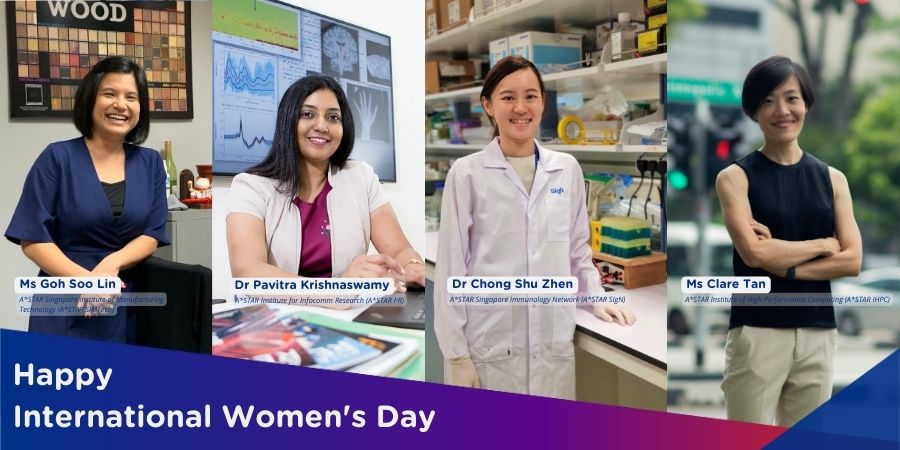
From groundbreaking discoveries to cutting-edge research, our researchers are empowering the next generation of female science, technology, engineering and mathematics (STEM) leaders.
Get inspired by our #WomeninSTEM