.png?sfvrsn=d3a97fa3_12)
News
6 Papers Accepted at CVPR 2026
Held from 2–6 June 2026 in Denver, Colorado, United States, the Conference on Computer Vision and Pattern Recognition (CVPR) 2026 is the leading annual scientific conference in computer vision. It is widely regarded as one of the world’s most prestigious venues for showcasing cutting-edge research on how machines interpret and understand visual data.
Congratulations to the following researchers from A*STAR Centre for Frontier AI Research (A*STAR CFAR) on having their papers accepted at CVPR 2026:
- Prof Ivor Tsang, Director, A*STAR CFAR
- Dr Joey Zhou, Deputy Director and Principal Scientist
- Dr Basura Fernando, Principal Scientist
- Dr Du Jiawei, Senior Scientist
- Dr Qian Hangwei, Scientist
- Dr Qu Bohao, Scientist
- Dr Yao Yinghua, Scientist
- Mr Eric Peh, Research Engineer
List of accepted papers:
| 1. | SEA-Flow3D: Simplified, Efficient, and Accurate Scene Flow via Spatial Vector Sampling and Multi-scale Refinement Han Ling***, Quansen Sun, Yinghua Yao, Ivor Tsang, Yinghui Sun SEA-Flow3D is a lightweight RAFT-style dense scene-flow method with Spatial Vector Sampling that jointly samples 3D coordinates and correlations, yielding direction-aware geometric guidance and state-of-the-art KITTI/Sintel accuracy efficiently. |
| 2. | PaCo-RL: Advancing Reinforcement Learning for Consistent Image Generation with Pairwise Reward Modelling Bowen Ping, Chengyou Jia*, Minnan Luo, Changliang Xia, Xin Shen, Zhuohang Dang*, Hangwei Qian This paper aims at consistent image generation, i.e., generate multiple images that are coherent in identity, style, etc. It introduces PaCo-Dataset (a large data set for consistency training), PaCo-Reward (a reward for evaluating visual consistency), and PaCo-GRPO (an efficient RL method for diffusion-based image generators). |
| 3. | Open-Ended Instruction Realisation with LLM-Enabled Multi-Planner Scheduling in Autonomous Vehicles Jiawei Liu***, Xun Gong, Fen Fang, Muli Yang, Bohao Qu, Yunfeng hu, Hong Chen, Xulei Yang, Qing Guo** This paper studies open-ended instruction realisation for autonomous driving, addressing the challenge of translating passenger natural language commands into safe, interpretable control signals. It introduces a scheduling-centric framework that leverages an LLM to generate executable scripts for coordinating multiple MPC-based planners, decoupling semantic reasoning from low-level control across timescales. |
| 4. | Reinforcement-Guided Synthetic Data Generation for Privacy-Sensitive Identity Recognition Xuemei Jia***, Jiawei Du, Hui Wei, Jun Chen, Joey Tianyi Zhou, Zheng Wang This paper proposes a reinforcement-guided synthetic data generation framework that adapts general-domain generative priors to privacy-sensitive identity recognition tasks by optimising diffusion models with multi-objective rewards for semantic consistency, diversity, and expressiveness. |
| 5. | Beyond Layer-Wise Merging: Chain-of-Merging for Vision-Language Models Xinyu Zhang*, Yuxuan Dong, Lingling Zhang, Chengyou Jia, Zhuohang Dang, YiXing Yao, Yaqiang Wu, Basura Fernando, Jun Liu Vision-Language Models (VLMs) struggle with complex reasoning, and existing merging methods with Large Language Models (LLMs) rely on rigid layer alignment and fixed weights. We propose Chain-of-Merging (CoM), an adaptive framework that matches compatible layers and assigns dynamic merging weights using structural and semantic similarity. |
| 6. | Causal Chain-Guided Reasoning for Modular and Explainable Causal-Why Video Question Answering (CVPR Findings) Paritosh Parmar**, Eric Peh, Basura Fernando We propose two-stage architecture comprises a Causal Chain Extractor (CCE) that generates causal chains from video-question pairs, and a Causal Chain-Driven Answerer (CCDA) that derives answers grounded in these chains. |
* denotes former student at A*STAR CFAR
** denotes former researcher at A*STAR CFAR
*** denotes current student at A*STAR CFAR
(accurate at the time of posting)
Learn more about CVPR 2026.
A*STAR celebrates International Women's Day
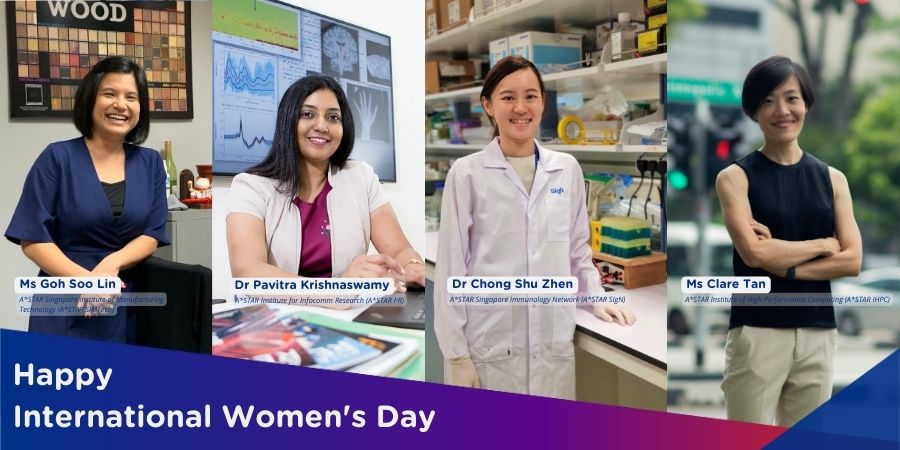
From groundbreaking discoveries to cutting-edge research, our researchers are empowering the next generation of female science, technology, engineering and mathematics (STEM) leaders.
Get inspired by our #WomeninSTEM