.png?sfvrsn=d3a97fa3_12)
News
7 Papers Accepted at AI4X 2026
Held from 15 – 19 June 2026 in Singapore, the AI4X – Accelerate Conference 2026 is a leading global platform at the intersection of artificial intelligence and scientific discovery, showcasing cutting-edge advances across disciplines – from materials science and biology to climate research and mathematics, while highlighting how AI-driven approaches accelerate innovation and real-world impact.
Congratulations to the following researchers from A*STAR Centre for Frontier AI Research (A*STAR CFAR) on having their papers accepted at AI4X:
- Prof Ivor Tsang, Director, A*STAR CFAR
- Prof Ong Yew Soon, Chief Artificial Intelligence (AI) Scientist and Advisor
- Dr Ooi Chin Chun, Investigator
- Dr Qian Hangwei, Scientist
- Mr Chen Caishun, Lead Research Engineer
- Mr Tang Leng Ze, Research Engineer
List of accepted papers:
| 1. | A Multimodal Conditional JEPA for Composite Materials Abhiroop Bhattacharya***, Hangwei Qian, Ivor Tsang We propose a conditional multimodal Joint Embedding Predictive Architecture (JEPA) model for composite materials, encouraging invariance to experimental measurement artifacts while retaining morphology and context-sensitive factors. |
| 2. | Divergence-Constrained Physics-Informed Neural Networks for Time-Domain Maxwell's Equations Chenhong Zhou, Zaifeng Yang, Xinyu Yang, Wei Bin Ewe, Hangwei Qian, Jie Chen We improve time-domain Maxwell PINNs by explicitly enforcing Gauss-law divergence constraints, yielding more accurate and faster-converging cavity simulations. |
| 3. | Quality-Diversity LLM for Generative Design Ariq Koh Boon Xiong, Melvin Wong, Jiao Liu, Caishun Chen, Yew-Soon Ong In this paper, we propose a new algorithmic or theoretical framework to improve learning efficiency or generalisation in modern AI models. |
| 4. | How Prompt Structural Framing and Cognitive Scaffolding Influence Performance in Generative AI Design? Yitian Huang, Caishun Chen, Jian Cheng Wong, Yew-Soon Ong We use large language models (LLMs) as zero-shot planners to translate natural language goals into executable action sequences, advancing general-purpose reasoning and decision-making abilities in AI agents. |
| 5. | When Designs Explain Themselves: Report Cards for Evolutionary LLMs Alex Siek Min Ping, Caishun Chen, Jian Cheng Wong, Yew-Soon Ong We introduce a reasoning-augmented evolutionary design framework where LLMs generate interpretable “report cards” from geometric and performance data to guide and explain iterative engineering optimisation. |
| 6. | VLM4Physics: Equation Discovery Using Multi-modal Inputs Ye Qianshu, Jian Cheng Wong, Chin Chun Ooi, Yew-Soon Ong This paper explicitly targets physics equation discovery and shows that combining visual inputs with LLM reasoning improves structural recovery and convergence in dynamical systems. |
| 7. | Multi-task Attention for Doped Thermoelectric Properties Prediction Tang Leng Ze, Trupti Mohanty, Sterling G. Baird, Leonard Ng Wei Tat, Taylor Sparks In this study, multi-task learning was applied alongside a composition-based transformer model, CrabNet, which lead to positive transfer and improved accuracy of thermoelectric properties. |
*** denotes current CFAR student
(accurate at time of posting)
More on AI4X 2026.
A*STAR celebrates International Women's Day
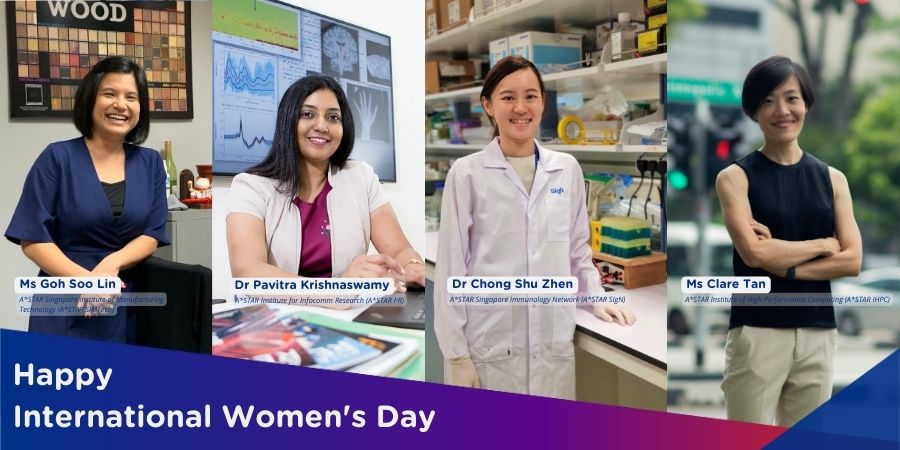
From groundbreaking discoveries to cutting-edge research, our researchers are empowering the next generation of female science, technology, engineering and mathematics (STEM) leaders.
Get inspired by our #WomeninSTEM