GIS
  • About Us
    • Welcome Message
    • GIS Story
    • GIS Brochures
  • News/Events
    • Press Releases
    • News
    • Genome: The GIS Speaker Series
    • Singapore RNA Seminar Series
    • Conferences and Other Seminars
      • #GIS25 Genome Innovation & Precision Medicine Conference
    • RNA Salon Singapore
    • Videos
    • Awards
  • Our People
    • FACULTY Staff
    • Associate Faculty
    • Adjunct Faculty
    • GIS FELLOWS / GIS INNOVATION FELLOW
    • Platform Leaders
    • Programme Managers
    • Research Administration
    • Senior Scientist
    • Scientist
  • Our Science
    • Sequencing Platforms
      • Next Generation Sequencing
      • Genotyping
    • Genome Informatics and AI
      • Artificial Intelligence (AI) at GIS
      • GRIDS
      • Computational Tools and Resources
    • Precision Medicine And Population Genomics
      • Centre for Genome Diagnostics
      • EMULSION
      • NPM
      • Eye Genetics
      • CaLiBRe
      • Operation Stronghold
    • Epigenetic And Epitranscriptomic Regulation
    • Spatial And Single Cell Systems
      • Spatial and Single Cell Genomics Platform
      • Singapore Single-Cell Network
      • Single-Cell In Situ Spatial Omics at Subceullar Resolution
    • Genome Architecture And Design
      • GERMS
      • Asian Skin Microbiome Programme
      • CRISPR Platform
      • Precision Infectious Disease Solutions
    • Disease Research At GIS
      • Oncology Disease Research
      • Eye Disease Research
      • Neurological Disease Research
      • Infectious Disease Research
      • Cardiovascular Disease Research
    • GIS Software for Commercial Licensing
      • MutSpot
      • NDRquant
      • PUREE
      • SMuRFv2
      • VarNet
      • gRNA Designers
      • m6anet
      • proActiv
      • xPore
      • BANKSY
      • DUBStepR
      • RCAv2
  • Join Us
    • Careers
    • Students
    • Partner With Us
  • Contact Us
  • Home
  • A*STAR GIS
  • News/Events
  • News
  • News 2024
  • A*STAR GIS
  • About Us
    • Welcome Message
    • GIS Story
    • GIS Brochures
  • News/Events
    • Press Releases
    • News
    • Genome: The GIS Speaker Series
    • Singapore RNA Seminar Series
    • Conferences and Other Seminars
      • #GIS25 Genome Innovation & Precision Medicine Conference
    • RNA Salon Singapore
    • Videos
    • Awards
  • Our People
    • FACULTY Staff
    • Associate Faculty
    • Adjunct Faculty
    • GIS FELLOWS / GIS INNOVATION FELLOW
    • Platform Leaders
    • Programme Managers
    • Research Administration
    • Senior Scientist
    • Scientist
  • Our Science
    • Sequencing Platforms
      • Next Generation Sequencing
      • Genotyping
    • Genome Informatics and AI
      • Artificial Intelligence (AI) at GIS
      • GRIDS
      • Computational Tools and Resources
    • Precision Medicine And Population Genomics
      • Centre for Genome Diagnostics
      • EMULSION
      • NPM
      • Eye Genetics
      • CaLiBRe
      • Operation Stronghold
    • Epigenetic And Epitranscriptomic Regulation
    • Spatial And Single Cell Systems
      • Spatial and Single Cell Genomics Platform
      • Singapore Single-Cell Network
      • Single-Cell In Situ Spatial Omics at Subceullar Resolution
    • Genome Architecture And Design
      • GERMS
      • Asian Skin Microbiome Programme
      • CRISPR Platform
      • Precision Infectious Disease Solutions
    • Disease Research At GIS
      • Oncology Disease Research
      • Eye Disease Research
      • Neurological Disease Research
      • Infectious Disease Research
      • Cardiovascular Disease Research
    • GIS Software for Commercial Licensing
      • MutSpot
      • NDRquant
      • PUREE
      • SMuRFv2
      • VarNet
      • gRNA Designers
      • m6anet
      • proActiv
      • xPore
      • BANKSY
      • DUBStepR
      • RCAv2
  • Join Us
    • Careers
    • Students
    • Partner With Us
  • Contact Us
Agency for Science, Technology and Research (A*STAR)
PartnershipsCareersSuppliersContact UsWhistleblowing
  • Report Vulnerability
  • Privacy Statement
  • Terms & Conditions
  • News 2024

    Does having too much red meat result in colorectal cancer (CRC)?
    27 Aug 2024
    • Whatsapp
    • Telegram
    • Facebook
    • Twitter
    • Email
    • Linked In

    astar-image-placeholder

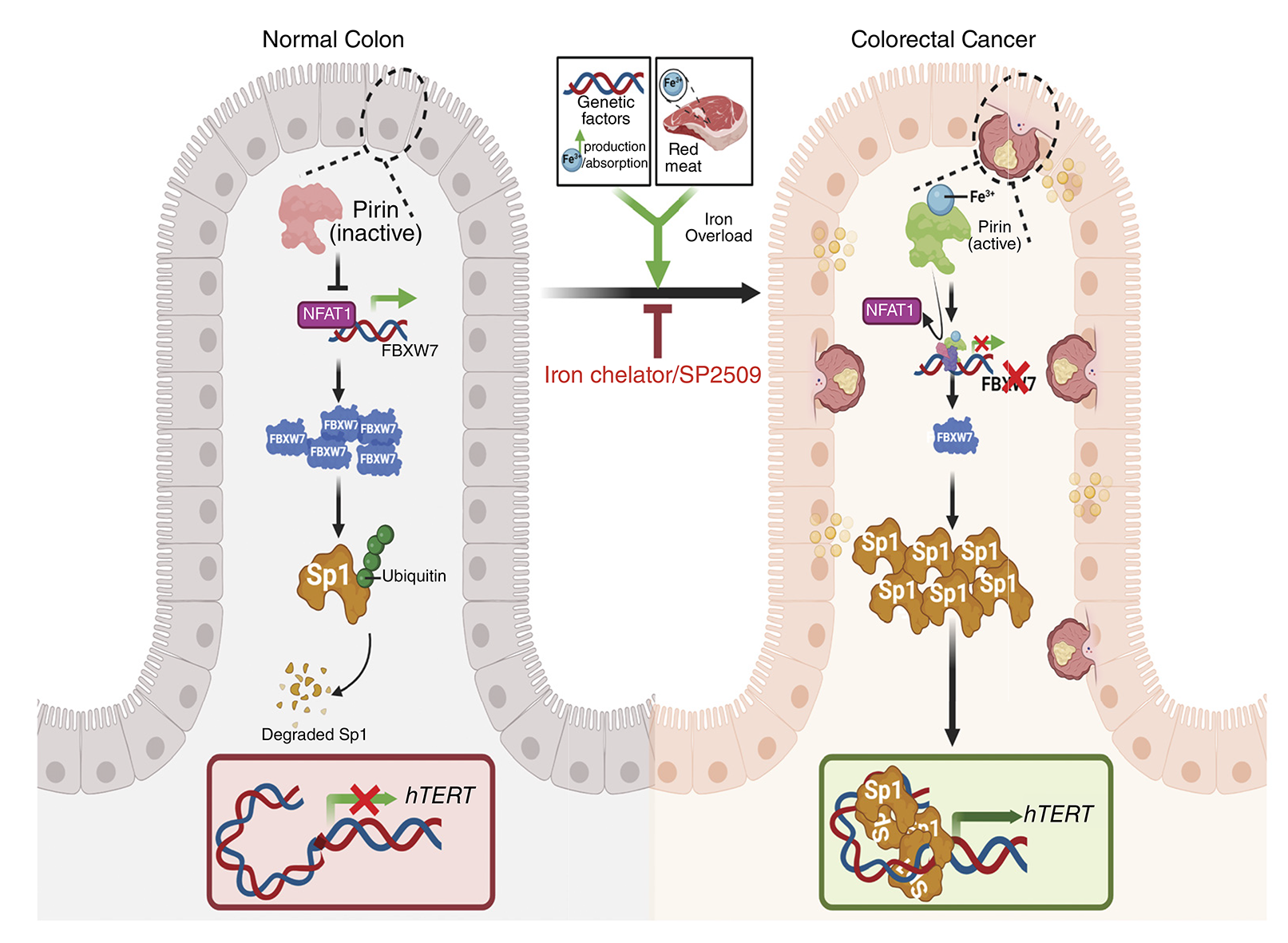
    F, Model of colorectal cancer pathogenesis by iron-(Fe3+)-dependent Pirin and its therapeutic targeting. The transformation of normal colonic epithelium to colorectal cancer is mainly attributed to genetic events that include driver mutations contributing to the adenoma–carcinoma progression as well as nongenetic factors like high iron levels. Here, we show that Pirin binding with iron-(Fe3+) (from sources such as red meat or because of iron overload due to genetic conditions like hereditary hemochromatosis) leads to its ability as a transcription factor, and this complex reduces NFAT1 occupancy on the FBXW7 promoter. On the reduced synthesis of FBXW7 protein, ubiquitination of Sp1 decreases leading to increased steady-state levels of Sp1. Consequently, Sp1 multimers activate hTERT transcription, leading to the reconstitution and activation of telomerase activity in cancer cells, causing cellular immortalization. Further molecules like SP2509 or iron chelators (DFX) that can block this pathway could be developed for colorectal cancer and other iron-dependent cancers. (F, created with BioRender.com.)

    27 August 2024 - A new study led by IMCB, GIS, National Cancer Centre Singapore, and Singapore General Hospital, revealed that high iron levels, often linked to red meat consumption, can drive colorectal cancer by reactivating telomerase, a key enzyme in 90% of cancers. Their research identified a novel mechanism where the iron-binding protein Pirin triggers telomerase reactivation, offering new insights into CRC pathogenesis.

    The NRF-CRP-funded collaboration between the two labs – IMCB’s Dr Vinay Tergaonkar (Lead-PI on CRP) and GIS’s Dr Ramanuj DasGupta (Co-I and theme lead on CRP) and team (Joo Leng Low, Mert B. Ozturk and Shumei Chia) led to the initial discovery of SP2509, a small molecule that specifically inhibits Pirin-mediated hTERT reactivation in colorectal cancers by competing with iron-(Fe3+) binding.

    This breakthrough has led to a greater understanding of the role of iron overload in cancer biology, paving the way for more innovative treatments to combat colorectal cancer.

    Read more about their research here: https://aacrjournals.org/cancerdiscovery/article/doi/10.1158/2159-8290.CD-23-1379/746672/Iron-Fe3-Dependent-Reactivation-of-Telomerase