Building a National Precision Medicine (NPM) programme – SG10K_Health
Background
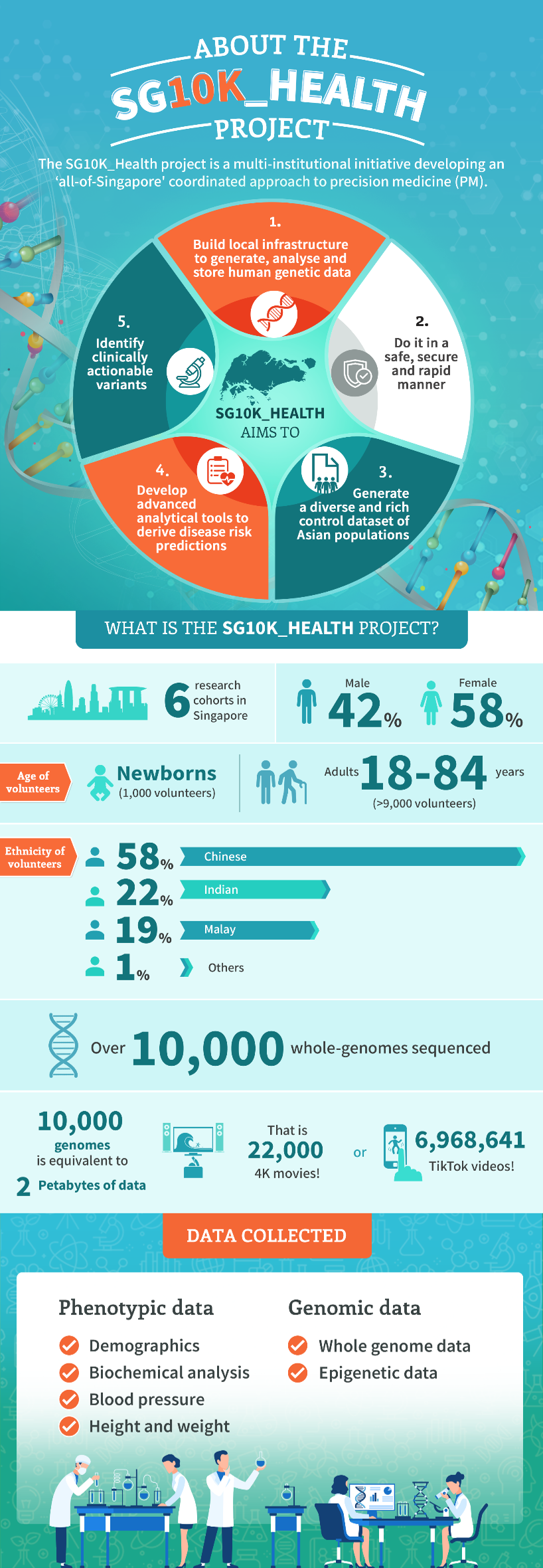
The SG10K_Health project is a multi-institutional initiative developing an ‘all-of-Singapore' coordinated approach to precision medicine (PM). PM is a fast emerging field that seeks to improve treatment and prevent disease by considering individual and population genetic variation in genes, environment and lifestyle patterns. Through PM, patients may receive more accurate diagnosis, customised treatments achieving maximal benefit while minimising side effects, and reduced health care costs by avoiding ineffective treatments. At present, the Asian population is severely under-represented in the public genotypic databases. The current lack of large-scale control databases of Asian-specific genetic variation linked to clinical phenotypes is a significant barrier to the conduct of PM in Asia, to avoid mis-diagnosis and overtreatment due to the mistaken identification of pathogenic variants. The Singaporean population consists of three major ethnic groups, Chinese, Malay, and Indian, which together represent over 80% of the genetic variation in Asia. The presence of these three major ethnic groups in a single country thus offers a unique opportunity for Singapore, despite its small size, to contribute to global efforts in PM, complementing other large-scale efforts such as All of US and Genomics England.
Objectives
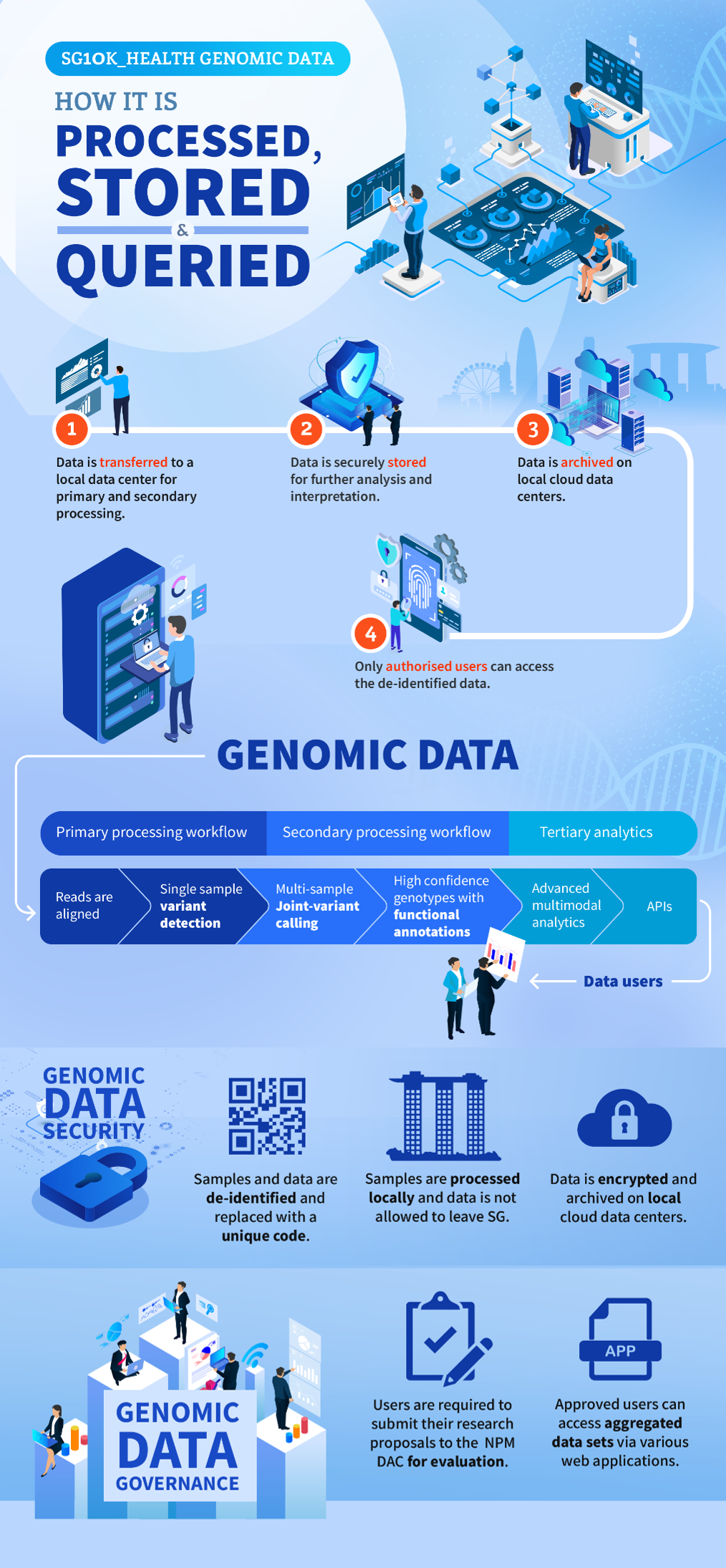
The SG10K_Health project aims to empower biomedical and genetic studies of Singapore and Asian-centric diseases by: 1) building local infrastructure and deep capabilities to generate, analyse and store human genetic data at population scale, in a safe, secure and rapid manner, 2) generating a diverse and rich control dataset of Asian populations for genetic association study of diseases, and 3) developing advanced analytical tools for genetic variants interpretation to derive disease risk predictions and identify clinically actionable variants. Notably, statistical estimates indicate that a genomic data set of 10,000 individuals will be sufficient to capture essentially all common alleles (ie more than 1% allele frequency) in our Singapore population. Currently, the SG10K_Health data is linked to research traits (e.g., height, weight, blood pressure) and in the future will be linked to clinical records, subject to participant consent.
Genomic Web Services
We have established various web services to enable users to query the SG10K_Health dataset, including allele frequencies, protein-drug interactions, and polygenic risk scores. The web services can be access through the below links:
Data Access
The NPM Phase I Data Access Committee (NPM DAC) has been established to oversee access to the SG10K_Pilot and SG10K_Health datasets. Click here for more details on Data access and RAPTOR data access platform.
Publications & Press Release
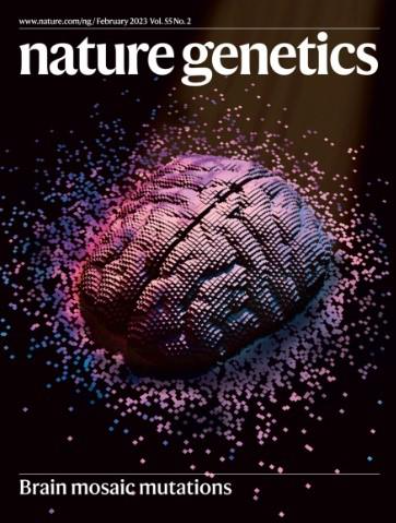
Credit image source: Nature Genetics

Credit image source: Cell
- Sequenced whole genomes of 10,323 healthy consented individuals
- Discovered over 179 million variants, 43% of which are novel (not detected in dbSNP151)
- Generated insights into population structure and identified clinically relevant variants and Asian specific structural variations
- Discovery of 52 million novel variants by 13.7× WGS of 4,810 Singaporeans
- Insights into population structure and evolutionary history of Asians
- Identification of 20 loci under selection that are enriched for GWAS signals
- Substantial improvement of imputation in diverse Asian and Oceanian populations
- Joanna Hui Juan Tan, Zhihui Li, Mar Gonzalez Porta, et al. A Catalogue of Structural Variation across Ancestrally Diverse Asian Genomes Nat. Comms. doi.org/10.1038/s41467-024-53620-8
- Eleanor Wong, Nicolas Bertin, Maxime Hebrard, et al. The Singapore National Precision Medicine Strategy Nature Genetics doi: 10.1038/s41588-022-01274-x (19 Jan 2023)
- Sock Hoai Chan, Yasmin Bylstra, Jing Xian Teo, et al. Analysis of clinically relevant variants from ancestrally diverse Asian genomes Nature Communication doi: 10.1038/s41467-022-34116-9 (05 Nov 2022)
- Jing Xian Teo, Sonia Davila, Chengxi Yang, et al. Digital phenotyping by consumer wearables identifies sleep-associated markers of cardiovascular disease risk and biological aging Communications Biology doi: 10.1038/s42003-019-0605-1 (04 Oct 2019)
- Yasmin Bylstra, Sonia Davila, Weng Khong Lim, et al. Implementation of genomics in medical practice to deliver precision medicine for an Asian population Genomic Medicine doi: 10.1038/s41525-019-0085-8 (07 Jun 2019)
- Degang Wu, Jinzhuang Dou, Xiaoran Chai, et al. Large-scale whole genome sequencing of three diverse Asian populations in Singapore Cell doi: 10.1016/j.cell.2019.09.019 (17 Oct 2019)[
Press Release
Whole Genome Sequencing (WGS) Quality Control (QC) Standards approved as an official GA4GH product
The Genome Institute of Singapore (GIS), A*STAR, has led the development of the newly approved Whole Genome Sequencing (WGS) Quality Control (QC) Standards, now recognised as an official product of the Global Alliance for Genomics and Health (GA4GH). Developed within the Large-Scale Genomics (LSG) Work Stream, with input from the Genomic Knowledge Standards (GKS) Work Stream, this framework provides a unified approach for assessing WGS data quality across global genomics initiatives. Product development was led by Maxime Hebrard, Justin Jeyakani and Nicolas Bertin from GIS, A*STAR — working closely with the GA4GH LSG community under the guidance of Work Stream Manager Reggan Thomas (EMBL’s European Bioinformatics Institute).
Programme investigators
Lead investigators: Prof Patrick Tan (GIS) and Prof Tai E Shyong (NUHs)
Co-investigators: Prof John Chambers (LKCMedicine), Dr Neerja Karnani (SICS), Prof Liu Jian Jun (GIS), Dr Shyam Prabhakar (GIS), Dr Birgit Eisenhaber (BII), Dr Chandra Verma (BII), Dr Sebastian Maurer-Stroh (BII), Dr Rick Goh (IHPC), Dr Sonia Davila (Duke-NUS), Dr Pavitra Krishnaswamy (I2R), Dr Sim Xueling (NUS), Dr Marie Loh (LKCMedicine), Prof Cheng Ching-Yu (SERI) and Dr Leong Khai Pang (TTSH).
Contact Us
For more information on the SG10K_Health program and web services, please reach out to us at contact_npco@a-star.edu.sg
FAQ
Q. How do each of the Genomics web services works?