AI-Based Method To Identify Cancer Mutations
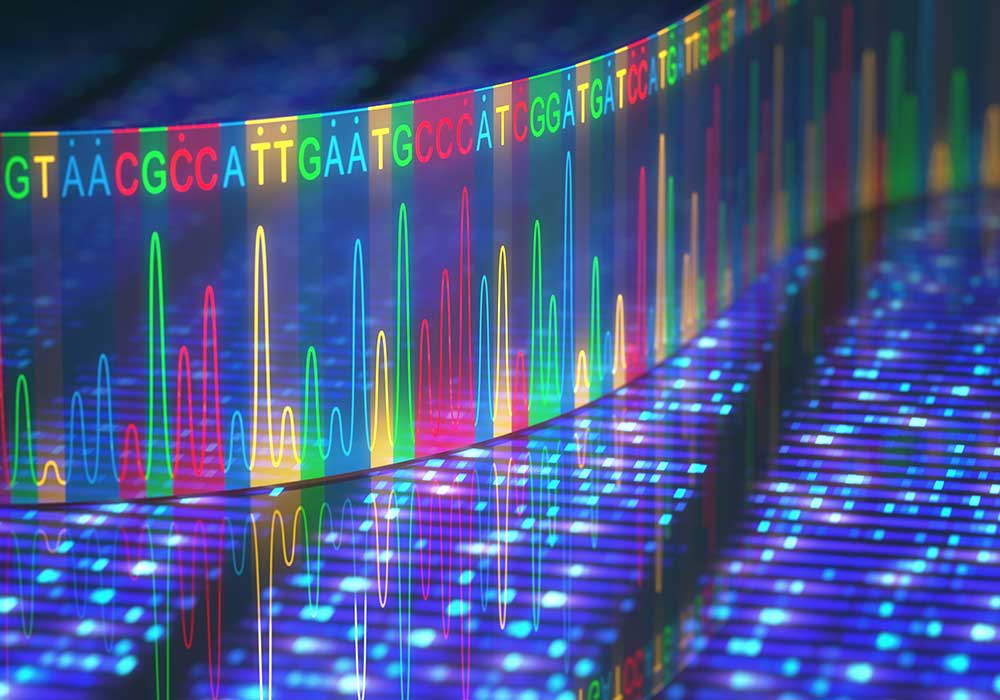
3D illustration of a method of DNA sequencing. (Copyright: Genome Institute of Singapore)
SINGAPORE – Scientists from A*STAR’s Genome Institute of Singapore (GIS) have developed a novel artificial intelligence (AI)-based method, named Variant Network (VarNet), that can inspect and identify cancer mutations (variants) in the millions of DNA fragments inside a tumour sample. It will serve as a key compass in steering personalised treatment strategies in the fight against cancer. VarNet can be used in both clinical as well as research settings to analyse mutations to tailor treatment strategies or better understand cancer. The research was published in Nature Communications on 22 July 2022.
Cancer is a genetic disease caused by mutations that are acquired during an individual’s lifetime. Identifying these mutations has been a longstanding challenge that must be solved in order to develop personalised treatment strategies—providing the right treatment to the right patient at the right time. This research was developed to address that challenge.
VarNet uses deep learning, an AI approach, to detect cancer mutations without any specialised knowledge of cancer and genomics. VarNet was trained on vast amounts of cancer sequencing data from both Singapore and international databases. When evaluated on real tumour benchmarks, VarNet often exceeds existing mutation identification algorithms in terms of accuracy. The accurate identification of mutations in tumours affects downstream analyses that could have an impact on research outcomes as well as treatment decisions in the clinic.
Dr Anders Skanderup, Group Leader of the Laboratory of Computational Cancer Genomics and corresponding author of the study, said, “We have been working on machine learning methods for some time to improve detection of cancer mutations. During this work, we learned that human experts were often involved in the process to validate selected high-confidence cancer mutations. Such human experts make decisions by inspecting images of DNA reads overlapping the potential mutations. However, while a human can only do this for a couple of mutations in a limited amount of time, an AI-approach could potentially perform the same task across the entire 3 billion nucleotides in the human genome. This inspired us to leverage deep learning approaches that learn patterns in images, and develop a pure AI-based method for identifying mutations in cancer.”
Kiran Krishnamachari, a PhD candidate and A*STAR Computing and Information Science scholar affiliated with GIS who is the first author of the study, noted that the system learnt to detect mutations from the raw data in a manner that a human expert would do when manually inspecting potential mutations. He remarked, "This gave us the confidence that the system can learn relevant mutational features when trained on vast sequencing datasets, using our weak-supervision strategy that does not require excessive manual labelling."
Prof Patrick Tan, Executive Director of GIS, said, “Identifying cancer mutation is a critical step in developing precision medicine. VarNet demonstrates that deep machine learning can detect cancer mutations with an accuracy often exceeding existing state-of-the-art methods.”
The new AI model is available to cancer researchers to provide fast and accurate detection of cancer mutations at https://github.com/skandlab/VarNet.
For media queries and clarifications, please contact:Genome Institute of Singapore, A*STAR
Lyn Lai
Senior Officer, Office of Corporate Communications
Genome Institute of Singapore, A*STAR
Tel: +65 6808 8258
HP: +65 8755 8759
Email: laiy@gis.a-star.edu.sg
About A*STAR’s Genome Institute of Singapore (GIS)
The Genome Institute of Singapore (GIS) is an institute of the Agency for Science, Technology and Research (A*STAR). It has a global vision that seeks to use genomic sciences to achieve extraordinary improvements in human health and public prosperity. Established in 2000 as a centre for genomic discovery, the GIS pursues the integration of technology, genetics and biology towards academic, economic and societal impact, with a mission to "read, reveal and write DNA for a better Singapore and world".
Key research areas at the GIS include Precision Medicine & Population Genomics, Genome Informatics, Spatial & Single Cell Systems, Epigenetic & Epitranscriptomic Regulation, Genome Architecture & Design, and Sequencing Platforms. The genomics infrastructure at the GIS is also utilised to train new scientific talent, to function as a bridge for academic and industrial research, and to explore scientific questions of high impact.
For more information about GIS, please visit www.a-star.edu.sg/gis.
About the Agency for Science, Technology and Research (A*STAR)
A*STAR is Singapore's lead public sector R&D agency. Through open innovation, we collaborate with our partners in both the public and private sectors to benefit the economy and society. As a Science and Technology Organisation, A*STAR bridges the gap between academia and industry. Our research creates economic growth and jobs for Singapore, and enhances lives by improving societal outcomes in healthcare, urban living, and sustainability. A*STAR plays a key role in nurturing scientific talent and leaders for the wider research community and industry. A*STAR’s R&D activities span biomedical sciences to physical sciences and engineering, with research entities primarily located in Biopolis and Fusionopolis. For ongoing news, visit www.a-star.edu.sg.
Follow us on
Facebook | LinkedIn | Instagram | YouTube