GIS AWARDED OF-LCG FOR NOSE CANCER RESEARCH
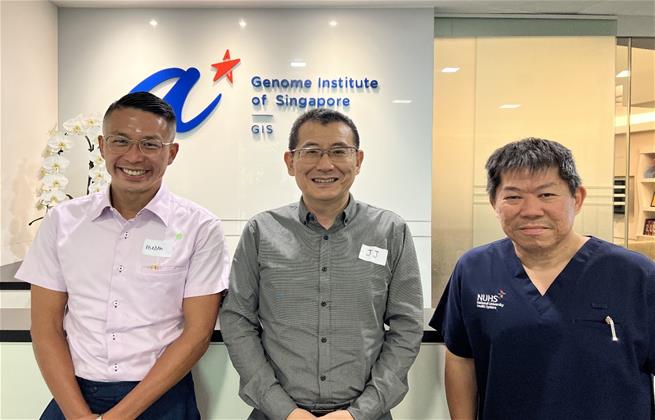
From left: Associate Prof Melvin L. K. Chua, Prof Liu Jian Jun, and Associate Prof Thomas Loh Kwok Seng. (Copyright: A*STAR’s Genome Institute of Singapore)
SINGAPORE – A team of researchers led by A*STAR’s Genome Institute of Singapore (GIS), along with the National University Cancer Institute, Singapore (NCIS) and National Cancer Centre Singapore (NCCS), was awarded the prestigious Open Fund-Large Collaborative Grant (OF-LCG), which is supported by the National Research Foundation, Singapore (NRF) and administered by the Singapore Ministry of Health’s National Medical Research Council (NMRC), to establish an integrated research programme to improve the early diagnosis and survival rate of patients with nasopharyngeal cancer (NPC).
Commonly referred to as nose cancer, NPC occurs in the upper part of the throat, behind the nose. It is the second most common cancer in adult males in Singapore between the ages of 40 to 49 years. It affects people of Chinese ancestry, particularly from Southern China, as well as the Malay and indigenous Southeast Asian populations.
Due to non-specific symptoms of NPC and clinical silence of early-stage tumour, the majority of NPC patients tend to be diagnosed with late-stage disease, with less than 10% of patients diagnosed at Stage 1. This has a bearing on prognosis and treatment for NPC patients—for those at a more advanced stage at diagnosis, poorer survival rates are expected and those who recover face up to a 40% chance of a relapse. If found and treated at an early stage, NPC survival and cure rates are usually higher, with 10-year survival rate of above 90% for patients with Stage 1 tumour.
Targeting the Epstein-Barr virus
NPC is consistently associated with Epstein-Barr virus (EBV) infection, but it still unclear why only some individuals, particularly the Southern Chinese, develop NPC, while over 90% of world population are infected by EBV. An early study1 by the team revealed that specific EBV high-risk strains are driving NPC development in populations from Southern China. However, it is unknown if this is also occuring in other NPC-endemic regions, such as Southeast Asia.
This new research programme aims to develop EBV-centric strategies to enable effective population screening for early diagnosis of NPC and advance personalised treatment. The programme will focus on three collaborative studies:
- Genome sequencing analysis studies to uncover EBV risk strain(s) that drive NPC development in Southeastern Asian populations.
- A screening programme in the community that will evaluate the effectiveness of EBV high-risk strains, serology, and circulating DNA as biomarkers to identify individuals who are at high risk of developing NPC. Clinical evaluation and subsequent follow-up of these individuals will enable the early diagnosis of NPC.
- A multi-arm platform clinical trial named RIBBON (tReatment optImisation By eBv stratificatiOn in Npc), which will test several individualised strategies in patients with Stage 2-4 and recurrent-metastatic NPC using their EBV DNA test results.
Prof Liu Jian Jun, Distinguished Institute Fellow at A*STAR’s GIS, and leading Principal Investigator of this research programme, said, “The discovery of EBV risk strains as a genetic determinant for NPC development has greatly unlocked opportunities to explore new strategies that can transform the clinical management of NPC. The success of this collaboration will improve the effectiveness of early-stage diagnosis and personalised treatment for NPC patients in Singapore as well as Southeast Asia.”
Associate Prof Thomas Loh Kwok Seng, Senior Consultant, Department of Otolaryngology – Head & Neck Surgery, National University Hospital (NUH) and Division of Surgical Oncology, NCIS, said, “We have shown the effectiveness of screening in first-degree relatives of NPC patients. This timely programme will allow us to extend screening to the at-risk population in the community between the ages of 40 to 60 years, to identify and effectively treat early stage disease.”
Associate Prof Melvin L. K. Chua, Head and Senior Consultant, Department of Head and Neck and Thoracic, Division of Radiation Oncology at NCCS, said, “Our NPC research programme is a long-awaited opportunity for investigators from surgery, oncology, genomics and immunology, and health service research to come together to address urgent gaps in personalised treatments for a cancer that predominantly affects Asian men who are in the prime of their lives. As ~30% of patients relapse following chemotherapy and radiotherapy, there is a great need for more effective drugs.”
For media queries and clarifications, please contact:Genome Institute of Singapore, A*STAR
Lyn Lai
Senior Officer, Office of Corporate Communications
Genome Institute of Singapore, A*STAR
Tel: +65 6808 8258
HP: +65 8755 8759
Email: laiy@gis.a-star.edu.sg
Dharshini Subbiah
Assistant Manager, Corporate Communications
National Cancer Centre Singapore
HP: +65 9616 7532
Email: dharshini.subbiah@nccs.com.sg
Amal Naquiah for National University Cancer Institute, Singapore
Manager, Group Communications
National University Health Systems
HP: +65 8200 0346
Email: amal_naquiah_ahmad@nuhs.edu.sg
About A*STAR’s Genome Institute of Singapore (GIS)
The Genome Institute of Singapore (GIS) is an institute of the Agency for Science, Technology and Research (A*STAR). It has a global vision that seeks to use genomic sciences to achieve extraordinary improvements in human health and public prosperity. Established in 2000 as a centre for genomic discovery, the GIS pursues the integration of technology, genetics and biology towards academic, economic and societal impact, with a mission to "read, reveal and write DNA for a better Singapore and world".
Key research areas at the GIS include Precision Medicine & Population Genomics, Genome Informatics, Spatial & Single Cell Systems, Epigenetic & Epitranscriptomic Regulation, Genome Architecture & Design, and Sequencing Platforms. The genomics infrastructure at the GIS is also utilised to train new scientific talent, to function as a bridge for academic and industrial research, and to explore scientific questions of high impact.
For more information about GIS, please visit www.a-star.edu.sg/gis.
About the Agency for Science, Technology and Research (A*STAR)
A*STAR is Singapore's lead public sector R&D agency. Through open innovation, we collaborate with our partners in both the public and private sectors to benefit the economy and society. As a Science and Technology Organisation, A*STAR bridges the gap between academia and industry. Our research creates economic growth and jobs for Singapore, and enhances lives by improving societal outcomes in healthcare, urban living, and sustainability. A*STAR plays a key role in nurturing scientific talent and leaders for the wider research community and industry. A*STAR’s R&D activities span biomedical sciences to physical sciences and engineering, with research entities primarily located in Biopolis and Fusionopolis. For ongoing news, visit www.a-star.edu.sg.
Follow us on
Facebook | LinkedIn | Instagram | YouTube
About the National Cancer Centre Singapore
The National Cancer Centre Singapore (NCCS) is a leading national and regional tertiary cancer centre with specialists who are experts in treating cancer. NCCS attends to the majority of cancer cases in Singapore’s public healthcare sector. In addition to offering holistic and multidisciplinary oncology care, our clinicians and scientists collaborate with local and international partners to conduct robust, cutting-edge clinical and translational research. To achieve the vision of being a global leading cancer centre, NCCS offers world class care and shares its depth of experience and expertise by training local and overseas medical professionals.
To meet growing needs, the new NCCS building will be completed in 2022 with increased capacity and expanded facilities dedicated to cancer care, rehabilitation, research and education. To give patients the best treatment outcomes, NCCS will offer access to advanced and innovative treatment such as proton therapy at the new Goh Cheng Liang Proton Therapy Centre.
For more information, please visit: www.nccs.com.sg
About National University Cancer Institute, Singapore (NCIS)
The National University Cancer Institute, Singapore (NCIS) offers a broad spectrum of cancer care and management covering both paediatric and adult cancers, with expertise in prevention, screening, diagnosis, treatment, rehabilitation and palliative care. The Institute’s strength lies in the multi-disciplinary approach taken to develop a comprehensive and personalised plan for each cancer patient and his or her family. Our award-winning clinician-scientists and clinician-investigators conduct translational research and clinical trials, providing patients with access to evidence-based cancer diagnostics, technology and therapies.