GIS
  • About Us
    • Welcome Message
    • GIS Story
    • GIS Brochures
  • News/Events
    • Press Releases
    • News
    • Genome: The GIS Speaker Series
    • Singapore RNA Seminar Series
    • Conferences and Other Seminars
      • #GIS25 Genome Innovation & Precision Medicine Conference
    • RNA Salon Singapore
    • Videos
    • Awards
  • Our People
    • FACULTY Staff
    • Associate Faculty
    • Adjunct Faculty
    • GIS FELLOWS / GIS INNOVATION FELLOW
    • Platform Leaders
    • Programme Managers
    • Research Administration
    • Senior Scientist
    • Scientist
  • Our Science
    • Sequencing Platforms
      • Next Generation Sequencing
      • Genotyping
    • Genome Informatics and AI
      • Artificial Intelligence (AI) at GIS
      • GRIDS
      • Computational Tools and Resources
    • Precision Medicine And Population Genomics
      • Centre for Genome Diagnostics
      • EMULSION
      • NPM
      • Eye Genetics
      • CaLiBRe
      • Operation Stronghold
    • Epigenetic And Epitranscriptomic Regulation
    • Spatial And Single Cell Systems
      • Spatial and Single Cell Genomics Platform
      • Singapore Single-Cell Network
      • Single-Cell In Situ Spatial Omics at Subceullar Resolution
    • Genome Architecture And Design
      • GERMS
      • Asian Skin Microbiome Programme
      • CRISPR Platform
      • Precision Infectious Disease Solutions
    • Disease Research At GIS
      • Oncology Disease Research
      • Eye Disease Research
      • Neurological Disease Research
      • Infectious Disease Research
      • Cardiovascular Disease Research
    • GIS Software for Commercial Licensing
      • MutSpot
      • NDRquant
      • PUREE
      • SMuRFv2
      • VarNet
      • gRNA Designers
      • m6anet
      • proActiv
      • xPore
      • BANKSY
      • DUBStepR
      • RCAv2
  • Join Us
    • Careers
    • Students
    • Partner With Us
  • Contact Us
  • Home
  • A*STAR GIS
  • News/Events
  • News
  • News 2024
  • A*STAR GIS
  • About Us
    • Welcome Message
    • GIS Story
    • GIS Brochures
  • News/Events
    • Press Releases
    • News
    • Genome: The GIS Speaker Series
    • Singapore RNA Seminar Series
    • Conferences and Other Seminars
      • #GIS25 Genome Innovation & Precision Medicine Conference
    • RNA Salon Singapore
    • Videos
    • Awards
  • Our People
    • FACULTY Staff
    • Associate Faculty
    • Adjunct Faculty
    • GIS FELLOWS / GIS INNOVATION FELLOW
    • Platform Leaders
    • Programme Managers
    • Research Administration
    • Senior Scientist
    • Scientist
  • Our Science
    • Sequencing Platforms
      • Next Generation Sequencing
      • Genotyping
    • Genome Informatics and AI
      • Artificial Intelligence (AI) at GIS
      • GRIDS
      • Computational Tools and Resources
    • Precision Medicine And Population Genomics
      • Centre for Genome Diagnostics
      • EMULSION
      • NPM
      • Eye Genetics
      • CaLiBRe
      • Operation Stronghold
    • Epigenetic And Epitranscriptomic Regulation
    • Spatial And Single Cell Systems
      • Spatial and Single Cell Genomics Platform
      • Singapore Single-Cell Network
      • Single-Cell In Situ Spatial Omics at Subceullar Resolution
    • Genome Architecture And Design
      • GERMS
      • Asian Skin Microbiome Programme
      • CRISPR Platform
      • Precision Infectious Disease Solutions
    • Disease Research At GIS
      • Oncology Disease Research
      • Eye Disease Research
      • Neurological Disease Research
      • Infectious Disease Research
      • Cardiovascular Disease Research
    • GIS Software for Commercial Licensing
      • MutSpot
      • NDRquant
      • PUREE
      • SMuRFv2
      • VarNet
      • gRNA Designers
      • m6anet
      • proActiv
      • xPore
      • BANKSY
      • DUBStepR
      • RCAv2
  • Join Us
    • Careers
    • Students
    • Partner With Us
  • Contact Us
Agency for Science, Technology and Research (A*STAR)
PartnershipsCareersSuppliersContact UsWhistleblowing
  • Report Vulnerability
  • Privacy Statement
  • Terms & Conditions
  • News 2024

    GIS RESEARCHERS DEVELOP FISHNCHIPS TO VISUALIZE DIFFERENT CELL TYPES WITHIN A DENSELY PACKED TISSUE

    15 Mar 2024
    • Whatsapp
    • Telegram
    • Facebook
    • Twitter
    • Email
    • Linked In

    15 March 2024 - In biology, cells are the fundamental units of life, playing vital specialized roles like neurons transmitting signals or immune cells fighting disease. Traditionally, the goal of spatial transcriptomics has been to identify individual cell types using individual marker genes within a tissue sample. But this can be as difficult as spotting a particular person from a distance in a crowd. Just as individual features may be indistinguishable from afar, markers for certain cell types can also be too faint or blurry.

    A team of researchers from A*STAR’s Genome Institute of Singapore (GIS) recently published a paper in Nature Communications to address this challenge. Principal Investigator and Group Leader at GIS’ Laboratory of Imagenomics, Dr Kok Hao Chen, Dr Nigel Chou and their team are early developers of spatial transcriptomics technologies in their research and wanted to derive an assay that would be more cost-effective and scalable. By using sets of genes, they developed FISHnCHIPs (Fluorescence In Situ Hybridization of Cellular HeterogeneIty and gene expression Programs), which maintains or even improves the robustness and sensitivity of the assay. The FISHnCHIPS method elegantly solves this challenge by looking at combinations of co-expressed markers instead of individual markers. The key insight is that genes involved in the same biological processes or pathways are co-localized within the same cells. Rather than relying on individual marker genes, FISHnCHIPs targets the entire gene programs. This allows it to rely on the multidimensional molecular "fingerprints" to robustly detect and distinguish different cell types. This enhanced sensitivity allows rapid, sensitive, and robust whole-tissue profiling under low magnification, and applicable for analyses of clinical tissue samples with low RNA quality. Remarkably, FISHnCHIPs also works robustly in frozen human samples, opening new avenues for discovering the spatial origin of rare cell types in disease. For more information, read the full article at: Protocols & Methods
    astar-image-placeholder
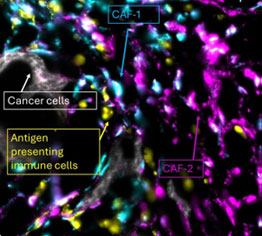
    The colon tumor microenvironment imaged with FISHnCHIPs, showing two major types of fibroblasts cells (CAF) and their interactions with the immune and cancer cells.
    astar-image-placeholder
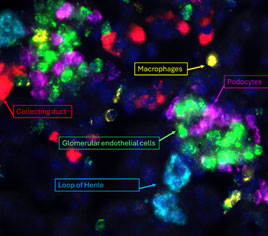
    Kidney tissue imaged with FISHnCHIPs, showing cell types in and surrounding the Bowman’s capsule.