GIS
  • About Us
    • Welcome Message
    • GIS Story
    • GIS Brochures
  • News/Events
    • Press Releases
    • News
    • Genome: The GIS Speaker Series
    • Singapore RNA Seminar Series
    • Conferences and Other Seminars
      • #GIS25 Genome Innovation & Precision Medicine Conference
    • RNA Salon Singapore
    • Videos
    • Awards
  • Our People
    • FACULTY Staff
    • Associate Faculty
    • Adjunct Faculty
    • GIS FELLOWS / GIS INNOVATION FELLOW
    • Platform Leaders
    • Programme Managers
    • Research Administration
    • Senior Scientist
    • Scientist
  • Our Science
    • Sequencing Platforms
      • Next Generation Sequencing
      • Genotyping
    • Genome Informatics and AI
      • Artificial Intelligence (AI) at GIS
      • GRIDS
      • Computational Tools and Resources
    • Precision Medicine And Population Genomics
      • Centre for Genome Diagnostics
      • EMULSION
      • NPM
      • Eye Genetics
      • CaLiBRe
      • Operation Stronghold
    • Epigenetic And Epitranscriptomic Regulation
    • Spatial And Single Cell Systems
      • Spatial and Single Cell Genomics Platform
      • Singapore Single-Cell Network
      • Single-Cell In Situ Spatial Omics at Subceullar Resolution
    • Genome Architecture And Design
      • GERMS
      • Asian Skin Microbiome Programme
      • CRISPR Platform
      • Precision Infectious Disease Solutions
    • Disease Research At GIS
      • Oncology Disease Research
      • Eye Disease Research
      • Neurological Disease Research
      • Infectious Disease Research
      • Cardiovascular Disease Research
    • GIS Software for Commercial Licensing
      • MutSpot
      • NDRquant
      • PUREE
      • SMuRFv2
      • VarNet
      • gRNA Designers
      • m6anet
      • proActiv
      • xPore
      • BANKSY
      • DUBStepR
      • RCAv2
  • Join Us
    • Careers
    • Students
    • Partner With Us
  • Contact Us
  • Home
  • A*STAR GIS
  • News/Events
  • News
  • News 2024
  • A*STAR GIS
  • About Us
    • Welcome Message
    • GIS Story
    • GIS Brochures
  • News/Events
    • Press Releases
    • News
    • Genome: The GIS Speaker Series
    • Singapore RNA Seminar Series
    • Conferences and Other Seminars
      • #GIS25 Genome Innovation & Precision Medicine Conference
    • RNA Salon Singapore
    • Videos
    • Awards
  • Our People
    • FACULTY Staff
    • Associate Faculty
    • Adjunct Faculty
    • GIS FELLOWS / GIS INNOVATION FELLOW
    • Platform Leaders
    • Programme Managers
    • Research Administration
    • Senior Scientist
    • Scientist
  • Our Science
    • Sequencing Platforms
      • Next Generation Sequencing
      • Genotyping
    • Genome Informatics and AI
      • Artificial Intelligence (AI) at GIS
      • GRIDS
      • Computational Tools and Resources
    • Precision Medicine And Population Genomics
      • Centre for Genome Diagnostics
      • EMULSION
      • NPM
      • Eye Genetics
      • CaLiBRe
      • Operation Stronghold
    • Epigenetic And Epitranscriptomic Regulation
    • Spatial And Single Cell Systems
      • Spatial and Single Cell Genomics Platform
      • Singapore Single-Cell Network
      • Single-Cell In Situ Spatial Omics at Subceullar Resolution
    • Genome Architecture And Design
      • GERMS
      • Asian Skin Microbiome Programme
      • CRISPR Platform
      • Precision Infectious Disease Solutions
    • Disease Research At GIS
      • Oncology Disease Research
      • Eye Disease Research
      • Neurological Disease Research
      • Infectious Disease Research
      • Cardiovascular Disease Research
    • GIS Software for Commercial Licensing
      • MutSpot
      • NDRquant
      • PUREE
      • SMuRFv2
      • VarNet
      • gRNA Designers
      • m6anet
      • proActiv
      • xPore
      • BANKSY
      • DUBStepR
      • RCAv2
  • Join Us
    • Careers
    • Students
    • Partner With Us
  • Contact Us
Agency for Science, Technology and Research (A*STAR)
PartnershipsCareersSuppliersContact UsWhistleblowing
  • Report Vulnerability
  • Privacy Statement
  • Terms & Conditions
  • News 2024

    Researchers Identify Gene Mutation in Lung Cancer Unique to Asian Population
    22 Jul 2024
    • Whatsapp
    • Telegram
    • Facebook
    • Twitter
    • Email
    • Linked In
    Researchers Identify Gene Mutation in Lung Cancer Unique to Asian Population
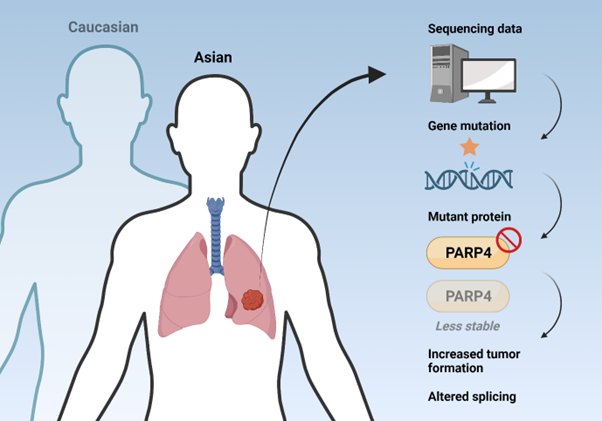
    Genetics of Asian lung cancer cohort reveal new biological insights on the tumorigenesis of non-small cell lung cancer (Source: Lee Yi Fei/A*STAR’s Genome Institute of Singapore. Created with BioRender.com)

    22 July 2024 - Scientists from A*STAR’s Genome Institute of Singapore (GIS) and Bioinformatics Institute (BII), Cancer Science Institute of Singapore and National Cancer Centre Singapore have identified a gene, known as PARP4, that is frequently mutated in Asians but was not previously linked to lung cancer. 

    Their discovery, published in Genome Medicine on 22 July 2024, was the outcome of large-scale sequencing efforts to better understand Asian disease biology. This study is part of the Open-Fund Large Collaborative Grant (OF-LCG) programme funded by the National Medical Research Council (NMRC) to tackle Asian lung cancer.

    Lung cancer is among the most frequently occurring cancers and a leading cause of cancer mortality worldwide. Among lung cancer cases, lung adenocarcinoma (LUAD) is the most prevalent histologic subtype, accounting for 38.5% of all cases. The OF-LCG program currently curates the largest Asian dataset for this subtype of lung cancer.

    Leveraging on the team’s expertise on whole-exome sequencing of the largest Asian LUAD patient data, genes that had not been previously implicated in driving lung cancer were discovered. By using different lung cancer models, the researchers discovered that PARP4 acts as a tumour suppressor, where tumours grew faster in the absence of PARP4. Through a combination of experimental and computational modelling approaches, a recurring mutation in PARP4 was found to destabilise the protein, disrupting its interactions with other protein partners. A key protein partner is the splicing protein – hnRNPM – which is associated with PARP4 to slow tumour formation. hnRNPM controls the process of splicing, which is a crucial step in precisely translating genetic instructions encoded in the human DNA into protein production. When either PARP4 or hnRNPM was removed from the cancer cells, splicing was affected, in turn leading to errors in translation. Furthermore, as PARP4 expression levels were inversely correlated with patient overall survival, this may be exploited as a biomarker to track lung cancer.

    Through this discovery, the researchers will now be able to explore ways to reactivate PARP4 function to slow down tumour growth and look for drug combinations that can specifically target and kill PARP4-mutant cancers.

    Dr Tam Wai Leong, Deputy Executive Director at A*STAR’s GIS and Lead Principal Investigator for this study, said, “The discovery of PARP4 and other mutations in lung cancer highlights the importance of studying disease biology that may be unique to our Asian population, allowing researchers and clinicians to focus on targeted treatments and alternatives to slow tumour growth in cancer patients.”

    Dr Darren Lim, Senior Consultant, Division of Medical Oncology at National Cancer Centre Singapore, said, “This paper illustrates the outcome of investing in a well curated repository of cancer data and models for common cancers in Singapore.  These data and models can be leveraged to bring about new discoveries such as this, that while early, hold the promise of new ways of treating non-smoker lung cancer prevalent in Asians.”