Advanced Welding Technologies
Introduction
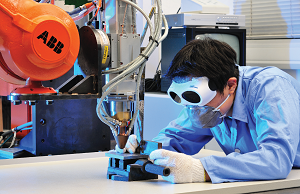
Welding plays a crucial role in various manufacturing sectors and has experienced substantial growth. As the demand for high productivity, quality, and cost-effective solutions increases, the need for advanced welding technology becomes more important. SIMTech's courses offer participants an integrated approach to understanding the diverse aspects of welding and related technologies. The curriculum covers various welding processes, including arc welding, laser welding, electron beam welding, friction stir welding, diffusion bonding, and brazing. Participants will also engage in discussions about welding metallurgy and the weldability of different ferrous and non-ferrous alloys.
Additionally, the courses are designed to provide a quick and effective guide to executing welding operations, developing welding procedures, weld design and simulation, troubleshooting, and welding quality control. The aim is to equip participants with the skills and knowledge of state-of-the-art welding technologies through a combination of classroom lectures, hands-on lab training, and project-based case studies.
Why These Courses
These courses are specifically designed to train participants in various aspects of welding technologies and to build the competencies needed for implementation in different industrial applications. Topics include welding processes, weld design, weldability testing methods, process automation, distortion control, material selection, and welding processing parameters. The courses will also benefit engineers looking to refresh their foundational knowledge and stay current with the latest developments in welding technology. The knowledge gained will enhance individual expertise while providing companies with opportunities to improve competitiveness.
Who Should Attend
The courses are geared towards operation managers, manufacturing managers/engineers, production planning engineers, materials engineers, mechanical engineers, production engineers, foremen, skilled operators, quality control managers/engineers, materials purchasing engineers, laboratory managers, and engineers. They are relevant for professionals in all manufacturing industries that utilise welding as a joining process, including precision engineering, aerospace, marine, oil and gas, automotive, and electronics sectors.