Structural relationship of HIV-1 Protease Inhibitor (PI) resistant mutants
Based on the structural responses and viral fitness cost of the clinically reported HIV-1 protease mutations, we reported a PI resistance-related pathway that the protease might undertake to cross-resist among current PIs in the anti-retroviral therapy.
We found the structural rationale for the rapid development of cross-resistance among the seven clinically used PIs, e.g. Atazanavir (ATV), Darunavir (DRV), Indinavir (IDV), Lopinavir (LPV), Nelfinavir (NFV), Saquinavir (SQV), and Tipranavir (TPV). Among these, some PIs would be better used in clinical settings against naïve HIV-1 infections or when resistance has already been developed towards another PI.
Our findings suggest the use of LPV as the first line of PI in the current anti-retroviral therapy. In circumstances with the emergence of PI-resistant mutations, certain other drugs would be more useful in subsequent lines of treatment (Figure 1). Hence the study provides a structural understanding that may be useful to guide the clinical PI use in the therapy, aiding in drug selection to prolong the effectiveness of the given PI.
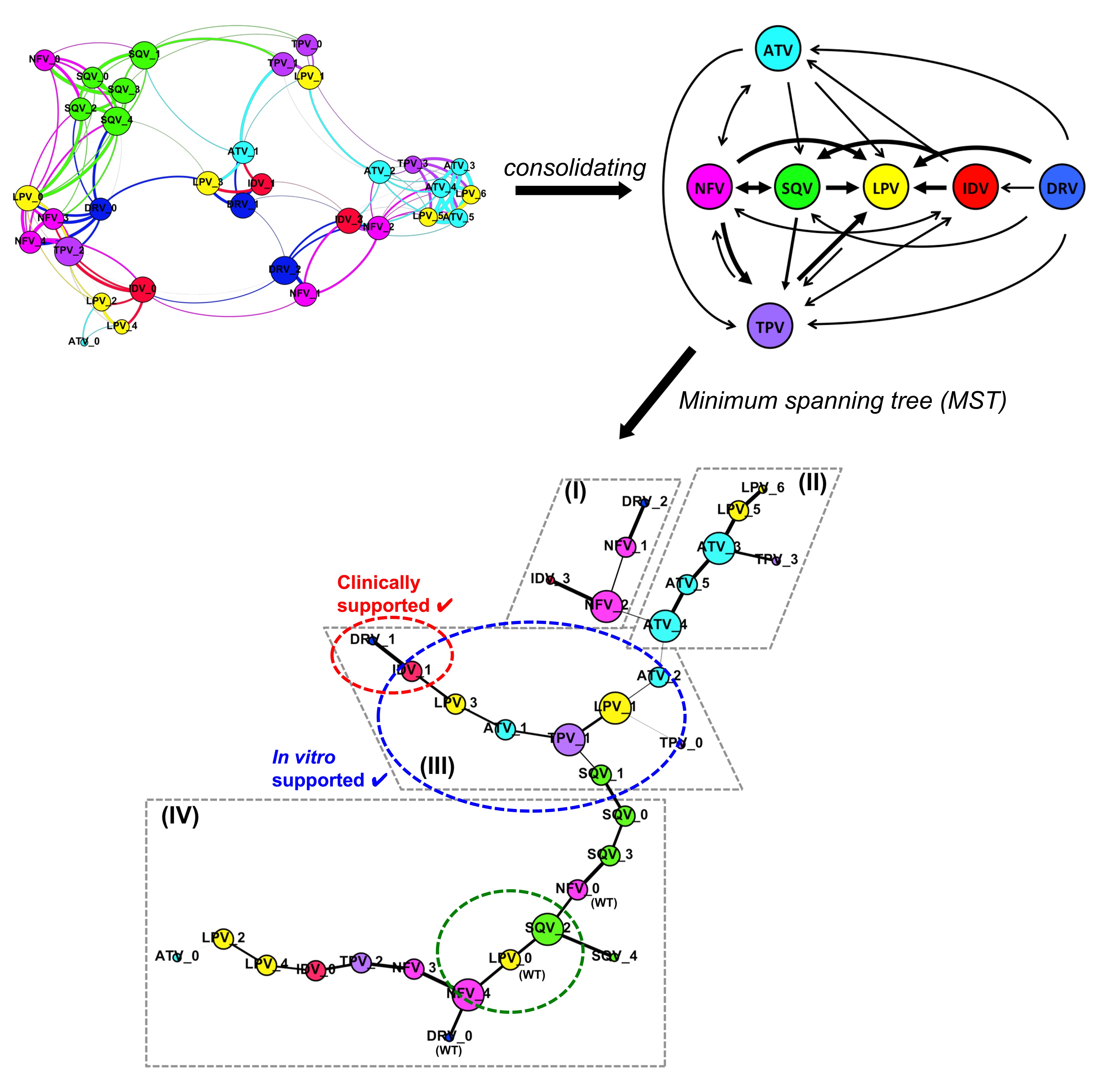
Figure 1 –The HIV-1 Protease Inhibitor (PI) resistance-related pathway that the viral protease might undertake to cross-resist among current PIs: Atazanavir (ATV, cyan), Darunavir (DRV, blue), Indinavir (IDV, red), Lopinavir (LPV, yellow), Nelfinavir (NFV, magenta), Saquinavir (SQV, green), and Tipranavir (TPV, purple).
Reviewing HIV-1 Gag Mutations in Protease Inhibitors Resistance
HIV-1 protease inhibitors against the viral protease are often hampered by drug resistance mutations in protease and in the protease substrate Gag (Figure 2A-B). To overcome this drug resistance, it may be more efficient to target Gag alongside with protease rather than targeting protease alone. To inhibit Gag, understanding of its drug resistance mutations and the corresponding structural changes on protease binding thus needs investigating.
While mutations on Gag have already been mapped to protease inhibitor resistance (Figure 2C), there remain many mutations, particularly those outside the Gag cleavage sites, that are not well-characterized. Through structural studies to unravel how Gag mutations contributes to protease drug resistance synergistically, it is thus possible to glean insights to design novel Gag inhibitors. In this review (Su et al., 2019), we discuss the structural role of both novel and previously reported Gag mutations in PI resistance, and how new Gag inhibitors can be designed.
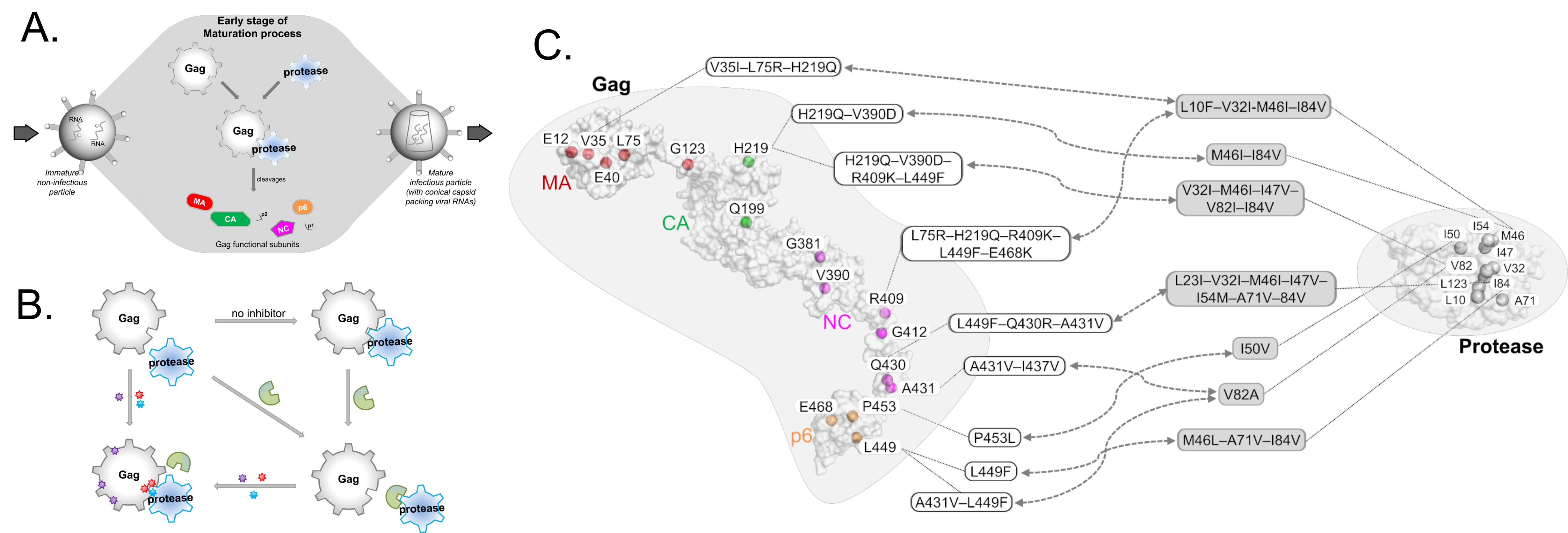
Figure 2 – (a) Schematic relationship between Protease and its substrate Gag in HIV-1 (A,B) and their associated drug resistance mutations (C). Mutation hotspots are shown for both Gag and Protease, with Gag mutations following domain-color schemes: MA (red), CA (green), NC (magenta), and p6 (orange).
Non-canonical glutamine binding Ni2+ mechanism in IgE
The binding of nickel (Ni) by immune proteins can manifest as Type IV contact dermatitis and less frequently as Type I hypersensitivity. Both mechanisms remains unknown. Using Trastuzumab and Pertuzumab IgE variant models that have been investigated by the APD Lab, with whom we found that Ni2+ (in Ni-NTA) interacted non-canonically with glutamine stretches. These stretches are formed at the interfaces of the antibody heavy and light chains in a certain of the IgE variants.
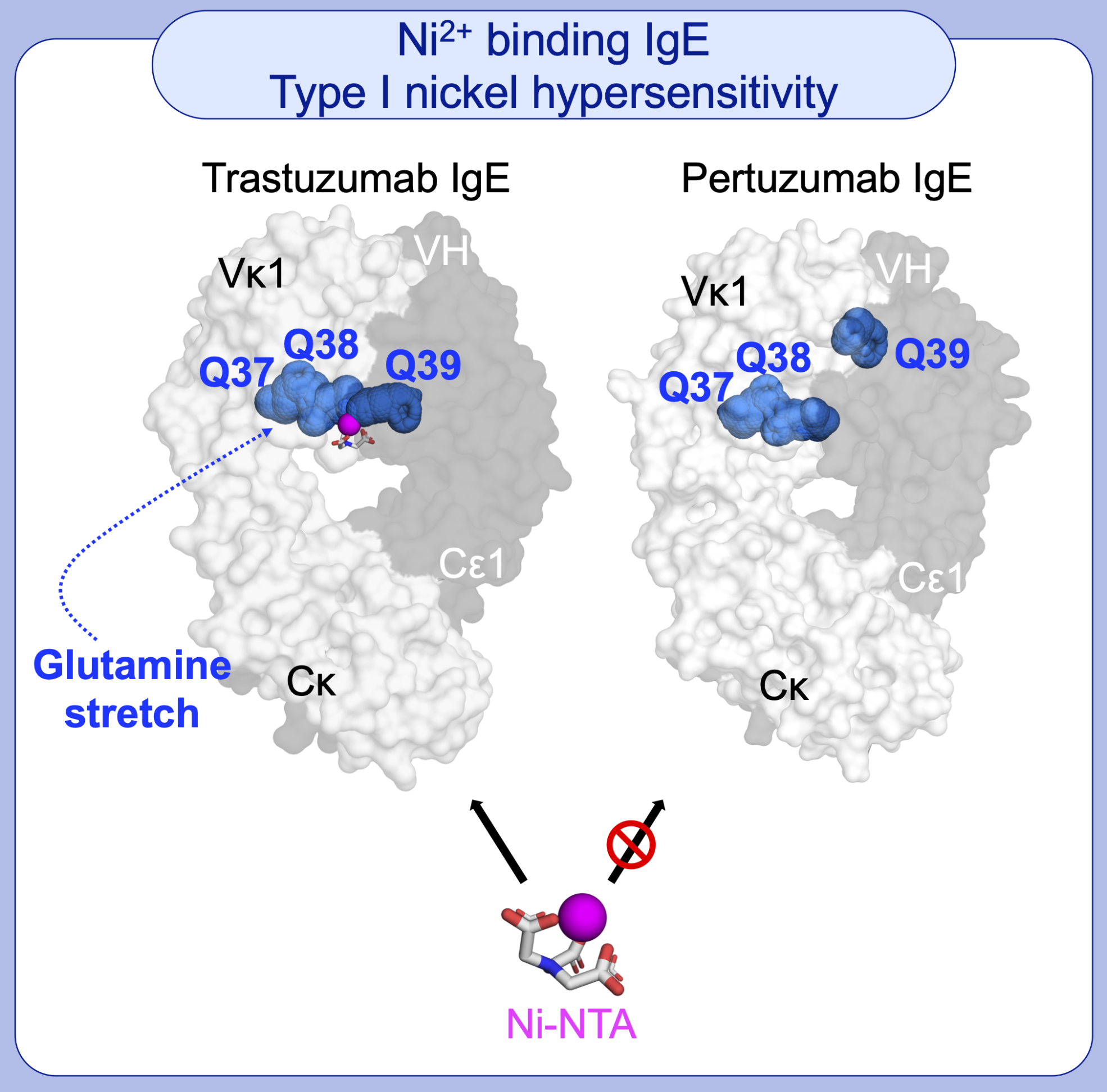
Figure 3 – Ni2+ (in Ni-NTA) binds to a particularly formed glutamine stretch in Trastuzumab IgE (but not Pertuzumab IgE) due to varying structural arrangement of heavy and light chain domains of different IgE variants.
IgE complexes with peanut allergen and FcεRIα receptor
Our current project focuses on the whole allergen-IgE-FcεRIα system and their affinities to guide therapeutic interventions against peanut allergy. This work aims to study the IgE-mediated interaction mechanisms at the atomic level, combining computational structural modelling and experimental cross-linking Mass Spectrometry for validation (collaborating with the Kalisman Lab in the Hebrew University of Jerusalem and the APD Lab in EDDC).